First Pages: The Most Important 250 Words in Your WIP

Photo credit: CollegeDegrees360 on Flickr
Imagine this: you're walking around a bookstore and a book catches your eye. Maybe it's the cover, or the title, or the author or a combination of those factors, but something makes you pick up the book to take a closer look at it. After reading the back cover copy, it still sounds interesting, so what's the next thing you do?

Chances are you aren't walking over to the counter to buy it yet—you're going to sample it first by cracking it open to the first page.

From there, one of two things happen: either the writing grabs you and you bring the book to the counter or make a mental note to buy it later, or you lose interest and return it to the shelf. Two very different results based solely on whether or not you like what you find on that first page.

I don't know about you guys, but when sampling a book, I generally read until I don't want to anymore. If I've made it to the end of the first chapter (or however long the sample is, in the case of e-books) and I'm still interested, I'll buy the book, or at least add it to my TBR list. If I lose interest somewhere before that (even if that "somewhere" is in the first sentence), I put the book back and move on. And as I understand it, I'm not the only one who samples books in a similar manner.

The thing is, when a reader picks up your book, your first page carries the very heavy responsibility of grabbing their interest and not letting go for anything. There's no such thing as a throwaway sentence in your first 250 words—every line must make the reader want to read the next, or it doesn't belong there.

Your first page must:

  • Hook the reader. Whether the reader is an agent, editor or someone contemplating whether or not to buy your book, the first page is your only chance to grab their attention. 

  • Introduce your protagonist. This pretty much goes without saying, but we need to meet your protagonist just about immediately if you hope to grab interest. 

  • Make your readers care. In most cases your readers aren't going to fall in love with your protagonist in the first 250 words, but by the end of the first page they should have a good sense as to why they should care about your protagonist's plight, which leads me to... 

  • Hint at conflict. This doesn't mean that there needs to be a gun battle on the first page, but we need to get a sense (even if it's just foreboding) that something isn't quite right, or that something will happen very soon. 

It's a lot of work for just 250 words, but it's truly essential to a successful first page, and it's why publishing professionals often advise against starting a novel with a character doing menial, everyday tasks (ergo brushing teeth, getting ready for school, etc.). When revising the beginning of your WIP, I recommend taking a good hard look at that first page to see if it accomplishes those four tasks. It might just be what you need to pique someone's interest in your work.

NOTE: After writing this post I found this very informative post by agent Laurie McLean on the first pages of a WIP including some very helpful dos and don'ts. Definitely check it out.

In your opinion, how important is the first page of a novel? How long do you usually read when sampling work?

How (Not) to Write the Perfect Query Letter (Part 2)

Photo credit: Meredith Harris on Flickr
Nearly a year ago I shared some golden advice on how to write the best query letter in the history of awesome query letters. Luckily for all of you reading this post, the query letter gods have imbued me with query masterpiece mana and I’m a generous person.

So.

How to Write the Perfect Query Letter (Part 2)*:

  1. Drown them in rhetorical questions. Agents love rhetorical questions—they live for them. Ask them questions that will make them want to jump out of their seat and scream, YES, GOD YES.

    Here’s one guaranteed to work: Don’t you want to represent a fiction novel that will make you bajillions? (I mean, you just can’t say no to that. It’s impossible). 

  2. Bribery. The only thing agents love more than rhetorical questions is chocolate. Just sayin.

  3. Don’t take no for an answer. Got a form rejection letter? Don’t let that get you down—send your query again! Send it enough times and they’ll have to represent you if only to shut you up.

  4. Pretty fonts are pretty. Pretty colors are pretty too and the best way to distract the agent from your query is with beautiful, hypnotic colors that make them stare at the shiny. (Agents love shiny). 

  5. No shorter than ten pages. Let’s face it—you’re a writer and writing is what you do. Writing a query letter any shorter than ten pages is completely selling yourself short. You have a lot to say! How else can you expect to sell your novel? 

  6. Let them know it’s a temporary offer. Nothing makes agents want to represent you faster than knowing they’re on a clock. 

  7. Stamp your copyright everywhere. And it doesn’t hurt to slip your lawyer’s name in there. 

  8. Talk about how wonderful you are. I mean, you have ten pages, so you might as well use them to talk yourself up. And what better way to let them know how wonderful you are to work with than to go on and on about your awesomeness? 

  9. Query before you’ve finished writing. That way by the time you’ve finished your book, you’ll be all set for publishing. 

  10. Make sure they know how stupid they’d be not to take your project. Just in case they missed the part about becoming a bajillionaire from your rhetorical question. 

*This post is sarcastic! As in not meant to be taken seriously. As in don’t do these things PLEASE.

I obviously haven’t covered all of the secrets to query letter gold, so now it’s your turn: what "tips" would you add to the list? 

Why Critiquing Others Helps You

Photo credit: cellar_door_films on Flickr
I’ve written in the past about the necessity of critique partners and why it’s so important to get your work critiqued, but it has occurred to me recently that I never really discussed the other side of the coin: that is, why it’s important to critique as well as getting critiqued.

You see, as those of you who follow me on Twitter probably know, I’ve been spending a lot of time as of late checking out pitch critique boards and contests. It’s been a lot of fun (and time consuming, but so worth it, you guys) and not just because I’ve had my work looked at.

Because the truth is this: while it’s extraordinarily helpful to get your work critiqued, it’s just as valuable to take the time to critique others.

The thing is, most writers who participate in critique boards and contests take the time to crit other entries mostly for a pay-it-forward/trading critiques type thing. What many of them don’t realize is that by critiquing other writers’ work, they’re actually learning just as much as they do from a critique of their own work.

While critiquing, you learn:

  • What works. You’re going to read writing that you absolutely love. Words that you wish you had put there—sentences that you envy and premises that make you second guess yourself. By taking the time to identify exactly what it is that attracts you to that sentence or paragraph or whatever it is, you’re teaching yourself why it works so that you can then apply it to your own writing. 

  • What doesn’t work. On the flip side, you’re going to read a lot of writing that doesn’t grab you. Writing that reminds you of when you first started writing or of a book that you didn’t really enjoy. When critiquing, you have to identify these spots—but even more importantly, you have to really think about what could be done to improve it. You have to figure out why it’s not working (or at least why you’re having a negative reaction to it) so that you can tactfully explain why it didn’t work for you.

    And guess what? You’re learning again. 

  • What others are and aren’t responding to. The most interesting bit of participating in public critiques is seeing how others responded to someone else’s work. Sometimes a line that you loved will be a line that someone else found confusing. Sometimes that first paragraph that you found dull someone else thought was beautifully written. This is not only a great reminder of the meaning of subjectivity, but when you start noticing patterns among the responses (and you will), it really draws attention to the most noticeably successful and unsuccessful elements of writing. 

Moral of the story is this: even if you don’t have something ready for critiquing, it’s still incredibly advantageous to participate in critiques. It’s a learning experience for everyone involved and I promise you’ll learn some lessons about writing that would have been much more difficult for you to glean on your own.

Have you ever participated in a critique board or contest? What other benefits of critiquing someone else’s writing can you think of?

Writing Tool: iBooks

Photo credit: nikkorsnapper on Flickr
So not too long ago, I wrote a post on the awesomeness of Scrivener. Since then I’ve bought the program, and so when time came to export my NaNo WIP for the first read-through, I decided to take advantage of one of Scrivener’s very handy features: the ability to export your book as an e-book.

Now while this is a particularly handy feature for indie writers, I’d like to argue that it’s actually a fantastic feature for any writer with an e-reader, because it allows you to read your WIP away from your computer without having to print it, which is pretty fabulous if you ask me.

So as I am also an Apple person, I decided this time to export the WIP to iBooks for the initial read-through. Best. Decision. Ever.

First of all, reading on iBooks is a joy. Even my completely unformatted WIP looked beautiful and professional and it felt pretty cool to be able to read an e-book version of my WIP. But beside the prettiness, I quickly discovered that iBooks is actually a great program for the read-through. Why?

Its awesome highlighting and notes feature.

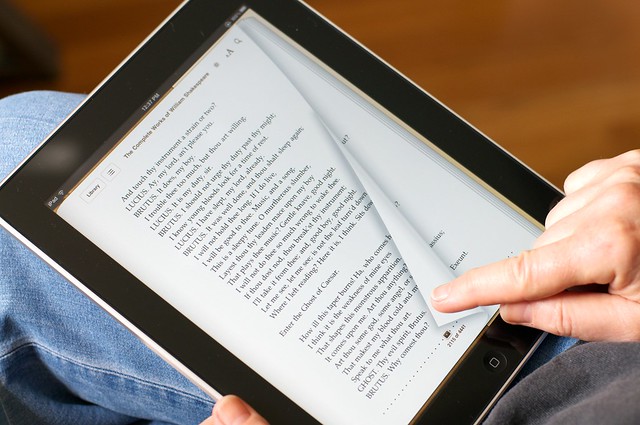
So basically if you have an iPhone or iPad, all you need to do to highlight a passage is drag your finger over the line you want to highlight with slight pressure, as if your finger was the highlighter. Ignoring the fact that I found this totally entertaining (yes, I’m rather easily amused), it also allowed me to make easy, color coded notes (there were five different colors for the highlighter, plus an underlining feature) while I was reading. As a bonus, I wasn’t tempted to edit prematurely because I couldn’t.

Even better: when time came to look back on my notes, iBooks collected all of my highlights and notes in a very easy to browse list. All I had to do to access it was jump to the table of contents and choose “Notes.” All of my highlighted passages and notes were organized by page. If I wanted to see it in context, all I had to do was tap the note and it brought me to the spot in the WIP.

Yeah. It’s pretty fabulous.

This was my first time using iBooks for a read-through, but I will definitely be using it again in the future.

Have you ever used iBooks or a program of the like for read-throughs? What was your experience like? 

Adding Contrast to Your Writing: Character

Photo credit: sally_monster on Flickr
It’s often said that some of the best movies out there are so-called “emotional roller coasters.” We praise books with ups and downs; books that make us laugh and cry.

In short, we love stories with contrast.

Contrast is an element of writing that is not often discussed, but is key to layered, interesting stories. It helps us emphasize strong emotion, highlight characters and can even be worked into symbol and theme.

While I can’t cover the full spectrum of contrast opportunities in one post, here are some key ways you can incorporate contrast within your cast of characters.

  • Personality. If you take a look at just about any famous group of characters, chances are you’ll find quite a bit of contrast within the group. One of my favorite examples is Gimli and Legolas from The Lord of the Rings. Physical differences aside, the two could not be more different, and yet they work side by side and even become friends by the end of the trilogy. 

  • Voice. Contrasting voices will manifest in primarily two different ways in novels: through dialogue and POV switching. While the much more common method is through dialogue (as not all novels have changes in POV), both can be highly effective to highlight contrasts in character, in this case Artemis Fowl and two gnomes Pip and Kip.

    Here’s an example from The Last Guardian by Eoin Colfer (page 49):
“‘Listen to me, you lowlife. This is Artemis Fowl. You may have heard of me.’
‘Oooh, Artemis Fowl. Wonder boy. We’ve heard of you alright, haven’t we Kip?’
Kip nodded, dancing a little jig. ‘Artemis Fowl, the Oirish boy who chased leprechauns. Sure and begorrah everyone has head of that smarty-pants.’” 
I think it goes without saying that no one will be mistaking Artemis’ speech for either gnome. 
  • Morals/ worldview. The great thing about contrasting morals and ideologies in stories is that it makes for great tension and conflict between characters. A great example is in Season 7 of House, when medical student Martha Masters is added to the team. Masters is a brilliant young doctor, but she follows a very stringent moral code—one that frequently clashes with House’s less than traditional (and sometimes legal) methods. 

These are just a couple examples of how you can introduce contrast within your cast to help flesh out your world and create more opportunities for conflict. When used correctly (and not overdone), contrast can help to make your WIP more dynamic and interesting and open up doors of opportunity for your plot.

Now it’s your turn: Do you utilize contrast amongst your characters? What examples of contrasting characters can you think of?

Discussion: Why Do You Love Writing?

Photo credit: DaveAustria.com on Flickr
So it's the day after Valentine's Day and I totally didn't write about romance or even mention the word "love" in Wednesday's post, so I thought it appropriate to mention a love-related topic today. Except not quite in a romance-y way because mushy gushy romance day was yesterday. So.

Assuming that most of you reading this are writers or readers who enjoy reading writing blogs, I'm sure many of you have on more than one occasion come across a post detailing all the downsides of being a writer. Hell, you may have even read some of those posts here, because I like to be realistic when talking about the whole writing thing.

But sometimes when the days are particularly hard, or when you have more than a handful of rejections sitting in your inbox, or you look at your writing and wonder why you're even bothering to attempt to write, we writers need a little reminder as to why we embarked upon this writing journey to begin with. Sometimes we forget why we ever wanted to be writers to begin with, why we tell others we love to write so much, why we subject ourselves to rejection after rejection or an assortment of other disappointments that invariably come with the territory. Sometimes we need to take the time to remember why we love to write.

For me, the answer lies in the characters. I never tire of falling in love with new characters and watching them grow and change. I never get bored watching them interact with each other—whether it's a page of witty dialogue or an argument that ends badly. There's something truly incredible about creating characters people care about, and writing a story people want to read, and devising a world with just words that continues to fascinate me.

There's something about creating something out of nothing that I absolutely love, and it gets me time and time again, manuscript after manuscript.

You guys, we writers have the coolest job on the planet: we pull characters and entire worlds from our imaginations and release them to the world for others to see and expand upon. And we do it all with combinations of letters and our minds.

And if you ask me, that's pretty darn cool. And I'll always love it.

Join the discussion! Why do you love writing or reading other people's writing?

A Quick, Easy Way to Write More

Photo credit: Rico-san on Flickr
Here’s the thing about writing: when we writers aren’t writing, most times we’re thinking about writing, or wanting to write, or the WIP we’re currently working on that we want to be writing this instant but aren’t. When we actually sit down to write, however, this weird thing tends to happen.

We suddenly aren’t so sure if we want to write anymore.

Ok, maybe that’s not exactly it: usually upon sitting in front of the keyboard, we still want to write...but we aren’t sure where to start. Or we think we know where to start, but the words are being stubborn and not magically appearing like they’re supposed to.

And so we get distracted. We open up Twitter, or tumblr, or Facebook, and start scrolling through feeds. We watch adorable videos on Youtube and look up old Harry Potter Puppet Pals episodes for fun (no? Just me then? Oh well). Then, before we know it, two hours have passed and we haven’t written a single word.

It’s funny, because while we’re unable to write, there are few things we’d rather do than write. When it actually gets to the writing bit, however, oftentimes it seems we’d rather do anything else than write another word. At least, on the sluggish writing days that’s often how it feels.

The problem isn’t so much that we need an attitude adjustment—it’s that we’re too easily distracted when the words don’t come easily. Luckily, there’s a very easy cure. Three cures, actually.

The first is an app called Freedom, that basically turns off your internet for an allotted time. While I haven’t tried this one (I’ll admit the concept of turning off the internet even just for a short time terrifies me), I’ve heard that the only way to turn the internet back on once you’ve set it is to wait for the time to end. While this sounds like some medieval punishment, it does effectively block distractions and allow you to focus on your writing.

The second cure is an online app called Write or Die. I’ve written about it’s awesomeness before, so I’m not going to repeat myself, but it is absolutely fantastic.

The third cure isn’t an app—it’s a feature available on just about every program and it’s called fullscreen. Maybe you’ve heard of it.

It seems almost obvious, but writing in fullscreen has proven time and time again to be a great way for me to really focus on what I’m writing. The rule is just that you don’t exit fullscreen mode until you’ve finished your writing sprint. Or else.

For those of you who use Pages or Scrivener, I’ve found that I particularly like their fullscreen options because it blocks out everything but the document on the screen (rather than stretching the document into oversize mode), which makes it very easy to focus. Even without the nice isolation effect, however, I’ve found that writing in fullscreen can really help to force you to write without getting distracted. And all it takes is a click of a button.

Have you tried writing in fullscreen mode? Did you find it helped? What other tips do you have for cutting distractions out of your writing time?
Related Posts Plugin for WordPress, Blogger...