Showing posts with label first read-through. Show all posts

The Quiet Before the First Read Through

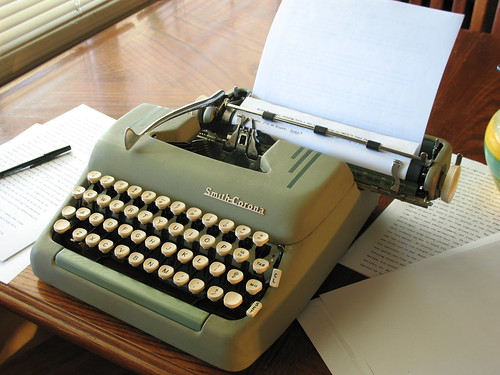
Photo credit: cmmccorkle2005 on Flickr
It's New Years Eve when I'm writing this, and on my side of the world there are a little less than seven hours left of 2016. It seems kind of especially fitting, then, that my not-writing month-long break is coming to a close too.

I've been thinking a lot this month about what project I want to dive into first. I have two foremost options right now: a first draft I wrote over the summer and haven't looked at since, and the first draft I wrote for NaNoWriMo. The project calling me more and more as of late is the one I haven't looked at in months, so in all likelihood that's where I'll start, but right now I'm in that moment of before. That breath as you stand at the tip of the diving board and peer down uncertainly at the water below.

I'm not unfamiliar with this process, but the pre-first read through moment tends to be one with a lot of writerly anxiety. For me, the biggest concern is the possibility that I might read it and dislike it so much I won't want to revise—which has happened in the past and made me move on to another manuscript without working on it anymore. But though that hasn't happened in a while, the possibility that it might happen again is always there, always making this moment of Before kind of shaky.

But it's also exciting, too, because there's the other possibility—that I'll fall in love with the project all over again and get energized to revise. That I'll have a concrete direction to go in and a new project to send to my CPs and eventually my agent. That I'll have a new possibility for publication completely unrelated to my current contracted projects.

The quiet of Before is full of possibilities. And while it can be a little intimidating, ultimately, it's a good thing. And it's something I'm more than ready to jump into once again.

What projects are you gearing up for or currently working on? 

Twitter-sized bite: 
Author @Ava_Jae talks about the uncertain moment before your first read through. (Click to tweet)

Discussion: Do You Print Your MS for Editing?

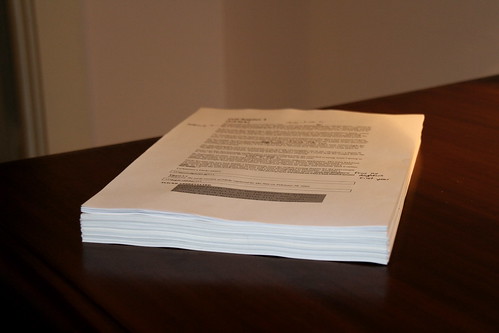
Photo credit: mpclemens on Flickr
So with revisions coming up for me, I’ve been naturally thinking about editing. A lot. And as I’ve seen people on Twitter mention printing out their manuscripts and getting the red pens ready, it occurred to me that it’s been a while since I’ve actually printed out a manuscript. Like, well over a year. Maybe even two.

Now, that’s not to say I haven’t done any revisions—on the contrary, I’ve done loads of revising over the last couple years. But after having printing issues a while back, it occurred to me that there are other ways to change formats so that I can look at the manuscript with fresh eyes.

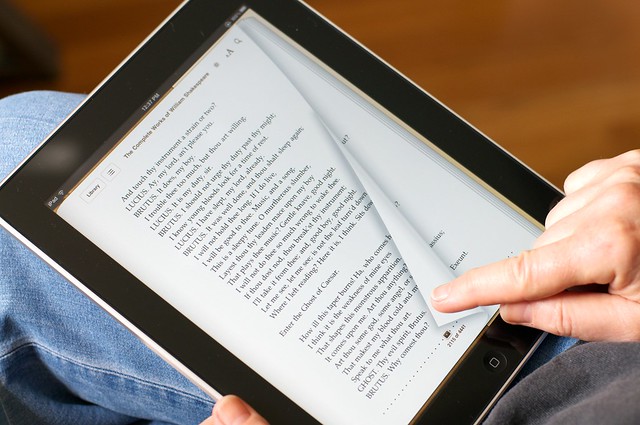
  • E-bookify! Exporting my draft as an e-book (using Scrivener) and reading it on an e-reader has been my favorite new method for a first read-through, specifically using iBooks on my iPad, which I’ve already blogged about.

  • Font fun. I’ve also heard of people changing the font and font size between drafts, and while I haven’t tried that myself (yet), it sounds like an easy way to change the way you look at your WIP.

  • Read it aloud. For purposes of revising for flow, reading your book aloud to your dog, a family member or an empty room works wonders.

So those are just a couple quick options, but now I want to hear from you: do you print your manuscript for editing?

Twitter-sized bites:
Can't print your MS out to edit? Here are a few other options to see your WIP in a new light. (Click to tweet)  
Writers, do you print your MS for editing? Join the discussion at @Ava_Jae's blog. (Click to tweet)

On Immediately Trunking Manuscripts

Photo credit: rich115 on Flickr
Confession: I have not polished every manuscript I’ve written to a submission-ready gleam—or even tried to, for that matter.

Over the course of eight years I’ve written eleven manuscripts. Of those eleven, I brought five of them to what I at the time considered submission-ready. To be fair, one of them I only just finished a couple weeks ago and thus isn’t ready for editing, so if I remove that from my statistics, that brings me to an even 50% immediate-trunk rate. Or polish rate, if you’re half-glass full.

So now you may be wondering what happened to those five manuscripts I immediately trunked and/or thinking they were a waste of time, but I assure you they were not.

If you’re looking just at time spent, I usually take about an average of a month to month and a half to finish first drafting, so you could say that I “lost” a month with every WIP I immediately trunked. But I don’t consider it a loss, because I gained a whole lot, too.

My first insta-trunked MS, I learned just how much I enjoy making up new cultures and worlds.

My second insta-trunked MS, I learned how not to end a book, and how not to write an antagonist, and why certain clichés really don’t work. I also learned I can indeed write a book in a month. (Unsurprisingly, I don’t anticipate removing this one from the trunk ever. But I suppose you never know).

My third insta-trunked MS, I remembered certain character types that I adore—I remembered I love writing characters who are rejected by everyone, who live on the fringe of society, trying to be the best they can be while everyone around them refuses to see them for who they are. I also reminded myself that I really don’t want to write an antagonist like that. Oops.

My fourth insta-trunked MS, I learned I like writing about aliens and making up languages. I also learned that writing with an outline works really well for me.

My fifth and most recent insta-trunked MS, I learned to let my characters go and try not to strictly plan their romances. I learned writing with an outline doesn’t mean I have to stick exactly to plan, and I learned when my characters suffer real consequences for their actions, they’re so much more powerful than a slap on the wrist.

These lessons may seem a little all over the place, but in my two most recent manuscripts, I used many, if not all of these lessons to better my work.

As for why I put them away to begin with? The reasons varied, but generally it was because somewhere between the first read-through and deciding on edits, I came to realize I either wasn’t ready to start editing for one reason or another, or I didn’t love the story as much as I had while drafting. Which isn’t the end of the world, but in order for me to get through edits (and do them well), I need to believe in the story completely.

Now I’ve said this before, and I’ll probably say it again, but trunking a manuscript does not mean it’s forever condemned or it’ll never escape the trunk. All it means is that I need to put it away for the time being, and true, some of them will probably never escape the trunk, but I have hope for others that when the time is right, I’ll polish them up and they’ll be ready.

But until then, I’ll keep writing.

Have you ever immediately trunked a manuscript? 

Twitter-sized bites: 
"Trunking a manuscript does not mean it's forever condemned..." (Click to tweet
Have you ever trunked a MS? Here's why one writer put five WIPs in the drawer without querying them. (Click to tweet

Writing Tool: iBooks

Photo credit: nikkorsnapper on Flickr
So not too long ago, I wrote a post on the awesomeness of Scrivener. Since then I’ve bought the program, and so when time came to export my NaNo WIP for the first read-through, I decided to take advantage of one of Scrivener’s very handy features: the ability to export your book as an e-book.

Now while this is a particularly handy feature for indie writers, I’d like to argue that it’s actually a fantastic feature for any writer with an e-reader, because it allows you to read your WIP away from your computer without having to print it, which is pretty fabulous if you ask me.

So as I am also an Apple person, I decided this time to export the WIP to iBooks for the initial read-through. Best. Decision. Ever.

First of all, reading on iBooks is a joy. Even my completely unformatted WIP looked beautiful and professional and it felt pretty cool to be able to read an e-book version of my WIP. But beside the prettiness, I quickly discovered that iBooks is actually a great program for the read-through. Why?

Its awesome highlighting and notes feature.

So basically if you have an iPhone or iPad, all you need to do to highlight a passage is drag your finger over the line you want to highlight with slight pressure, as if your finger was the highlighter. Ignoring the fact that I found this totally entertaining (yes, I’m rather easily amused), it also allowed me to make easy, color coded notes (there were five different colors for the highlighter, plus an underlining feature) while I was reading. As a bonus, I wasn’t tempted to edit prematurely because I couldn’t.

Even better: when time came to look back on my notes, iBooks collected all of my highlights and notes in a very easy to browse list. All I had to do to access it was jump to the table of contents and choose “Notes.” All of my highlighted passages and notes were organized by page. If I wanted to see it in context, all I had to do was tap the note and it brought me to the spot in the WIP.

Yeah. It’s pretty fabulous.

This was my first time using iBooks for a read-through, but I will definitely be using it again in the future.

Have you ever used iBooks or a program of the like for read-throughs? What was your experience like? 

How NOT to Edit

First and foremost, I had the pleasure of guest blogging about Harry Potter on the awesome Lyn Midnight’s blog yesterday. Considering it was my FIRST GUEST POST EVER, the feedback was truly humbling. I also learned that guest posting is fun and I would TOTALLY do it again. YAY GUEST POSTING!

SO. Now that I got that out. On to today’s blog post!

I made a mistake when approaching my very first read-through with my very first manuscript. I made this same mistake more than a couple of times with later manuscripts, too.

I edited.

Now, now, I know that doesn’t seem so bad, but hear me out.  I wasn’t just editing during my first read-through I was *shudder* line-editing. You know. Like you do to the final, polishing drafts.

It’s not that I didn’t know you were supposed to tackle the big things first—I knew that. But I had a pen in my hand and a stack of paper on my lap and the temptation was just too much. I saw something I didn’t like. I marked it up with my pen. I thought I did a good thing.

What I didn’t realize was that I might as well have carved out the final details to a rock. I forgot about the big things—the characters that needed tweaking, the scenes that needed cutting, the situations that sounded a million times better in my head that needed COMPLETE re-writing. Instead I was fixing awkward sentences and descriptions I didn’t like.

Then—even worse—I was moving on like it was ready for betas.

GOOD NEWS is I now see the error of my ways and vow to NEVER do that again. *phew!* I also decided to write a blog post about it to warn you awesome people about this trap. The first read-through is not a place for line edits.

Let me say that again: the first read-through is NOT a place for line edits. DON’T DO IT.

I’ve developed a method for myself to make sure I don’t fall into it again. It’s simple, really, and it acts as a laser crossbow to that tricksy little trap. TAKE THAT! HEE-YAH!

Eh-hem. For the first read-through I now keep a notebook and a pencil beside me. When I see something that needs fixing (and I DON’T mean an awkward sentence, that’s for later edits so RESIST, MY CHILDREN, RESIST!) I write it down in my notebook. I make a running list. See how long I can make it. The longer the better, really, because it means I’m being nitpicky which is what I want when I’m picking apart my WIP.

Because in the end, each fixed bullet point will make the new draft THAT much better.

SO! When you’re reading that shiny new WIP for the first time, remember to look out for the BIG problems. The characters that need fleshing out and the evil plot that upon second glance is actually a little bit ridiculous. Yeah, those bad boys. They need a butt-kicking first.

Then you can worry about making that manuscript sparkle.

Have you ever fallen into the line-editing trap? What tips do you have for the first read-through? 

Related Posts Plugin for WordPress, Blogger...