Showing posts with label WIP. Show all posts

Discussion: How Many Projects Do You Work On Simultaneously?

Photo credit: aescoba on Flickr
Once upon a time, I only worked on one project at a time. That's still my preferred method of working—I like to be able to focus on a single project and divert all my energy into that project until it's done, a method that's often allowed me to finish both first drafts and thorough revisions relatively quickly.

Then I started getting published and joined the world of deadlines I didn't set for myself.

Right now I have, oh, five projects simmering at once,  counting a half-plotted project I have to start drafting this summer on a not self-imposed deadline. One has been thoroughly revised and is waiting for external feedback, one has been partially revised but had to be set aside for a deadline project, one is a short (for now) deadline project, and one is my 2016 NaNo novel which...I'll get to when I get to. Two are Sci-Fi, two are Fantasy, one is a Thriller—all are YA. Which is to say I've been keeping really busy.

Though it's been interesting to transition from one project to juggling several in different stages at a time, in a way it's also been encouraging because I have plenty to work on—which has helped dispel the fear of "what if this is the last book idea I ever come up with?" And it's pretty cool knowing I've got several real, on-the-page, ready-to-work on projects, some of which (all of which?) may one day be published.

Working on many projects simultaneously has been a lot of work, and sometimes it feels like the workload will never end (which is why breaks are so important!), but it's been gratifying so far. This may very well be how my writing career continues for the foreseeable future, and I am very okay with that.

How many projects do you work on at once? 

Twitter-sized bite: 
How many projects do you work on at once? Join the discussion on @Ava_Jae's blog. (Click to tweet)

How Important is Word Count?

Photo credit: harvest breeding on Flickr
In a word? Very.

While I don’t think it’s something you need to stress over while first drafting—you can always refine during your revisions—after the first draft, you may want to take a good, hard look at your word count and make sure it’s within what’s expected for your genre and category. Particularly if you’re pursuing traditional publishing.

The truth is, if you’re way over or under the expected word count for your genre, it’s often a sign of a wide-scale problem in your WIP. That 200k-word YA tells agents that you need some major cutting: maybe your plot is unfocused, or you’ve got too many lengthy descriptions, or your pacing is way off, or the writing itself is rambling and unpolished. By the same token, that 25k YA tells publishing professionals that the story isn’t fleshed out. Maybe it’s true (which is likely), and maybe it’s not, but those are some of the assumptions that you’ll be facing.

If you’re not sure what the right word count is for your genre/category, here’s a great breakdown by agent Jennifer Laughran, which covers just about every fiction category except for New Adult and Adult.

Are there exceptions to the rule? Sure. There are always outliers, both successful and not on both sides of the scale, but the fact of the matter is, if you’re a debut novelist trying to get published, you don’t want to give publishing professionals a reason to automatically reject you. And a word count way over or under what is expected is one of those reasons.

In case you don’t read that fantastic post I linked to above, here’s a short snippet that I think is really important:
“* It is really not advisable to go over 100,000 words as a debut author, unless you already have a following. Consider yourself warned - 100k is often the magic number that makes editors and agents curse, cry, and possibly delete. Not that you CAN'T be published over 100k, it definitely happens for select super-awesome YA fantasy in particular... just that it really will be yet another hurdle for you.” 
(Read the rest of the post here. No really. Go read it). 
Getting published is difficult enough—the last thing you want is to make it more difficult for yourself by trying to be an exception to the rule.

Do you think word count is important? Why or why not?

Twitter-sized bites: 
Getting your manuscript's word count right is more important than you might think—and this is why. (Click to tweet)  
Don't try to be an exception to the rule—here's why getting your word count right is so important. (Click to tweet)

Write What Scares You

Photo credit: Wrote on Flickr
Late last spring, I came up with an idea for a new book. It was an ambitious idea, different from anything I’d written in a long time, and required a lot of world-building. As in, an entirely new planet, species and language, kind of world-building. 

I’ll admit, it intimidated me. I worried that I wouldn’t be able to do it justice. But I liked the idea, and I had a feeling that I may even be able to love the idea if I dove in headfirst, and after plotting it, I knew that if I somehow managed to pull it off, it might even be good. 

So I started writing. Tentatively, at first. I called it an experiment and tested the waters and told myself that if it didn’t work out, it was fine. It was just testing an idea. 

When I hit 10,000 words, I knew I had to make a commitment. This wasn’t just a little experiment anymore—if I continued down this road and fully committed myself to the project, I could have a completed draft in a matter of weeks. 

It still scared me. I still worried that I wouldn’t do the story justice, that I’d lose interest or confidence in the story halfway through. I hated the idea that I may hit 20 or 30k and realize it was wrong, as I had done with an ambitious project in the past

But despite my nervousness, I made it official and told Twitter I was working on an actual WIP. Which made it official to me, at least. 

Now several months and drafts later, I’m starting to think this WIP may be the best MS I’ve ever written. I love the story, the characters, the world that I was terrified to create. I love the plot, every jerk character or snarky line, you guys, I’m a tad bit obsessed with this WIP. And I love it. 

But had I allowed my fear to stop me from writing it to begin with, had I given in to the voice that whispered it won’t be good enough, I never would have fallen in love with my new characters and world. I would have missed out on several weeks of absolute joy while first drafting and revising. 

I’m not saying this MS is going to be The One—I have no idea what will happen from here. But regardless of what does or doesn’t happen with this WIP, I am so grateful for the experience. And even if the only ones who ever read it are my CPs, I would do it again in a heartbeat. 

I’d heard writers say you should write what scares you, and it always seemed like a nice idea. But now that I’ve experienced it myself, I can tell you with absolute confidence that the fear is worth it. Acknowledge it, accept that your project makes you a little nervous, then write it anyway. 

Because at the end of the road, when you’ve conquered your fear and have a shiny new WIP to boot, the feeling of accomplishment and wonder makes it all worth it. 

Are you or have you ever written something that scared you? 


Twitter-sized bites: 
Don't let fear paralyze your words. Writing what scares you might just lead to your best work yet. (Click to tweet
Have you ever written something that scared you? Writer @Ava_Jae shares her experience with fear and writing. (Click to tweet)

Why I Keep Every Draft of My WIP

Photo credit: Images_of_Money on Flickr
Not too long ago, Katie Axelson wrote a fantastic post on The Write Practice on why you should never delete your writing. She makes a great point, and the following discussion online made me think about my editing and revision habits and how I handle sections cut from my WIPs.

It probably won't surprise you to hear that I never delete anything permanently, but I actually take it a step further: I save every draft of my WIPs. That's right, I hoard my writing.

In my pre-Scrivener days, I was a Microsoft Word fiend. After writing up the first draft of my WIP and deciding I was going to polish it to a final draft, I made a folder for my book. Inside the folder I placed everything that had to do with that WIP, from query letters to synopses to drafts that I labeled by number (Scrivener has made this much easier, but that’s another post altogether). For example, if my WIP was titled SECRET, I'd have files named SECRET, SECRET V2 (for Version 2), SECRET V3, etc. Before the start of every draft, I duplicated my most recent draft, give it a new number and start revising.

While some of you may consider the habit a little obsessive (and maybe it is), I quickly found that keeping my drafts separate allowed me to make sweeping changes without fear. I always knew that if I took something too far or deleted too much, I could always go back to my last draft (or however many drafts back I needed) and recover the original writing.

Now I'll admit that for a while, I never actually had need of going back to a previous draft. I had it as an option, of course, but it was an option that I found little need to exercise. That is, until my fifth manuscript.

My fifth WIP has gone through the most changes out of all of my manuscripts. While I currently have six specifically saved drafts, truth be told, there were probably more. The original draft was written in third person past with dual points of view. Then I switched it to first person past with a single point of view. Then first person present. Then two first person present POVs.

That last switch, from one POV back to two is the change where I was immediately glad that I hadn't deleted my previous drafts. While the new POV wasn't the same character that the old POV was written in, having the older draft allowed me to more easily figure out natural breaks for the second POV, and I was even able to take many of those older POV scenes and rewrite them to fit the new character.

I had never been so glad that I obsessively saved my writing.

The thing about permanently deleting anything is that you obviously can never get it back—and truth be told, you don't really know if you'll ever need to. Keeping old drafts really doesn't take up much space on a hard drive, and while I doubt you will ever regret saving old drafts, you may one day find yourself wishing you hadn't permanently deleted that old scene, or draft, or whatever it is that you threw into the abyss.

And if you never look at those old saved drafts? Well, no harm done. But at least you know they're there in case you ever need it.

Do you save old drafts, or are you a deleter? Share your experience in the comments below! 

Writing Tool: iBooks

Photo credit: nikkorsnapper on Flickr
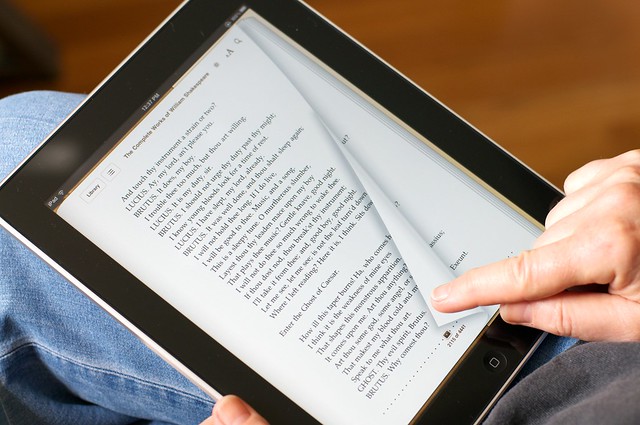
So not too long ago, I wrote a post on the awesomeness of Scrivener. Since then I’ve bought the program, and so when time came to export my NaNo WIP for the first read-through, I decided to take advantage of one of Scrivener’s very handy features: the ability to export your book as an e-book.

Now while this is a particularly handy feature for indie writers, I’d like to argue that it’s actually a fantastic feature for any writer with an e-reader, because it allows you to read your WIP away from your computer without having to print it, which is pretty fabulous if you ask me.

So as I am also an Apple person, I decided this time to export the WIP to iBooks for the initial read-through. Best. Decision. Ever.

First of all, reading on iBooks is a joy. Even my completely unformatted WIP looked beautiful and professional and it felt pretty cool to be able to read an e-book version of my WIP. But beside the prettiness, I quickly discovered that iBooks is actually a great program for the read-through. Why?

Its awesome highlighting and notes feature.

So basically if you have an iPhone or iPad, all you need to do to highlight a passage is drag your finger over the line you want to highlight with slight pressure, as if your finger was the highlighter. Ignoring the fact that I found this totally entertaining (yes, I’m rather easily amused), it also allowed me to make easy, color coded notes (there were five different colors for the highlighter, plus an underlining feature) while I was reading. As a bonus, I wasn’t tempted to edit prematurely because I couldn’t.

Even better: when time came to look back on my notes, iBooks collected all of my highlights and notes in a very easy to browse list. All I had to do to access it was jump to the table of contents and choose “Notes.” All of my highlighted passages and notes were organized by page. If I wanted to see it in context, all I had to do was tap the note and it brought me to the spot in the WIP.

Yeah. It’s pretty fabulous.

This was my first time using iBooks for a read-through, but I will definitely be using it again in the future.

Have you ever used iBooks or a program of the like for read-throughs? What was your experience like? 

How to Rewrite Old WIPs Like a Pro

Photo credit: greg.turner on Flickr
So I've written in the past about how to know when it's time to shelve your WIP, and I've talked about how trunking your work doesn't mean the death of your novel, but I never really covered the afterlife of a trunked work: that is, the un-trunking. Ok, so un-trunking probably isn't a word, but hopefully you get what I mean.

I truly believe that nothing you write ever goes to waste — at least, not for writers. We learn and gain experience from every piece we write — whether it's an essay for school, or a report for work, or a poem scratched on the back of a napkin, or an 80k novel shoved in the drawer. You see, the great thing about putting WIPs that weren't working at the time away, is that nothing is stopping you from going back at a later time to bring them back to life. Or, if more drastic measures are necessary, cannibalizing its parts to create a completely new version of the novel.

Granted, rewriting a trunked WIP isn't skipping through a field of daisies whilst singing songs, but if you break it down into manageable steps, this seemingly daunting task can become significantly less overwhelming.

  1. Choose your soon-to-be reincarnated WIP wisely. Depending on how long your WIP has been sitting in the proverbial (or possibly literal) drawer and how much writing you've done between WIPs, you may have many WIPs to choose from when considering a rewrite. The key to a successful rewrite, however, begins with this crucial step.

    The good news is chances are, if you've become excited about a project again, or found new inspiration for an old WIP, you're headed in the right direction. We writers tend to have pretty decent instincts when it comes to what WIPs we're ready to work on, so just the fact that you're seriously considering rewriting an old WIP is a fantastic sign. The key is to make sure you choose a project that you're willing to put a lot of hard work, time and effort into. You need to be excited about your work in order to really be willing to put the time you'll need into it to create a decent rewrite. 

  2. Read it through (again). Before you begin any major rewrite, you need to re-familiarize yourself with your work. Since this is a trunked WIP, chances are it's been a while since you really took a good look at it, so now's the time to sit down and read from beginning to end.

    Depending on how long it's been since you wrote it, this step may be a bit painful, but if you're able to look at your old work, see the potential in it and cringe at your writing from however long ago at the same time, it's actually a good thing. It means you've grown as a writer, your writing skill has improved and you may very well have a potentially excellent rewrite on your hands.

    Note: now is NOT the time to edit. NO EDITING (seriously). Make notes on what you like, what you love and what you hate. Make a list of elements you'd like to keep in your rewrite and elements that need serious tweaking (or removal altogether). Now, however, is not the time to edit, because chances are you'll be ripping the WIP apart and completely rewriting large portions of it anyway. Any editing you do in this stage will very likely be altered or erased later on while rewriting. 

  3. Brainstorm. Now that you're familiar with your WIP and you have a list of elements you love and elements that need changing, it's time to delve deeper into the list. Brainstorm potential rewrite ideas — what works and what doesn't? Could you put it in a new setting? Rewrite the protagonist as someone new? Use the POV of a different character? Change the antagonist? Remember that you don't necessarily have to rewrite the same story — now's the time to consider maybe using the elements you like to create something entirely new. Push yourself to brainstorm new possibilities. You don't have to choose the craziest idea you put on your list, but you might surprise yourself with the scope of possibilities your WIP has. 

  4. Know where you're going with your new rewrite? Good. Now get to work. In other words: start writing. 

Have you ever rewritten or taken elements from a trunked WIP? What tips would you add to the list?

How to Know It's Time to Shelve Your Novel

Photo credit: Erwyn van der Meer (Flickr)
I received an interesting question on the blog from one of you lovely readers the other day (have I mentioned lately how much I love it when this happens? Keep the questions coming, you fabulous readers, you). As is often the case, it was a question that I thought I'd answered, but I've since realized that I skimmed over.

You see, I've written in the past about what happens when your novel isn't the one—meaning, when you come to realize that you might want to consider shelving your WIP. What I failed to discuss, however, was how to know when the time to shelve your novel has arrived.

In my experience, there isn't ever one definite sign that you need to shelve your WIP —instead, it's often a combination of signs plus a sprinkle of instinct that generally lets you know that now would be a good time to move on to a new WIP.

While this is far from a comprehensive list, here are a few signs that it might be time to shelve your novel and start writing something new.

  1. You've edited your WIP to your best ability and it's still not working. "Not working" can mean a couple of things—for those who seek traditional publication, it can mean that you can't find representation for it despite massive editing and feedback from others. "Not working" can mean that your beta readers still think it needs more work, or it can mean that you're still not happy with it. Whatever the case may be, this sign can be a pretty big red flag.

  2. You've lost interest in your novel. This tends to be something we writers don't like to admit, but it is perfectly possible to lose interest in your WIP. While this doesn't always mean you need to shelve your work (sometimes you just need to fall in love with it again, which is also possible), it can be a good indication that it might be time to take a break from your novel and start writing something else—at least for the time being.

  3. You have ideas for new WIPs. This is a tricky one, because you don't want to confuse it with Shiny New Idea Syndrome, which is a pretty common writing danger that you should be wary of. The difference, you see, is that Shiny New Idea Syndrome hits when you're in the middle of another WIP, and it tempts you to begin writing your new idea immediately. What I'm referring to, instead, is when you've completed a previous WIP (the one that you're now contemplating shelving) and you've along the way collected idea for future novels.

  4. You're wondering if it's time to shelve your novel. When I said that instinct plays into this one, this is what I meant. We writers usually have a good sense for when something isn't working, or when something with our writing is off. And when we do, it's often when we begin to contemplate if maybe it's time to start something else—and you know what? Sometimes it is.

The thing I'd like you guys to understand about shelving your work is that it doesn't have to be permanent. Shelving your novels doesn't mean that you're giving up—it means that you're accepting that it's not quite the right time for your novel at the moment. That's it. It doesn't mean you're a failure, or that your WIP is a failure, or that it'll never see the light of day again (although, you may later on decide that you don't want it to see daylight again)—it just means that it's time to move on.

And that's ok.

Go ahead and write another WIP—hell, go write three or four more. I guarantee that with each novel you write, you will at the very least continue to refine your writing skills, and at the most, end up with a nice collection of wonderful writings to choose from.

What do you think? For those of you who have shelved novels in the past, how did you know it was time? For those that haven't, have you ever contemplated shelving a novel? Share your experiences in the comments below!

The Value of Reading Your WIP Out Loud

Photo credit: Marc - who just moved on Flickr
I’d always heard it was good for writers to read their work out loud, but the value of doing so didn’t really hit me until I really started delving into revisions.

With my first few WIPs, I actually read my work out loud as I was writing the first draft…to family members. It became this sort of thing with my family where I would read the draft (often a chapter at a time) up until the point where I’d stopped writing and they would look at me and say and? And I would shrug and say, I don’t know. That’s where I’m at. Which was usually followed by get back to work.

While I now cringe at the thought of reading the first draft to anyone, I’ve since learned that reading subsequent drafts out loud is especially helpful after you've done a couple of rounds of revision and your eyes start to glaze over when you try to read your WIP again.

You see, most of us know that if you read something a certain amount of times and you become familiar with the text, your brain starts to skip over things. It stops noticing typos and awkward sentences and words that you’ve used way too many times and when “it is” should be “it was” or he accidentally becomes she.

When you read your work out loud, however, you start to notice those things again. You’ll stumble over a sentence and squint at it and realize just how awkward it sounds, or you’ll be reading a sentence about your male protagonist and say, “then she went” and realize—quite suddenly—that your mistake just changed the gender of your main character. And while your brain may forget that you’ve said a certain word too many times, your ears will notice when you say gaze again and again and again.

 The best part? You don’t need to read aloud to anyone in particular.

You can read to your dog, your fish, your one-eyed gerbil Alfredo, or your child’s collection of stuffed animals. Bonus points if you can drag/bribe/coerce someone into listening to your story as you read it out loud, because then you can gage their reaction during various parts of your WIP (did he fall asleep during your action scene? Laugh at something that wasn’t supposed to be funny? etc.), but if not, it’s ok because the exercise is really for you, anyway.

Reading your work out loud allows you to pick up on inconsistencies, breaks in flow and all those little errors that your brain decided to ignore while you last read it. As long as you don’t mind looking slightly crazy while reading to an empty room (or not), I highly recommend trying it out.

Have you ever read your WIP out loud? If so, was it helpful? If not, why not? 

Why Tough Critiques Are Exciting (To Me)

Photo credit: Roxanne Cooke on Flickr
I’m a quirky sort of writer. Aside from being a perfectionist and overly detail-oriented, I’m also a rather competitive person. Not so strange, I know, until you consider I’m competitive with myself.

This will make sense in a moment. Bear with me.

Last week, fellow awesomesauce writer/twitterer Daniel Swensen (@surlymuse) wrote a post about taking criticism gracefully. I recommend the post both for its insightfulness and his masterful way with dry wit and humor, but I digress.

The post reminded me that taking writing criticism gracefully has never been much of a problem for me—and that’s not because I have the patience of a Tibetan monk (I don’t) or because I’m a particularly graceful person (let’s not even pretend). The reason I’ve been able to take much of the writing criticism I’ve received in stride is, in fact, largely due to my competitive nature.

You see, when I receive a manuscript or chapter from a critique partner dripping with red ink, I don’t see it as a mountain load of work (even though, let’s face it, it usually is) or as another chore I have to now complete. To me, a manuscript that’s been ripped apart by my most difficult and nit-picky critique partner is a challenge. The red ink dares me to be better and the notes are arrows giving me a not-so-gentle nudges to a much improved manuscript.

When I see weaknesses pointed out in my WIP, something riles up inside me challenging me to do better, to be better, to make this WIP the very best it can be. I “compete” so-to-speak, with my desire to submit the manuscript for publication now now now and the part of me that is exhausted from years of work on a single story with the perfectionist, challenge-seeking part of me that loves nothing more than to rip the weaknesses out of my work until I’m confident it has reached its potential.

I also adopt the same attitude when critique another writer’s work—to me, when a writer hands over a chapter or manuscript for critique, they’re challenging me to find the weaknesses (I know that’s not actually the case, but try telling that to my competitive side). This can sometimes make me a rather nit-picky critique partner, but I digress.  

Now that’s not to say that I don’t get tired of doing revision after revision after revision only to have a critique partner tell me that it’s nowhere near ready. That’s not to say that sometimes I don’t feel like Sisyphus, forever pushing that boulder up the hill, with no end in sight. That’s not to say that sometimes this writer thing doesn’t feel ridiculously hard and I wonder if I’ll ever get published at all.

We all have those moments at one time or another. But that’s when we have to ask ourselves what kind of writer we want to be: one who buries his head in the sand and ignores the need to improve, perfectly content with his current writing ability or one who strives to continuously be better.

I for one choose the latter, even when it’s the more painful and exhausting option of the two. And a good critique partner can certainly help you get there.

How do you handle tough critiques? 

How to Gather Distance from Your WIP

Photo credit: Jonathan L D Bennett on Flickr
In my last post I may have said something a little flippantly that went along the lines of if you’re not 100 million percent sure that the beginning of your novel would grab you, it might need some work and I sort of might of accidentally insinuated that getting that kind of distance from your manuscript is not only entirely achievable, but easy enough that I don’t even have to talk about how insanely difficult it is.

So on that count, I apologize for that accidental insinuation, because as I’m sure many of you know, getting that kind of distance from your WIP is not an easy feat. However it’s not impossible.

I mentioned this briefly in a post I wrote a while back about the cooling off period, but I’d like to talk about it again both because I’m currently in that torturous don’t even look at your WIP phase and because I think it’s important enough to talk about twice.

You see, in order to glean the best insight on how to improve your WIP, you need to “forget” that the words on the page are ones that you put there yourself. You need to be able to read the words with a critical eye and look specifically for weaknesses—whether it’s a cliché phrase, a shallow character, lack of motivation, too much or too little explanation, etc.

The question, of course, is how? How do you distance yourself from a novel you’ve practically memorized, from words that you agonized over to get on the page?

Truth is, achieving the kind of wow, I entirely forgot I wrote this distance from you book takes time—a lot of time in fact, as in months to a year of doing everything but looking at your WIP, which probably (but doesn’t have to) includes writing other stories and reading a lot. Don’t panic though, I’m not suggesting that you have to take a year away from your WIP in order to edit it correctly.

I do suggest that you take a month off after you’ve finished writing a draft before you start editing. Although you most certainly won’t forget the words after a month, I’ve found that 30 days tends to develop enough distance so that you can look at your work more critically. Even then, however, you need to go into editing mode with the right mindset.

You see, after a month you will have developed distance from your WIP—distance enough to start editing, at least—but you need to be aware that despite that agonizing month of not looking at your WIP, you’re still about twenty thousand times closer to your manuscript than any outside reader who comes across it. When you start editing your WIP, you need to look specifically for weaknesses.

Before you start editing, ask yourself:

What do I already know needs fixing?

What do I hope to achieve with this round of editing?

Once you’ve answered those questions thoroughly, you can start reading. Even while you’re going through your WIP though, there are more questions you need to ask. Questions like how can I make this situation worse? Did my character respond realistically? Is this situation believable? What are my characters’ motivations? You need to be on the lookout for clichés and lazy shortcuts like information dumping and telling rather than showing.

You need to be aware that unless you proactively search for mistakes, most of them will hide from you.

Let’s be honest, subconsciously, most of us don’t want to find weaknesses in our WIPs. And it’s only natural—we love our stories and we’ve probably already worked on them for ages and the thought of having to do even more work can be a little scary.

Don’t let it scare you.

When you hone in on the weaknesses in your story and it starts to become overwhelming, think of how much better your WIP will be once you’ve finished. Tackle one issue at a time and don’t worry about the other things. Prioritize what needs to be fixed first and cross it off your list when you’ve finished.

Then, when you’ve finished, let your critique partner have at it and start all over again.

What tips do you have for distancing yourself from your WIP? 

Do You Need That Scene?


Photo Credit: E. Briel on Flickr

For me at least, one of the most difficult things I had to come to terms with when learning how to edit, was cutting. In theory, it makes sense. Not everything you write in the first draft is going to be worthy of sticking around until the final draft. I understood that.

In practice though, it was a little more difficult.

You see, I didn’t mind cutting lines or even entire paragraphs—those could be easily replaced. But when it occurred to me I might need to cut entire scenes or even characters, well, that was a little more painful.

But truth be told, editing doesn't mean cutting the occasional paragraph here and there and tweaking character traits. Sometimes editing requires that you be brutally honest with yourself and answer some difficult questions.

Questions like, do I really need this scene?

Think about it. Go through your WIP and pick a random scene. Could your book still make sense without it? Is it just there for the sake of being there?  

If you answered “yes” to either of those questions, then you have two options:
  1. Cut it.
  2. Make it essential.

Both are going to require some legwork on your part, but consider this: every chapter, every scene, every page and paragraph and sentence should serve one major purpose—to keep your readers reading. The moment they reach a point in your novel that is less than spectacular, you risk losing them.

Here’s a hint: Unessential scenes are not spectacular.

Whether you decide to cut it altogether or rewrite it with purpose is up to you, but if you come across a “meh” scene in your WIP, changes need to be made. “Meh” is ok for first drafts, but it has no place in your final copy.

No one said writing was easy, but the extra effort you take to make sure every scene shines will make your novel that much better.

Have you ever had to cut a scene from your WIP? Was it worth the extra effort? 

Cooling Off

Finishing the first draft of a WIP is exciting. It’s that time when you jump around the house screaming OMG GUYS OMG I JUST FINISHED MY NOVEL LET’S HAVE CUPCAKES and then you have a baking extravaganza with lots of confetti and chocolate icing.

What? Don’t look at me that way. You know that’s totally your fantasy, too.

Anyway. If you announce the completion of your first draft on Twitter and I see it, I’ll throw virtual confetti at you because that’s just what I do. Wait. That’s not the point I was trying to make. Where was I?

Oh yeah. Upon completing the first draft, writers tend to have a lot of energy. We’re (usually) amenable to a day off, but our minds are already thinking about the editing and what it’ll be like to have it TOTALLY DONE FOR REALS. Oh, the excitement, the terror, the EXCITEMENT!

So it’s not surprising that I see this on Twitter all the time: I JUST FINISHED MY WIP CAN’T WAIT TO EDIT TOMORROW.

To which I slam my head against the keyboard and scream something incoherent reminiscent of a dying cat and a giggling goblin.

It’s tempting to begin editing your newly finished WIP immediately. I know. Even waiting a week is hard because you want more than anything to dive back into it and make it shine. But if you really want to get the most out of editing, if you really want to be able to see the flaws so you can stomp them out early, then guys you need a cooling off period.

This is not optional. In order to really edit your work you need to distance yourself, and that’s pretty difficult to do when you finished your WIP yesterday.

I wait a minimum of a month. During that month I distract myself with other things. This too, is important. If you spend your cooling off period thinking about your WIP, you haven’t done anything but waste your time, because you haven’t distanced yourself at all.

But AVA, you say. What am I supposed to do for a WHOLE MONTH? Do not despair! Distraction month can be great:

  • Read a book. Or two. Or four. 
  • Write a book. That’s right, start a new COMPLETELY UNRELATED story. No sequels. NO SEQUELS. Sequels make you think of the WIP you’re trying not to think about and that’ll just give you a headache. 
  • Watch movies. Lots of them. Like, ridiculous amounts. I don’t know about you, but movies give me awesome ideas. Plus they’re just pretty sweet in general. 
  • Go outside. Let’s face it, you’ve been writing probably a while now. When’s the last time you just chilled outside without thinking about your WIP? That’s right. Now get some sun on that pasty skin.
  • Spend a day with friends and family. They missed you. Just don’t talk about your WIP. That’s against the rules.
  • Travel. If you can, anyway. But if you get the opportunity, go for it. At the very least, you’ll make your Twitter friends jealous and you might get some inspiration for a new idea. 
  • Dance! DANCE MY PRETTIES, DANCE! Err…I mean…dancing is good for you…or…something. IT’S FUN! 

You get the idea. The possibilities are endless; just do something that’ll take your mind off your WIP.

THEN, in a MONTH, guess what? Vacation’s over. Now get back to work.

What do you do during YOUR cooling off period?

Brainstorming

As I’m currently in the brainstorming-editing-brainstorming-rewriting-brainstorming-WAITING FOREVER TO EDIT MY RECENTLY FINISHED WIP!-stage, I thought it appropriate to talk about ferrets and how ridiculously adorable they are.

Aha! Weren’t expecting that, were you? Just kidding. Today I’ll introduce you to my two favorite brainstorming techniques; one of which I’ve used for ages and another I just recently fell in love with.


TECHNIQUE #1: THE WHAT-IF GAME

I’m sure many of you have tried this, but if you haven’t, for the love of all things bookish, TRY IT!

The What-If game is very simple. I’ll describe it in steps, because steps are fun.

STEP ONE—THE MAGICAL QUESTION: sit down with a blank sheet of paper and a pencil (or pen or marker or crayon or keyboard or what-have-you) and at the top you write the miraculous words “What if…?”

STEP TWO—DOT: Now make a bullet point (or star or heart or fish because you can).

STEP THREE—BREATHE IN, BREATHE OUT, THINK: Close your eyes, take a deep breath and let the question hang. What if…what if what if…what if ALIENS INVADED THE EARTH AND THEIR ONLY WEAKNESS WAS…WAS…FERRETS! Ok, that one might be a tad bit ridiculous, but write it down anyway. There’s no such thing as anything that’s too out there for the What-If game.

In all seriousness, this really works. Start with an idea, a basic idea (What if I wrote about pirates?) and see how far you can push it. What if their Captain was a crazy, egotistical half-wit only someone as insanely talented as Johnny Depp could play convincingly? What if he didn’t have a ship? A crew? What if the world was flat? What if they sailed over the edge?

This can go on forever people, FOREVER! And it’ll help you uncover some gems you may not have thought of otherwise. Trust me.


TECHNIQUE #2: THE IDEA STORM

As I mentioned earlier, I discovered this technique very recently, but it’s quickly becoming a favorite.

The idea storm is simple and best done on a sheet of notebook paper or on a program that lets you write literally all over the page, like OneNote. I still think pencil and paper will work best, though. It helps with the whole freeing, creativity thing which is what you’re going for here.

So! I was inspired by the Wordle word clouds online and thought it’d be fun to make one by hand, except instead of writing words that you use often, you write words that relate to whatever you’re trying to write. Let’s not get ahead of ourselves. Step by step, here we go!

STEP ONE—PAPER: Get your notebook paper out and turn it SIDEWAYS. I don’t know why this helps so much but something about writing over the lines instead of conforming to the shape of the page really gets your right brain going.

STEP TWO—THE FIRST WORD: Write a word somewhere on the page. It can be as big or small as you like, except it’s probably best that you don’t take up the whole page (unless you want to cram the rest of your words in tiny little letters around it. Actually that might be fun. Maybe I’ll try that.). Anyway! If all you know at this stage is that you’re writing a dystopian novel, then go ahead and make your first word dystopian. Maybe you want to make your antagonist sympathetic. Write that. Maybe you only have a name. Go ahead and slap that baby down.

Great. Now you have the first word.

STEP THREE—GO CRAZY: This is pretty self-explanatory. Go crazy. Write all over the page. Write in funny angles if you want, different sizes, above and below the red line, around the holes in the page, it doesn’t matter, write wherever you’d like. The goal is to fill up the page with ideas, words, thoughts, names, even full sentences that pertain to your new WIP idea. If you’ve got some symbol in your head, go ahead and draw it. There are no rules here. Use funny colors, use pens and pencils. Doodle if you’d like. Just think about your idea and get it down.

Best part is you can use either one of these at any stage of the game. Don’t have a novel? Start with this. Stuck in the middle of a scene and don’t know how to end it? Whip out the paper and get your brain storming.

I challenge you guys to try these at least once. Who knows? You might just find you like these methods too.

These are obviously only two of many different brainstorming techniques. What do you do to get your ideas on paper?
Related Posts Plugin for WordPress, Blogger...