Showing posts with label rewriting. Show all posts

NaNoWriMo is Over...Now What?

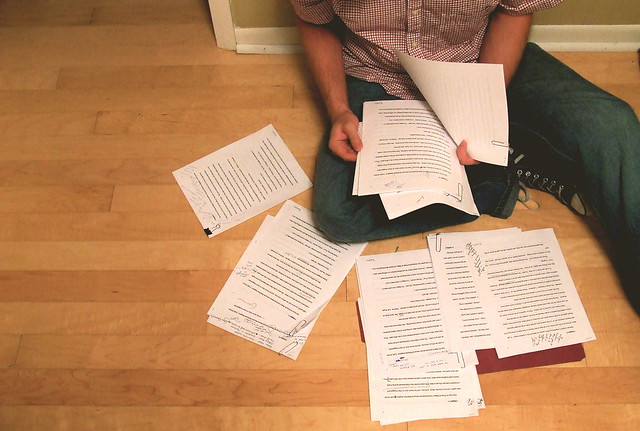
Photo credit: noodlepie on Flickr
It’s December! Which means Christmas is coming and Thanksgiving is over and NaNoWriMo is complete! Now many of you have 50,000 new words or maybe even a new manuscript all nice and shiny on your computer. So what now?

What to Do:

  • Finish your manuscript. Assuming you haven’t already. 50,000 words isn’t always a full novel, depending on the genre and how lean your first drafts usually are. But if you didn’t finish, keep going! You’re nearly there. 

  • Celebrate! You deserve it! Writing 50,000 words in a month is nothing to scoff at—watch your favorite shows, read your favorite books, eat something delicious and enjoy some time with your family and friends. You’ve done something pretty fantastic, so enjoy it. 

  • Back up your files. No really. Go do it right now. I’ll wait. 

  • Make pre-edit notes. As many of you raced through that first draft, you may have some ideas already as to what will need to be adjusted or researched for and during the editing period. Write these down now, before you forget them. Because chances are, you will forget them. 

What NOT to Do:

  • Submit to agents or editors. A lot of agents and editors close to queries and unsolicited submissions in December both for the holidays and to avoid the NaNo rush. Do not under any circumstances be part of the NaNo rush. You’ve done something you should be proud of—you wrote a novel, or a large part of one at least. But what you have is a first draft, and first drafts need to be re-read, and revised, and ripped apart and edited to death before they’re refined enough to be submission-ready. And that takes time.

    Don’t sabotage your future efforts by submitting your manuscript prematurely. Take your time to get it right and you’ll be glad you did. 

  • Publish. Same as the above. Take the time to get it right before you upload your book.

Consider:

  • Give your manuscript some space. I’ve already written about the importance of letting your manuscript cool between drafts, as well as how to read your writing objectively, so I’m not going to reiterate the whole thing here. But the short version is giving your manuscript some space allows you to develop distance from your words, which in turn makes editing much more effective. 

  • Edits and revisions are not optional. I basically went over this in the first bullet, but if you want to publish your work, whether traditionally or independently, editing is not optional. Ever. The only way to make your book as good as it can possibly be is to put it through extensive edits and trade with critique partners and revise revise revise. There aren’t any shortcuts in writing. 

So those are my post-NaNoWriMo tips—what would you add to the list?

Twitter-sized bites: 
Now that #NaNoWriMo is over, writer @Ava_Jae shares some post-madness tips. (Click to tweet)  
With #NaNoWriMo over, writer @Ava_Jae shares some dos and don'ts for your shiny new WIP. (Click to tweet

How to Edit in Passes

Photo credit: Law H8r on Flickr
As I work on the second draft of my newest WIP, I’ve decided to try something a little different while working on my edits. 

I’ve mentioned in the past that I like to be pretty organized when I tackle my edits, and I often employ editing lists to help me to capitalize on that organization. Even with the list method, however, editing can quickly become exhausting, and so this time around I wanted to focus on a method that would allow me to get through my edits without burning out. 

And so I decided to enhance the list method with focused passes. 

You see, oftentimes the biggest issue with editing is that writers start to feel overwhelmed by the enormity of the edit at hand. Most times there will be several things to fix in any given draft, but the focused pass forces you to tackle one problem at a time. 

Basically, the idea behind a focused edit pass is to go through your WIP with one goal in mind. Maybe it’s to authenticate dialogue, or expand on your setting, or fix a major plot hole, but whatever it is, you go through your WIP and fix that one problem, until whatever it is is cohesively worked out throughout the entirety of your WIP. 

For example, say you’re adding a character. Using the focused pass method, you would go through your WIP from beginning to end, adding all scenes, mentions and effects that character leaves, and you ignore all other problems while doing so. It isn’t until you’ve fully integrated the new character into your WIP that you move on to the next problem—and again, you focus solely on the new issue. 

Ideally, I recommend starting with the most difficult fix and moving on from there, because once you’ve fixed the big problems, everything else will feel easier in comparison. 

So far, I’ve found that isolating the issues and focusing on them one at a time has allowed me to handle the issues without being overwhelmed. And when you’re neck-deep in edits, that can be quite a blessing. 

How do you handle your edits? Do you try to tackle everything chronologically, use passes, or another method? 

Twitter-sized bites:  
Do your edits leave you feeling overwhelmed? Here's a quick tip to help avoid writer burnout. (Click to tweet).  
Is your list of needed edits enormous? Here's how editing in passes helps one writer keep focused. (Click to tweet)

How to Rewrite Old WIPs Like a Pro

Photo credit: greg.turner on Flickr
So I've written in the past about how to know when it's time to shelve your WIP, and I've talked about how trunking your work doesn't mean the death of your novel, but I never really covered the afterlife of a trunked work: that is, the un-trunking. Ok, so un-trunking probably isn't a word, but hopefully you get what I mean.

I truly believe that nothing you write ever goes to waste — at least, not for writers. We learn and gain experience from every piece we write — whether it's an essay for school, or a report for work, or a poem scratched on the back of a napkin, or an 80k novel shoved in the drawer. You see, the great thing about putting WIPs that weren't working at the time away, is that nothing is stopping you from going back at a later time to bring them back to life. Or, if more drastic measures are necessary, cannibalizing its parts to create a completely new version of the novel.

Granted, rewriting a trunked WIP isn't skipping through a field of daisies whilst singing songs, but if you break it down into manageable steps, this seemingly daunting task can become significantly less overwhelming.

  1. Choose your soon-to-be reincarnated WIP wisely. Depending on how long your WIP has been sitting in the proverbial (or possibly literal) drawer and how much writing you've done between WIPs, you may have many WIPs to choose from when considering a rewrite. The key to a successful rewrite, however, begins with this crucial step.

    The good news is chances are, if you've become excited about a project again, or found new inspiration for an old WIP, you're headed in the right direction. We writers tend to have pretty decent instincts when it comes to what WIPs we're ready to work on, so just the fact that you're seriously considering rewriting an old WIP is a fantastic sign. The key is to make sure you choose a project that you're willing to put a lot of hard work, time and effort into. You need to be excited about your work in order to really be willing to put the time you'll need into it to create a decent rewrite. 

  2. Read it through (again). Before you begin any major rewrite, you need to re-familiarize yourself with your work. Since this is a trunked WIP, chances are it's been a while since you really took a good look at it, so now's the time to sit down and read from beginning to end.

    Depending on how long it's been since you wrote it, this step may be a bit painful, but if you're able to look at your old work, see the potential in it and cringe at your writing from however long ago at the same time, it's actually a good thing. It means you've grown as a writer, your writing skill has improved and you may very well have a potentially excellent rewrite on your hands.

    Note: now is NOT the time to edit. NO EDITING (seriously). Make notes on what you like, what you love and what you hate. Make a list of elements you'd like to keep in your rewrite and elements that need serious tweaking (or removal altogether). Now, however, is not the time to edit, because chances are you'll be ripping the WIP apart and completely rewriting large portions of it anyway. Any editing you do in this stage will very likely be altered or erased later on while rewriting. 

  3. Brainstorm. Now that you're familiar with your WIP and you have a list of elements you love and elements that need changing, it's time to delve deeper into the list. Brainstorm potential rewrite ideas — what works and what doesn't? Could you put it in a new setting? Rewrite the protagonist as someone new? Use the POV of a different character? Change the antagonist? Remember that you don't necessarily have to rewrite the same story — now's the time to consider maybe using the elements you like to create something entirely new. Push yourself to brainstorm new possibilities. You don't have to choose the craziest idea you put on your list, but you might surprise yourself with the scope of possibilities your WIP has. 

  4. Know where you're going with your new rewrite? Good. Now get to work. In other words: start writing. 

Have you ever rewritten or taken elements from a trunked WIP? What tips would you add to the list?

Writing by Hand vs. Typing: Is There a Difference?

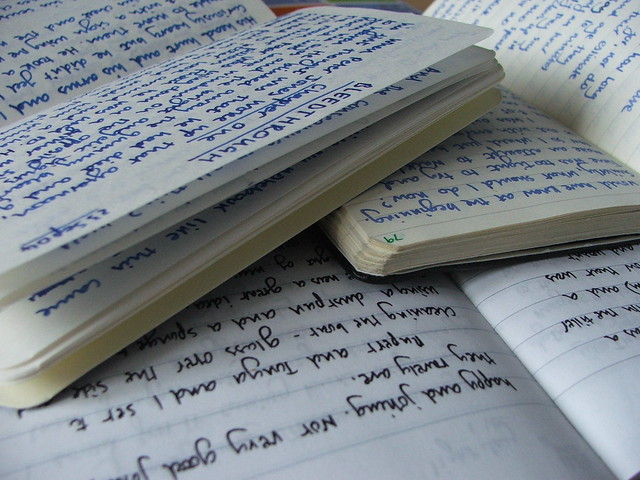
Photo credit: LOSINPUN on Flickr
I hadn't paid much attention to it before, but I noticed recently that I've developed a particular writing habit that I wouldn't have expected from myself: I like to write by hand.

Now, before the groaning begins let me clear something up — when I'm not fighting with my keyboard, I'm pretty decent at typing. I'm not claiming to be superwoman over here, but I usually type at about 80 wpm-ish, give or take, so as you could imagine when I'm doing writing sprints or going for speed, there's no question that I choose typing over writing by hand. In fact, most times when I'm writing, I’ll sit down in front of the computer rather than picking up a pencil and pad of paper.

However, when my fast drafting round is complete and the time comes to begin rewriting and editing, speed is no longer my goal, and in those instances I've found that I really enjoy writing by hand.

The reason I like handwriting my revisions is simple — I'm more careful when I write by hand. I'm not entirely sure why that is, but my guess is that it has to do with the process of typing versus handwriting itself. You see, typing is largely an automatic thing — your fingers jot down the first words that come to mind and allow you to keep up with the flow of your thoughts relatively well, which makes it a really good instrument for fast-drafting.

Writing by hand, however, is a completely different animal. Unless you're Flash or otherwise ridiculously fast, hand writing takes more time — you can't just tap a button and watch a letter appear, you have to write the letter out by hand, and although it doesn't take very long, it certainly takes longer than typing. When writing by hand your thoughts often race ahead of the actual writing, and as a result of that, you have a little more time to think about the words you're actually putting on paper. In addition to this, there isn't an easy backspace button to press if you write a word or sentence you don't like, which for me at least, causes me to be more careful with what I commit to paper.

In short, writing by hand forces me to think about the words I write as I write them, something that has proven invaluable while working on revisions.

Now I'm not suggesting that you attempt to rewrite your entire WIP on paper — although more power to you if you do — but what I've found is that for those scenes that I want to scrap and relive entirely, writing by hand has proven to be an effective way to get my thoughts in order and really focus on the words as I write. My handwritten work tends to be more poetic and thoughtful than what I come up with in fast-draft mode.

So in my experience at least, the difference between writing by hand and typing is more than just the speed at which you can write — the shifting of the process itself changes the result in ways that I wouldn't have guessed had I not tried it out.

So now I'm curious — do you prefer to write by hand or type? For those of you who have done both, have you found a difference in your handwritten work versus your typed writing? Share your thoughts in the comments below.

Why You Need to Stop Rewriting

 “Every time my computer has ever crashed in the middle of writing an unsaved scene, and I had to rewrite it all from word one, it’s turned out better. There’s a lesson in that, and I think it’s this: I don’t need a muse; I need a less dependable computer.” –James V. Smith, Jr. from The Writer’s Little Helper.
Photo credit: Abizern on Flickr
The very first writing book I ever purchased was The Writer’s Little Helper by James V. Smith, Jr. When I came across the quote I started this post off with, it stuck with me. I thought it was an interesting observation, although I secretly hoped it was one I’d never have to make myself. Over the years I did a lot of writing and editing and even some rewriting, and as I tried to rewrite sections of my WIP, I would occasionally think back to that quote and silently thank my computer for not crashing on me so I had something to reference while I was rewriting.

Then, as I continued reading books on the craft, I started to notice a pattern.

In many of the exercises that included completely rewriting a scene in The Fire in Fiction by Donald Maass, one of the steps included a variation of, “Without looking at your original draft, rewrite this [x]” (x being passage, scene, exposition, etc). And in Plot & Structure byJames Scott Bell, these two quotes stuck out to me:
“Let your characters have their way. Let your secret life be lived. Then at your leisure, in the succeeding weeks, months or years, you let the story cool off and then, instead of rewriting, you relive it.” –Ray Bradbury (page 173)
“Relive your scenes. Not rewrite. Relive.” –James Scott Bell (Page 203)
I have to admit, I initially resisted the thought of reliving versus rewriting scenes, but this really hit home for me when one of my critique partners suggested I rewrite a scene from my last WIP. Even though I’d already rewritten it, I took her advice and rewrote the scene again and submitted it to her to take a look at once more to see if it had improved. I was hoping she would say it was better so I could move on, but she didn’t. She suggested I rework it. Again.

I’m not going to pretend I wasn’t frustrated. I was. But as I sat down with my notebook to try to rewrite the scene yet again, I remembered what I’d read about reliving the scene rather than rewriting it—and at this point, what did I have to lose? So I did. I relived it and got the new version of the scene on paper. And while the scene played out the same way, it was different this time. I felt more directly connected to my protagonist’s experience and the writing showed it.  

So when my hard drive died the other day and I lost a new WIP idea I was working on (which I hadn’t backed up yet), I’ll admit I was less than happy. I may or may not have even written a few passive-aggressive tweets and Facebook posts about it. But part of me instantly remembered the quote I started this post off with, and I thought, well, I guess now I’m going to find out how true it is. So I replotted everything and started over. And I have to say, even if I do manage to get those files back, I don’t think I’ll need them anymore.  

Have you ever tried reliving a scene? If so, what was your experience? If not, do you think you will? 
Related Posts Plugin for WordPress, Blogger...