Showing posts with label do what you love. Show all posts

I Was That Teenage Writer

Photo credit: nicole.pierce.photography on Flickr
I was the teenage writer with big dreams.

I was the weird thirteen-year-old sitting at her desk during free period, huddled over a piece of paper with a pencil and a story rolling through her fingers.

I was the fourteen-year-old smiling shyly as her mother proudly announced to anyone who would listen that her teenager had written a book and was going to be published one day.

I was the fifteen-year-old who secretly enjoyed those English writing assignments and whipped out that four page essay so that she could get back to writing her next book.

I was the sixteen-year-old pretending to take notes in math class while actually writing a passage for her novel.

I was the seventeen-year-old disappointed with “I like this” non-critiques from Creative Writing class and anxiously dreaming all day about those query letters she sent out the night before.

I was the eighteen-year-old starting to realize that she might not be a published teenage writer after all, that she might not even get an agent as a teenager, that maybe her writing wasn’t as good as she thought it was.

I was the nineteen-year-old coming to terms with the fact that she may very well leave her teenage years with nothing to show for it except for many trunked manuscripts and a pile of rejection letters.

Here’s what I wasn’t as a teenager:

I wasn’t published.

I wasn’t agented.

I wasn’t a prodigy.

I wasn’t the next Christopher Paolini.

But now, looking back on those years, I’m glad I wasn’t any of those things. Because yes, I was a decently good writer for my age, and yes, I learned a lot from writing all of those books, and yes, it hurt to come to realize that I was going to have to give up my dream of being a published teenage writer. But at the end of it all, I was focused. I knew how to handle rejection (for the most part), I knew the value of patience (even if I struggled to maintain it), and I knew that time was on my side after all—that getting published wasn’t a race and I didn’t regret a second that I spent focused on my dream as a teenager.

Because it may have taken me a long time to come to terms with everything, but in the end, I know I’m a better writer for it.

I guess I just want to say this: to all you teenage writers out there, I know it’s tough. I know it sucks to give up so much to make your writing dream happen, and realize it might not happen in the time frame you were hoping for, even despite the sacrifices. I know it sucks to start writing young and have all your loved ones tell you how you’re going to be so successful because look how young you are and you wrote a book (or many books!), and meanwhile the clock is ticking and nothing seems to be happening and you start to wonder if maybe everyone’s just humoring you and you’re not that good after all.

I want to say that for those of you who are eighteen or nineteen or reaching that point of I may not be a published teenage writer after all, it’s ok. It’s more than ok. You’re not a failure for not getting published or agented as a teenager. You are amazing and talented and so very wonderful and I salute you. I salute you for hunkering down and chasing your dream while the rest of your friends goof off in class. I salute you for quietly taking rejection after rejection and continuing to write despite the pain. I salute you for not rushing to self-publish and taking your time to get your writing right, to really hone your craft.

What you’re doing isn’t easy. And if I’m being honest, it doesn’t really get easier. But it does get better. You’ll get better. Your writing will get better and you’ll be so glad for those manuscripts you had to put away and those rejections that branded your soul.

I guess I just want to say don’t give up if you don’t make your dream come true before you turn twenty. You’ve got your whole life ahead of you and as a bonus, you started on that path nice and early, which is pretty darn cool if you ask me.

Hang in there, pal. Everything is going to be ok.

Twitter-sized bites: 
Writer @Ava_Jae shares an open letter to all current and former teenage writers. (Click to tweet)  
"What you're doing isn't easy...but it does get better." #writinglife (Click to tweet)  

Are You a Writer?

Photo credit: Kitone on Flickr
Some of you may remember a post I wrote way back when titled Ten Indisputable Signs That You’re a Writer. It was a list post I wrote for fun, detailing some quirks that many writers share in common, and overall I had a pretty positive response from you lovely readers. 

Sometime after I posted it, however, the intro of the post was stripped out and someone re-posted it on several sites, and it eventually ended up on tumblr where it exploded a little. Long story short, the version of the post that became popular was a version without the intro, and so my fun list started to sound like a list of qualifying characteristics that you must have to be a writer. Which wasn’t my intention at all. 

I cleared it up to the tumblr community and it all got worked out in the end (yay!), but it made me realize that there are a lot of people out there who believe that there are some sort of lofty requirements to being a writer. 

I want to nip this lie in the bud right now. There is one requirement to being a writer.

Do you know what it is? I bet you can guess. 

The only question you ever need to ask yourself when wondering if you qualify for the title of “writer” is this: do you write? 

If the answer is yes—guess what? You’re a writer. No really. That’s it. 

This is why I don’t agree with the term “aspiring writer.” It’s also why it really hurt me to see people responding to my stripped list post with I guess I’m not a writer. I wanted to reach through the interwebs and hug those people and tell them that if they write and they love to write, then they’re writers. 

You see, there isn’t a panel of highbrow writerly judges that look down their noses at so-called would-be writers and tell them that they aren’t writer enough. As long as you write, there is no such thing as not being writer enough. 

You don’t need to be published to call yourself a writer. You don’t need to have written for x-amount of years or completed several novels (or even a single novel, for that matter). You don’t need to have a successful blog, or a witty Twitter, or hoards of fans to be a writer. 

All you need is your words and your love for language. All you need is a keyboard or pen and paper and the determination to keep writing, even when no one knows or cares that you love to write. 

All you need is you and the courage to say, “I’m a writer.” 

Because that, my friends, is the only requirement that matters.

Now tell me: Are you a writer?

Twitter-sized bites:  
There's only one question you need ask when wondering if you're a writer. Do you know what it is? (Click to tweet
There's only one requirement for being a writer—do you meet it? (Click to tweet)

On Writing and Giving Up

Photo credit: Daryl Cauchi on Flickr
As a week of two major pitch contests came to a close over the weekend, it was inevitable that their respective Twitter feeds became a place of polar opposites. A record of ecstatic writers celebrating good news, and an echo of, well, everyone else.

But the truth of every contest is this—while there will always be a handful (or a couple handfuls, depending on the size of the contest) of winners, by and large, the majority of entrants will receive rejections. And many will write it off as just that—another rejection. Most will shrug it off and continue writing, and entering contests, and submitting to professionals with their eyes steadfast on the eventual goal of publication.

But unfortunately not everyone can handle the mounting rejections quite so well, and so every once in a while I see a writer throw their hands up and say, “That’s it. I’m done,” and it makes me sad.

It’s never an easy thing to see a dream die, regardless of whether or not the dream is yours or someone else’s. It’s never easy to see someone give up, to watch other writers buckle under the weight of rejection.

Because the truth is, writing is hard. But beyond that, the whole journey of the writer—from first draft of the first novel to final draft of their final (published or not) novel takes such a toll. Every book you write is exhausting, every rejection you receive—whether it’s a form letter or bad review hurts. We’re told not to take those things personally, but let’s face it—it feels personal. It’s not an easy thing to pour your heart and soul into a book, only to be told that it’s not good enough.

It sucks. Rejection sucks.

It makes me sad to see writers give up, because I understand why. It becomes exhausting to hear strangers and friends tell you to keep pushing on and keep writing when professionals keep slapping you with not good enough. The journey of the writer is an emotional rollercoaster—from hopeful maybe this is the one highs to crushing form rejection lows, and quite frankly, it can be really hard to handle.

The thing is, I can’t promise you that you’re going to be published one day—no one can. I can’t promise you that if you self-publish you’re going to sell enough copies to make those bestseller lists—I can’t even promise you that you’ll get decent reviews. What I can do is encourage, but even that isn’t enough sometimes, because the truth is, the decision to keep writing despite the disappointments has to be your own.

Everyone has the right to give up—and if you decide that the road of the writer isn’t for you, then that’s ok. It’s not for everyone, and deciding to take another path doesn’t make you a failure—it just means that the life of the writer wasn’t for you. And it’s ok.

But if you do give up, make sure you’re doing it for the right reasons. Give up because you realize you don’t really enjoy writing. Give up because there are other things you would rather be doing, because you aren’t happy when you write, because you have other dreams that you’d rather be chasing.

But don’t give up because you think yourself a failure (you’re not). Don’t give up because you’ve received twenty, or fifty, or a hundred rejections (so has every other published writer out there). Don’t give up because of bad reviews (even J.K. Rowling has them), or because you don’t think anyone will ever love your writing (someone will), or because despite your best efforts, your writing just isn’t there yet (EVERY writer goes through this stage). Don’t give up because you think you’ll never be published (no one can see the future) or because you’re tired of hearing “not yet” (“not yet” doesn’t mean “you never will”).

Every writer deals with rejection, some more than others. Every writer feels inadequate or entirely discouraged at times. Every writer gets told “no” and feels like publication is a dream that will never come true.

I’m not here to tell you not to give up. Just don’t give up for the wrong reasons.

Discussion: Why Do You Love Writing?

Photo credit: DaveAustria.com on Flickr
So it's the day after Valentine's Day and I totally didn't write about romance or even mention the word "love" in Wednesday's post, so I thought it appropriate to mention a love-related topic today. Except not quite in a romance-y way because mushy gushy romance day was yesterday. So.

Assuming that most of you reading this are writers or readers who enjoy reading writing blogs, I'm sure many of you have on more than one occasion come across a post detailing all the downsides of being a writer. Hell, you may have even read some of those posts here, because I like to be realistic when talking about the whole writing thing.

But sometimes when the days are particularly hard, or when you have more than a handful of rejections sitting in your inbox, or you look at your writing and wonder why you're even bothering to attempt to write, we writers need a little reminder as to why we embarked upon this writing journey to begin with. Sometimes we forget why we ever wanted to be writers to begin with, why we tell others we love to write so much, why we subject ourselves to rejection after rejection or an assortment of other disappointments that invariably come with the territory. Sometimes we need to take the time to remember why we love to write.

For me, the answer lies in the characters. I never tire of falling in love with new characters and watching them grow and change. I never get bored watching them interact with each other—whether it's a page of witty dialogue or an argument that ends badly. There's something truly incredible about creating characters people care about, and writing a story people want to read, and devising a world with just words that continues to fascinate me.

There's something about creating something out of nothing that I absolutely love, and it gets me time and time again, manuscript after manuscript.

You guys, we writers have the coolest job on the planet: we pull characters and entire worlds from our imaginations and release them to the world for others to see and expand upon. And we do it all with combinations of letters and our minds.

And if you ask me, that's pretty darn cool. And I'll always love it.

Join the discussion! Why do you love writing or reading other people's writing?

Why I Don’t Like the Term “Aspiring Writer”

Photo credit: Wiertz Sèbastien on Flickr
First and foremost, I’d like to thank Tymothy Longoria and Allie Burke for making me aware of this about a year ago. 

I see the words "aspiring writer" all the time online—in Twitter bios, Facebook profiles, blog pages, just about anything that has a space for people to describe themselves. And on paper, it sounds nice, aspiring writer –it's not overdramatic or overly-ambitious and it even has a nice ring to it.

But every time I see it, I sigh a little, because while I know what people mean when they say they're an aspiring writer, I truly don't believe the "aspiring writer" actually exists.

Hear me out.

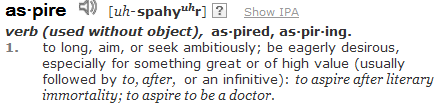
Let's take a look at the words "aspiring" and "writer." What do they actually mean?


Take a look at those definitions (from dictionary.com and Google, respectively)—longing, aiming, seeking, directing ones hopes. Some synonyms provided by Google are "yearn" and "strive." Notice a pattern? There’s a lot of dreaming, but none of those words involve taking action.

Now let's look at Google's definition of "writer."


I especially like that first definition—a person who has written a particular text. That's it. Not a person who has published x-number of books or a person who has made x-dollars writing—a person who has written.

Put the two together, and what do we have? Someone who longs or aims to write. The implication of such a combination is clear—the definition of an aspiring writer is someone who wants to write, but doesn't.

Now I know that's not what most people mean when they say they're an aspiring writer. In most cases, they're thinking more of the second definition of writer—someone whose job it is to write. By "aspiring writer," in most cases, they really mean "aspiring published writer," which is another thing entirely.

But an "aspiring writer"? It doesn't exist. Because you can't be a writer if you don't write, and if you write, you're not aspiring to do so at all—you're actually doing it. You've already met your goal. You're already a writer.

If you write, then you're no longer aspiring—you are doing. It doesn't matter if you haven't finished a novel, or if you've never been published, or if you're thirteen or eighty-four—if you write, and you love to write, then you are a writer. Period.

Aspire to be published, or to make a living with your writing, or to sell x-number of copies or make x-number of dollars with your writing. Aspire to be a bestseller, or to have your book on the shelves at Barnes & Noble, or to get an agent at your favorite agency.

But don't aspire to write. Just sit down and do it.

What do you think about the term "aspiring writer"? Have you ever defined yourself as one? Share your thoughts in the comments below!

So You Want to Be a Writer?

Photo credit: @optikalblitz on Flickr
An open letter to new and aspiring writers:

First and foremost, the "aspiring writer" does not exist—there is the writer and the not-writer, but you cannot aspire to be a writer any more than you can aspire to be a reader (do you read or not?) or an artist (do you create art? Yes? Then you’re an artist). If you want to be a writer, the first thing you must do is eliminate "aspiring" from your vocabulary. You either write or you don't. Decide.

But first make absolutely sure that you want to be a writer—there can't be any doubts in your mind, you must know that you want to write like you know that you need to breathe to live. The words "maybe" "might" "perhaps" and "possibly" are not acceptable terms. You must know this with your heart, mind and soul.

Once you have decided that you are, indeed, a writer, you must, of course, begin to write. Chances are if you're reading this, you've already done so, but if you haven't you must begin immediately. Write as much as you can—write awful, melodramatic poetry and ridiculous, clichéd short stories and novels that go on for 100,000 words with little character development, a bald, moustache-twirling villain and an ending that features your protagonist waking up and realizing it was all just a very strange dream. Share it with your family who will tell you it's fantastic. Forget about editing and write query letters to top agents around the country, then receive your first and second and third and fourth form rejection letter.

Throughout this time, you should be reading. Read everything—trashy novels and books from the children's section and long, classic novels that make you want to tear your eyes out. Read the good, the bad, the ugly, the beautiful, non-fiction and novels, poetry and plays. If you don't have time to read, then you most certainly don't have time to learn how to write. Accept this and start reading widely, even if it means reading just a couple minutes at a time.

Eventually, you will probably realize that your first novel is terrible. This is good—it means you're learning. Don't let it discourage you—put your first novel away and start the second. And third.

If you want to get serious about writing, you must learn to edit. You'll have to make painful decisions—decision like tossing the first 50,000 words of your first draft or eliminating characters entirely or adding another 40,000 words to your novel long after you thought you'd be finished.

Read about writing as much as you can—blog posts, non-fiction, advice from agents and published writers—this is your bread and butter, the food that will mold you into the writer you want to become. Read it, apply it to your work then write some more.

Repeat.

Don't read about those writers who published their very first novel and became New York Times bestsellers. Don't let jealousy paralyze you when you see others around you get book deals, or when your best friends become successful and pat you on the back as you continue to slog through this disease called writing.

Accept that your friends and family will not understand your passion. Don't let this stop you.

Over time you will get tired. You'll be working a non-writing job or going to school or raising a family or all of the above and there will be bills to pay and long hours at work and family members who will smile politely when you talk about your writing and ask when you're going to get published.

Know that it will likely be many years before you see any of your writing in print.

Know that your debut novel will probably not be your first book. Or your second. Or your third.

Know that even when you do get published, chances are you'll probably still need that other job.

Know that there are much easier ways to make a living.

Are you sure you want to be a writer? Are you absolutely sure? Because the road of the writer is not an easy one—it's long and often lonely and frustrating. It's exhausting and not unlike repeatedly smashing your head into a wall.

Above all else: you must love to write.

If you're sure—if you know you love writing—then know this: as long as you don't give up, you will one day succeed. It might take two years or six or ten or twenty. It might be your fourth novel that gets published or your sixth or your thirteenth. But if you're sure this is the road you want to take and you devote your spare time to improving your craft and falling in love with your stories over and over again, one day you'll make it.

Being a writer isn't always easy or fulfilling or fun. But if you're sure that's who you are, don't let go of your dream—never let it escape you.

Because it's up to you to make your dream come true.

So now, tell me: are you a writer or aren't you? 

A Guaranteed Way to Fail

“I don't know the key to success, but the key to failure is trying to please everybody.”—Bill Cosby
Most of us like to make people happy. We want to be liked and accepted and when it comes to our writing, we want people to enjoy it. As many people as possible—ideally, everyone.

I mean really, how great would it be if everyone loved your writing?

Photo credit: kate.gardiner on Flickr
Unfortunately, that’s not going to happen. Truth be told, there’s always going to be someone who doesn’t like your style, or your characters, or your pacing or sentence structure or the way you throw virtual confetti around like it’s nobody’s business.

You can’t please everyone—there will always be bad reviews or people who unsubscribe to your blog or a stack of rejection letters.  That’s just the way the world works and it’s not a bad thing. Let’s face it—the world would be a boring place if everyone liked the same thing.

So what’s my point?

If you try to please everyone, you will fail. I usually say there are exceptions, but there really aren’t any here. You can’t please everyone, period.

It doesn’t matter if everyone else likes your work, what matters is that you are happy with it. Are you proud of your writing? Do you love your characters, your story? If the answer is no, then it probably needs more work.

If the answer is yes, then don’t worry about everyone else. Write until you know you’ve done your best and you smile when you read the words you put on the page. That’s when you know you’ve succeeded.

And chances are someone else will like it too.

Have you ever fallen victim to trying to please everyone? 

Writing--What's Your Favorite Part?

Photo credit: _StaR_DusT_ on Flickr
We all know writing isn't an easy thing—finding the time, getting ideas, discovering voice, editing and rewriting and editing and rewriting again—it’s a lot of work, and quite frankly, sometimes it’s frustrating.

But what about the moments that make it all worth it? I don’t think we talk enough about them.  

So, let’s talk: what’s your favorite part of writing?

For me, there are two parts that I can’t get enough of:

  1. The discovery—the moment when a character comes alive—really comes to life for the first time on the page—when they do something unexpected or say something that makes you grin every time you read over it, that moment when you can say, “Wow, I really found you.” Discovery can be in the characters, in a world you’ve created that finally clicks, in that plot point that you’ve needed for days that suddenly hits you…the discovery is easily one of my favorite parts of writing.

  2. Wow…I wrote this?—This part I suppose is more of my favorite part of rewriting, since it tends to come up much more often after a bajillion drafts, but when you read over something for the umpteenth time and it hits you that it’s right, that it sounds finished, that you wrote it…that’s something really special.

Let’s take a moment to focus on the parts that make everything worth it. Tell me guys, what’s your favorite part of writing? 

Do What You Love


“You’ve got to find what you love. And that is as true for work, as it is for your lovers. Your work is going to fill a large part of your life, and the only way to be truly satisfied is to do what you believe is great work. And the only way to do great work is to love what you do. If you haven’t found it yet, keep looking and don’t settle. As with all matters of the heart, you’ll know when you find it.” –Steve Jobs
After Apple’s announcement Wednesday night, I watched Steve Jobs’ Stanford commencement address, and it really struck a chord. If you haven’t taken the fifteen minutes to watch it yet, I highly recommend it—it’s inspirational.

That being said, one of the (many) things that stuck out to me was the quote I gave to you guys above. You’ve got to find what you love.

Life is short and every day is a gift. You only have one life to live, so why not spend it doing something that you love?If you’re not passionate about your work, maybe you should be doing something else. Maybe you should consider making a change and doing that thing that you really want to do.

I remember when I was in high school and I would ask my peers what they wanted to do and I’d get answers like “I want to be a doctor” or “I want to be a lawyer”—and that was great for some of them. Some of them really loved the medical field and were fascinated with law and that’s fantastic.

But some of them were motivated by money, or just going along the path their well-intentioned parents pushed them onto. They worked hard to get the grades and went to ivy league schools to study a profession that could make them money not because it was what they wanted to do, not because they loved it, but because it was what was expected of them.

It’s hardly an uncommon story and looking back, I wish I had said something. Because guys, money means nothing if you’re not happy. And all those expectations from your friends, your family, they’re real and it’s hard to disappoint them, but sometimes they don’t line up with your dreams. Sometimes they don’t line up with who you are. And sometimes when that happens you need to take a stand and do what makes you happy.

And no, they may not understand you. They may think you foolish for stepping off the secure path to do that risky thing that you really enjoy doing.

But in the end it comes down to you. Your happiness. Your life.

I leave you with another gem from Mr. Jobs:

“…for the past 33 years, I’ve looked in the mirror every morning and asked myself: ‘If today were the last day of my life, would I want to do what I am about to do today?’ And whenever the answer has been ‘No’ for too many days in a row, I know I need to change something.”  

And the video, in case you haven’t watched the address yet:


Are you doing what you love? 
Related Posts Plugin for WordPress, Blogger...