Showing posts with label failure. Show all posts

On Writing and Giving Up

Photo credit: Daryl Cauchi on Flickr
As a week of two major pitch contests came to a close over the weekend, it was inevitable that their respective Twitter feeds became a place of polar opposites. A record of ecstatic writers celebrating good news, and an echo of, well, everyone else.

But the truth of every contest is this—while there will always be a handful (or a couple handfuls, depending on the size of the contest) of winners, by and large, the majority of entrants will receive rejections. And many will write it off as just that—another rejection. Most will shrug it off and continue writing, and entering contests, and submitting to professionals with their eyes steadfast on the eventual goal of publication.

But unfortunately not everyone can handle the mounting rejections quite so well, and so every once in a while I see a writer throw their hands up and say, “That’s it. I’m done,” and it makes me sad.

It’s never an easy thing to see a dream die, regardless of whether or not the dream is yours or someone else’s. It’s never easy to see someone give up, to watch other writers buckle under the weight of rejection.

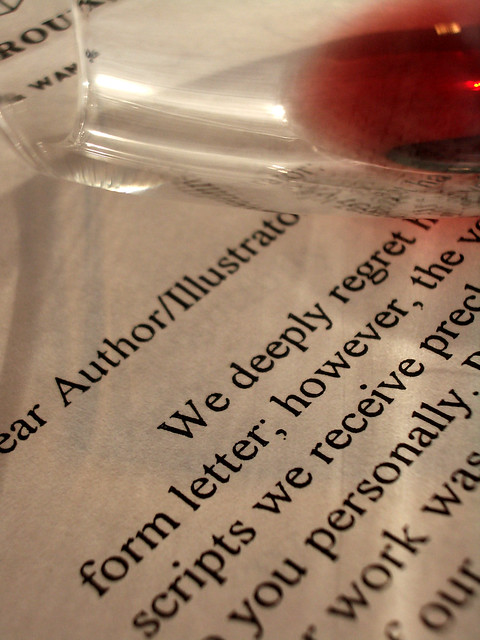
Because the truth is, writing is hard. But beyond that, the whole journey of the writer—from first draft of the first novel to final draft of their final (published or not) novel takes such a toll. Every book you write is exhausting, every rejection you receive—whether it’s a form letter or bad review hurts. We’re told not to take those things personally, but let’s face it—it feels personal. It’s not an easy thing to pour your heart and soul into a book, only to be told that it’s not good enough.

It sucks. Rejection sucks.

It makes me sad to see writers give up, because I understand why. It becomes exhausting to hear strangers and friends tell you to keep pushing on and keep writing when professionals keep slapping you with not good enough. The journey of the writer is an emotional rollercoaster—from hopeful maybe this is the one highs to crushing form rejection lows, and quite frankly, it can be really hard to handle.

The thing is, I can’t promise you that you’re going to be published one day—no one can. I can’t promise you that if you self-publish you’re going to sell enough copies to make those bestseller lists—I can’t even promise you that you’ll get decent reviews. What I can do is encourage, but even that isn’t enough sometimes, because the truth is, the decision to keep writing despite the disappointments has to be your own.

Everyone has the right to give up—and if you decide that the road of the writer isn’t for you, then that’s ok. It’s not for everyone, and deciding to take another path doesn’t make you a failure—it just means that the life of the writer wasn’t for you. And it’s ok.

But if you do give up, make sure you’re doing it for the right reasons. Give up because you realize you don’t really enjoy writing. Give up because there are other things you would rather be doing, because you aren’t happy when you write, because you have other dreams that you’d rather be chasing.

But don’t give up because you think yourself a failure (you’re not). Don’t give up because you’ve received twenty, or fifty, or a hundred rejections (so has every other published writer out there). Don’t give up because of bad reviews (even J.K. Rowling has them), or because you don’t think anyone will ever love your writing (someone will), or because despite your best efforts, your writing just isn’t there yet (EVERY writer goes through this stage). Don’t give up because you think you’ll never be published (no one can see the future) or because you’re tired of hearing “not yet” (“not yet” doesn’t mean “you never will”).

Every writer deals with rejection, some more than others. Every writer feels inadequate or entirely discouraged at times. Every writer gets told “no” and feels like publication is a dream that will never come true.

I’m not here to tell you not to give up. Just don’t give up for the wrong reasons.

On Dealing with Rejection

Photo credit: BookMaMa on Flickr
When I first set out to become a writer so many years ago, there were four words that I heard over and over again, four words that reappeared everywhere I turned: develop a thick skin.

At the beginning of my journey I had this hope, you see. This flutter inside me that secretly wished I wouldn't have to, that whispered maybe not me. I clung on to that hope, and when my very first query letter brought back a request for a partial, I was ecstatic. I thought maybe I would be an exception, maybe, just maybe, I would be the writer that didn't have to deal with rejection.

I didn't send out any more query letters. I waited.

My first rejection arrived in the mailbox many weeks later. It was a heavy thing, literally, because it was attached to the first fifty pages I had printed out and sent to New York, now returned to me in a large yellow envelope. It was a nice rejection, personalized with a little feedback on why the agent had passed, but it didn't hurt any less. To my inexperienced eyes, a rejection was a rejection and the hopeful whisper died.

Since then, over the course of many years and manuscripts, I've collected more rejection letters than I care to count. But I'm not here to whine about rejection, in fact, I am, in a way, grateful for them. Because while they were difficult lessons to learn, dealing with rejection has taught me a few things:

  • Not all rejections are created equal. There's a world of difference between a form rejection letter and a personalized one. Personalized rejections mean it was a near-miss, it means the agent (or editor) took the time to personally write you a rejection letter rather than doing the easy thing and sending a quick form rejection. True, they both mean "no," but the latter is a subtle way of saying you're almost there. Keep going. 

  • Rejections aren't the end. I know sometimes it doesn't feel like it, but life goes on after five, ten, fifty, a hundred rejections. Rejections don't mean that you're a terrible writer, or that you'll never be published, or any of those awful doubts that tend to creep in upon receiving bad news about your writing. Every writer has dealt with rejection of one form or another and the best thing you can do is keep going. Keep writing. 

  • For the writer, rejections are a part of life. Believe it or not, post-publication writers still receive rejections—they're called bad reviews, and even the legendary New York Times Bestselling authors receive them pretty regularly. As harsh as it sounds, the rejections that you receive while querying are teaching you an important lesson—they're teaching you how to develop a thick skin and continue working when the stones are being thrown. They're teaching you how to ignore the negativity and keep pushing forward. 

These are lessons that are essential if you want to be a successful writer, and for that, I'm grateful. No, it's not easy, and truth be told, those rejections start to get heavy after a while, even when they're not attached to fifty pages of the manuscript that you poured your heart into.

But despite all that, I honestly believe that in the end, we'll all be better for the experience.

Have you dealt with rejection? What did you do to help you get through it?

Do Your Characters Fail Enough?

Photo credit: amboo who? on Flickr
I've written before about the importance of being a sadist if you're a writer and on allowing your characters to earn their victories, but it occurred to me that I missed an equally important and somewhat related point, namely, allowing your characters to fail.

Let's face it — very rarely do we as readers or writers want our characters to lose, particularly when that character is the protagonist or otherwise well liked. But allowing our characters to fail time and time again is an essential part of both plot progression and character development that writers should be careful not to overlook.

What makes character failures so important, you ask? Let's take a look at the various advantages of allowing your character to lose:

Character failures...

  • Raise the stakes. One of the easiest ways to quickly (and dramatically) raise the stakes in your story is to allow your characters to fail. For example, not only do Faramir and his men lose the battle at Osgiliath, forcing them to retreat to Minas Tirith, but when they attempt to retake the fortress he is severely wounded and most of his men are slaughtered, leaving Minas Tirith with less soldiers, a crazy, cowardly leader and another impending battle that they are sure to lose (The Return of the King by J.R.R. Tolkien). 

  • Test your character. Failures reveal another side of our characters — it tests their strength (physical, emotional and mental), their determination and the nature of their character. Will your protagonist crumble under pressure? How does he handle failure — does it make him angry? Hopeless? More determined to succeed? Who will buckle under the pressure first? These are questions that can only be answered when your characters face failures. 

  • Emphasize the victory. The biggest and best victories are the ones that the characters have earned by persevering through the toughest odds. Victories handed to your characters on a silver platter are worthless — as they say, nothing worth having comes easily, and your character victories should be no different. 

These are just a few advantages of allowing your characters to lose, but now I'd like to hear from you — do you allow your characters to fail often? What other advantages do characters failures have?
Related Posts Plugin for WordPress, Blogger...