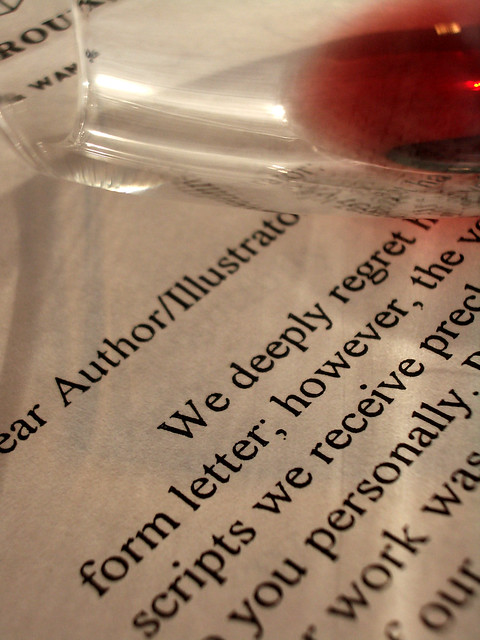
Showing posts with label rejection. Show all posts

Vlog: On Dealing with Rejection

Rejection is a tough, but inevitable part of being a writer. Today I'm talking the different stages of rejection and how to deal with them.


RELATED LINKS: 


How do you deal with various forms of rejection? 

Twitter-sized bites: 
"The truth is, when you're a writer, rejection is inevitable." #vlog (Click to tweet
Nervous about or struggling to handle rejections? @Ava_Jae vlogs about this inevitable part of being a writer. (Click to tweet)

Rejection Doesn’t Stop

Photo credit: Daniel Kulinski on Flickr
Some tough love today.

Every once in a while, I’ll get an e-mail from writers who say they’re having trouble with rejection, or scared of rejection, or getting tired of rejection, etc. These are feelings, I think, that just about every writer can identify with. After all, rejection is never easy to handle, especially over and over and over again.

Unfortunately, if you’re a writer, that’s too bad.

I hate to sound callous or cold, because I get it. I do. I’ve dealt with close to a decade of writing-related rejection and I expect more in my future. Rejection sucks. It’s exhausting and eats away at your confidence and motivation and it’s really hard.

It’s also inevitable.

The truth is, for writers, rejection never goes away. Not after you get an agent. Not after you get your first book published (or publish it yourself). Not after you publish five, ten, twenty novels. Rejection will always be a part of the writing life. Always.

Before you get an agent, rejection will come from agents in answer to query letters. Many writers see hundreds of rejections before they sign with an agent. It’s normal. It sucks. It’s reality.

After you get an agent and you go on submission, rejection will come from editors in answer to submissions. Many writers wait for months and see rejection after rejection before they sell their book. Some writers don’t sell their first book on submission at all. It’s normal. It sucks. It’s reality.

After you get a book deal or self-publish your first book, rejections will come from readers in the form of bad reviews. All writers get bad reviews. Many of them. It’s normal. It sucks. It’s reality.

It doesn’t matter how successful you are, or how many books you publish, or how popular your books become—rejection doesn’t stop. And yes, it’s hard, but the truth is, one way or another, writers just have to learn how to deal with it. That’s really all there is to it.

The good news is other writers understand. When you get agented, your agent understands. There are people around you who you can go to when rejection starts to feel like too much, when it weighs you down and makes it hard for you to continue.

But most importantly, I think, is to remember you’re not alone. All writers deal with rejection over and over and over again. And while it’s absolutely hard to handle, I like to think that with a little support and a lot of determination, it’s manageable. Eventually, at least.

What do you think?

Twitter-sized bites: 
"The truth is, for writers, rejection never goes away." (Click to tweet)  
Having trouble with rejection? @Ava_Jae shares her thoughts on this inevitable part of the writing life. (Click to tweet)

Why I’m Grateful for (Nearly) Seven Years of Rejections

Photo credit: Ultra Sonic Photography on Flickr
On May 28, 2007 I sent out my first ever query letter for my very first manuscript, which I began writing in Fall 2005. The manuscript and the query were not good. Actually, I cringed while re-reading the query before writing this post, so it was very not good. 

But I didn’t know that at the time. When I sent out that query letter, I was sure the book and the letter were amazing and I had dreams of getting published and maybe if I was lucky a movie deal, and I can laugh at my past self now, but at the time, they were legitimate feels. 

And the rejections I got for that query and manuscript legitimately sucked. 

In 2007, self-publishing wasn’t what it is today—something I’m so ridiculously grateful for. Because if it was? I might’ve published it. And I was so not ready for that. 

The thing is, looking back, I’m grateful for those rejections. Because yeah, they sucked, and I’m pretty sure I cried over a couple of them, and at the time it wasn’t what I wanted to hear. But now, nine manuscripts and seven years later, I can’t imagine debuting with any of the manuscripts I once thought were going to be it (except maybe one). 

I’m grateful for nearly seven years of rejections because quite frankly, I wasn’t ready. I still had so much more to learn about writing and the publication process and what makes a good book and how to write a decent antagonist and so many things that are so essential to writing a captivating novel. But I didn’t know that then. I thought I was ready then. 

I was wrong. 

To be fair, I still have loads more to learn—I’m of the belief that writers are never done learning. But my point is, while all those rejections hurt in the moment, they were worth it. Because they pushed me to do better. They motivated me to keep learning. And they taught me I’m so much stronger than I ever thought I was. 

I don’t regret a single query letter. I’m grateful for the nos that brought me to where I am today. Because when I did finally hear the yes I’d been dreaming about for years? It sounded that much more incredible. 

Twitter-sized bites: 
Writer @Ava_Jae shares why she’s grateful for 6+ years of query rejections. (Click to tweet)  
Are you grateful for your query rejections? Here’s why one writer says she is. (Click to tweet)

Encouraging Stats for the Querying Writer

Photo credit: ladytimeless on Flickr
Fun fact: I love reading How I Got My Agent stories. They’re exciting and often full of smile-worthy GIFs and squeeing and it’s kind of the whole reason I like watching the blind auditions of The Voice; there’s something really special about seeing someone taking a real-life step into their dream.

Oftentimes, at the end of these How I Got My Agent stories, writers will include their query statistics, which include numbers like how many queries they sent out, how many rejections they received vs. how many partial/full requests they received, etc.

What I found really interesting was the sheer number of writers who reported sending well over fifty queries before finding representation. And so out of curiosity I collected data from thirty How I Got My Agent stories scoured across the web.

The results, to me at least, were both surprising and somewhat encouraging.

Out of thirty now-agented writers, the average number of queries sent before finding representation was 59. The most was 154 (although four writers sent over 100 queries), and the least was ten. The majority of those writers only received one offer of representation—and that’s all it takes. You only need one yes.

Think about that: most of these writers, all who now have agents, received a lot of rejections. When we say rejection is just part of the process, that all writers face their fair share and then some, we really mean it.

Everyone gets rejected. Everyone gets disappointed or discouraged, and I’m willing to bet that just about every writer who has entered the query trenches has at one point or another seen a form rejection.

It’s an unavoidable part of the process, and it’s not fun, but it’s ok.

So whether you’re querying now or will be in the future, remember that rejection is expected.

And above all, remember this: in the end, it doesn’t matter how many rejections you get. Because all you need is one yes.

Have you entered the query trenches? 

Twitter-sized bites: 
Entering the query trenches soon? Here are some encouraging statistics to keep you going. (Click to tweet)  
"In the end, it doesn't matter how many rejections you get. Because all you need is one yes." (Click to tweet

Hope: The Best Remedy for Rejection

Photo credit: DieselDemon on Flickr
I’ve written several times about the inevitability of rejection. As a writer writing about writing (say that five times fast), it’s a topic that I would be remiss to avoid. 

Today, however, I don’t want to talk about how much rejection sucks. I want to talk about my master strategy for taking the bite off an otherwise difficult experience: that is, how to cultivate hope despite the no’s sitting in your inbox. 

There are two steps that I take to dull the sting of rejection, and I find they work best when done (or at least started) simultaneously. 

Hope Rejuvenizer # 1: Revise your query and try again.

If you only send one query out, and you receive one rejection in response, it’s going to hurt. You know that saying about eggs in one basket? It’s the same idea—if all of your hope is resting on one query, it hurts twice as bad if it doesn’t work out and you have nothing to lean back on. 

Instead, make a list. Decide on five to ten agents or editors (or both) you’d like to send to, and send your queries in batches. If you get nearly all form rejections, that’s a sign that you should probably rewrite your query before sending out batch two (remember what I said about getting your query critiqued? Do it), but the point is that you get a batch two out there. 

The reason I call this a Hope Rejuvenizer is because with every query you send out, you have a new chance. A new open door. And maybe it won’t work out, it’s true, but maybe it will. And that’s what hope is all about. 

Hope Rejuvenizer # 2: Work on a new manuscript. 

This may sound like an anti-rejuvenizer because some may consider working on a new manuscript as a sort of throwing in of the towel. I know I did when I first started out in my writing journey, but it’s not true. 

You see, there are two benefits of working on a new WIP while querying another manuscript. 

  1. Distraction. Do not underestimate the power of distraction. When you’re querying, it can often be very difficult to focus. Every e-mail feels like it could be the e-mail, even if you only sent that query out ten minutes ago. When you’re busy working on another WIP, it is much easier to set those panicky thoughts aside and immerse yourself in a new world where queries don’t exist.


  2. Backup plan. Eventually there may come a time when you decide to trunk the novel you were querying. This often happens after a slew of rejections, and it can be very difficult to accept, especially if you don’t have something else to work on. Something else to be hopeful about. By working on a second (unrelated) manuscript while querying your novel, you have something to fall back on if you decide to trunk the first. You can say, ok, maybe this one didn’t work out—but the one I’m writing might! 


    Take my word for it. It really takes the edge off the sting. 

So those are my main hope rejuvenizers, but now I want to hear yours: what do you do to keep your chin up while dealing with rejections? 

Twitter-sized bites: 
Dealing with rejection? Here are two strategies to help you to keep moving forward. (Click to tweet
Rejection is hard, but here are two steps to remaining hopeful despite it. (Click to tweet)

On Dealing with Rejection

Photo credit: BookMaMa on Flickr
When I first set out to become a writer so many years ago, there were four words that I heard over and over again, four words that reappeared everywhere I turned: develop a thick skin.

At the beginning of my journey I had this hope, you see. This flutter inside me that secretly wished I wouldn't have to, that whispered maybe not me. I clung on to that hope, and when my very first query letter brought back a request for a partial, I was ecstatic. I thought maybe I would be an exception, maybe, just maybe, I would be the writer that didn't have to deal with rejection.

I didn't send out any more query letters. I waited.

My first rejection arrived in the mailbox many weeks later. It was a heavy thing, literally, because it was attached to the first fifty pages I had printed out and sent to New York, now returned to me in a large yellow envelope. It was a nice rejection, personalized with a little feedback on why the agent had passed, but it didn't hurt any less. To my inexperienced eyes, a rejection was a rejection and the hopeful whisper died.

Since then, over the course of many years and manuscripts, I've collected more rejection letters than I care to count. But I'm not here to whine about rejection, in fact, I am, in a way, grateful for them. Because while they were difficult lessons to learn, dealing with rejection has taught me a few things:

  • Not all rejections are created equal. There's a world of difference between a form rejection letter and a personalized one. Personalized rejections mean it was a near-miss, it means the agent (or editor) took the time to personally write you a rejection letter rather than doing the easy thing and sending a quick form rejection. True, they both mean "no," but the latter is a subtle way of saying you're almost there. Keep going. 

  • Rejections aren't the end. I know sometimes it doesn't feel like it, but life goes on after five, ten, fifty, a hundred rejections. Rejections don't mean that you're a terrible writer, or that you'll never be published, or any of those awful doubts that tend to creep in upon receiving bad news about your writing. Every writer has dealt with rejection of one form or another and the best thing you can do is keep going. Keep writing. 

  • For the writer, rejections are a part of life. Believe it or not, post-publication writers still receive rejections—they're called bad reviews, and even the legendary New York Times Bestselling authors receive them pretty regularly. As harsh as it sounds, the rejections that you receive while querying are teaching you an important lesson—they're teaching you how to develop a thick skin and continue working when the stones are being thrown. They're teaching you how to ignore the negativity and keep pushing forward. 

These are lessons that are essential if you want to be a successful writer, and for that, I'm grateful. No, it's not easy, and truth be told, those rejections start to get heavy after a while, even when they're not attached to fifty pages of the manuscript that you poured your heart into.

But despite all that, I honestly believe that in the end, we'll all be better for the experience.

Have you dealt with rejection? What did you do to help you get through it?

Why I Celebrated a Rejection

May 17, 11:42 PM: Gmail informed me that I had a new e-mail. It was from the agent I’d queried over the weekend and “I’m sorry” was in the first ten words. I’d seen enough rejection letters to recognize one even from the little blurb at the bottom of my computer screen.

I opened my inbox just so that my Gmail icon would go back to neutral. I’m a little OCD about those things. I’m OCD about a lot of things, but that’s beside the point.

Ah-hem. Anyway.

I always read my rejections. I’m a bit of a masochist I guess, but there’s a part of me deep down inside that hopes I’ll be able to get something other than bitter disappointment from them. Nine out of ten times, it’s a form letter rejection.

Dear Author,
blah blah blah sorry but this isn’t for us blah blah blah
we wish you the best, remember that this is a very subjective business blah blah blah

They’re all pretty much the same. And having an archive full of them is great for your confidence. But it’s (an unfortunate) part of the process.

Upon a second glance however, I realized this one was different. First off, it started with “Hey there” and in my experience at least, no form rejection starts with “Hey there.” And it was a rejection, but rather than a normal Dear Author letter, this one said REAPER had “poise” and “polish.”

I read those two words over and over again. Yes, it really said that. It wasn’t my imagination. Poise. Polish.

Wow.

What excited me the most was that this was the beginning of my second round of queries for REAPER. After collecting more than a handful of form rejections, I re-wrote it completely. Everything. I put it in first person, deleted entire sections and rewrote every word.

Then I re-wrote my query letter to match my book. I wasn’t sure it was going to work.

But this rejection was much more than I’d ever received before for REAPER. It was a spark. A hope that maybe, just maybe, I was headed in the right direction.

I’m not saying I’m going to get an agent now. Or even a partial request. Hell, I may get form rejections from here on out.

But personalized rejections mean it was a near-miss. It means the agent took the time to write back to you rather than sending the easy “no thank you” form.

It’s a pat on the back and it goes a long way.

What’s the BEST rejection letter you’ve ever received? 
Related Posts Plugin for WordPress, Blogger...