Showing posts with label don't give up. Show all posts

On Dealing with Rejection

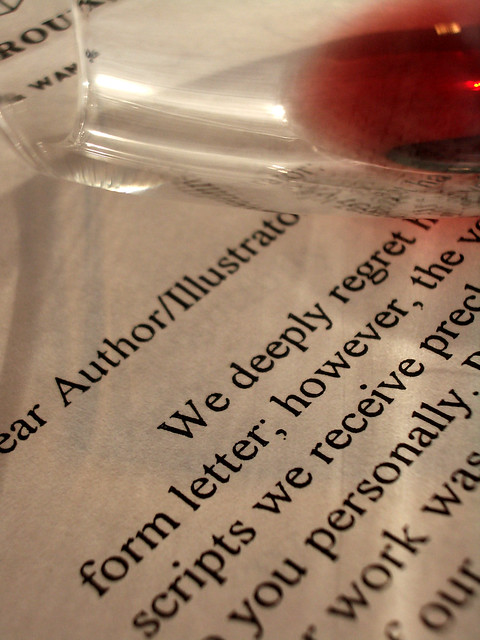
Photo credit: BookMaMa on Flickr
When I first set out to become a writer so many years ago, there were four words that I heard over and over again, four words that reappeared everywhere I turned: develop a thick skin.

At the beginning of my journey I had this hope, you see. This flutter inside me that secretly wished I wouldn't have to, that whispered maybe not me. I clung on to that hope, and when my very first query letter brought back a request for a partial, I was ecstatic. I thought maybe I would be an exception, maybe, just maybe, I would be the writer that didn't have to deal with rejection.

I didn't send out any more query letters. I waited.

My first rejection arrived in the mailbox many weeks later. It was a heavy thing, literally, because it was attached to the first fifty pages I had printed out and sent to New York, now returned to me in a large yellow envelope. It was a nice rejection, personalized with a little feedback on why the agent had passed, but it didn't hurt any less. To my inexperienced eyes, a rejection was a rejection and the hopeful whisper died.

Since then, over the course of many years and manuscripts, I've collected more rejection letters than I care to count. But I'm not here to whine about rejection, in fact, I am, in a way, grateful for them. Because while they were difficult lessons to learn, dealing with rejection has taught me a few things:

  • Not all rejections are created equal. There's a world of difference between a form rejection letter and a personalized one. Personalized rejections mean it was a near-miss, it means the agent (or editor) took the time to personally write you a rejection letter rather than doing the easy thing and sending a quick form rejection. True, they both mean "no," but the latter is a subtle way of saying you're almost there. Keep going. 

  • Rejections aren't the end. I know sometimes it doesn't feel like it, but life goes on after five, ten, fifty, a hundred rejections. Rejections don't mean that you're a terrible writer, or that you'll never be published, or any of those awful doubts that tend to creep in upon receiving bad news about your writing. Every writer has dealt with rejection of one form or another and the best thing you can do is keep going. Keep writing. 

  • For the writer, rejections are a part of life. Believe it or not, post-publication writers still receive rejections—they're called bad reviews, and even the legendary New York Times Bestselling authors receive them pretty regularly. As harsh as it sounds, the rejections that you receive while querying are teaching you an important lesson—they're teaching you how to develop a thick skin and continue working when the stones are being thrown. They're teaching you how to ignore the negativity and keep pushing forward. 

These are lessons that are essential if you want to be a successful writer, and for that, I'm grateful. No, it's not easy, and truth be told, those rejections start to get heavy after a while, even when they're not attached to fifty pages of the manuscript that you poured your heart into.

But despite all that, I honestly believe that in the end, we'll all be better for the experience.

Have you dealt with rejection? What did you do to help you get through it?

How to Write Consistently

"The funny thing is that, although writing has been my actual job for several years now, I still seem to have to fight for time in which to do it. Some people do not seem to grasp that I still have to sit down in peace and write the books, apparently believing that they pop up like mushrooms without my connivance. I must therefore guard the time alotted to writing as a Hungarian Horntail guards its firstborn egg." --J.K. Rowling
Photo credit: The Ticker Collector on Flickr

Last week I wrote about the benefits of writing blog posts consistently—not just for the readers, but for the writer as well. Most will agree that writing consistently in one manner or another is important, especially for writers, but writing on a consistent basis isn't always as easy as it sounds.

Everyone has their own challenges—even those who write professionally often struggle to find the time to write, as evidenced by the quote I used above, and those of us who don't write professionally often have just as much difficulty (if not more) in finding the time during the course of our busy lives to sit down and write.

But the key to writing consistently is accepting that you don't need to write thousands of words in every sitting. Sometimes all it takes to write a few hundred words is a couple of ten minute breaks scattered throughout the day—and as I mentioned in my post on writing a novel 500 words a day, writing in small chunks is just as productive and helpful as writing in large, hour-long sections.

"I don't have the time" isn't a valid excuse—even ten minutes before breakfast and ten minutes before bed is better than nothing at all. Even just training yourself to write a hundred words a day helps to hone your writing skill slowly over time.


If you truly want to hone your skill as a writer, then your writing time is sacred. Don't let it slip away from you—hold on to it as if today were your last day on Earth and you'd never be able to write again. Guard those precious moments and do the work that writers do.


Because as long as you continue to hone your craft, you'll one day look back and realize just how far you've come.


What tips do you have for writing consistently?

How to Survive the Query Wars

Photo credit: ashley rose, on Flickr
Maybe it's because summer is finally starting or maybe it's just a coincidence, but I've noticed more than a handful of writers mentioning that they've finished their WIP and will shortly be entering the trenches of the query wars as of late.

Querying is not an easy process for either partyfor agents and publishers it means reading hundreds (or even thousands) of letters a month in search for a story that refuses to be passed up, and for writers it means researching agents until your eyes are about ready to fall out and forcing yourself to write letter after letter to be sent into cyberspace only to sit back and... wait. And wait.

No, it's not easy to send out query letters (or even write the darned things for that matter) nor is it easy to wait for responses and receive inevitable rejections (because regardless of how good your story is, it's very near impossible to avoid receiving any rejections).

However! There is hope! It is indeed possible for writers to survive the query warsin fact, slews of writers do it all the time, and with these easy tips, you can too.

How to Survive the Query Wars: 

  • You will be rejected. Accept this. I'm not being a pessimist when I say you're going to be rejected, nor am I saying that everyone you query is going to reject you. What I am saying is that as a writer you're going to face a lot of rejection throughout your career, both in the form of form letters from agents and publishers and in the form of reviews later on. You are a writer. Rejection is part of your life, now. But that's ok, because every writer has faced iteven those who went on to become multi-billion dollar successes (*cough* J.K. Rowling *cough*). 

  • Learn to discern. Not all rejection letters are created equal. Receiving a form rejection means something a little different than receiving a personalized rejection (more on that here), and when you receive the rejection (i.e.: upon initial querying, after a partial/full request, etc.) speaks volumes about you might need to revise to get more positive responses. Remember: personalized rejections are a good sign. It means it was a near miss. Don't lose hope. 

  • Write something else. I sometimes forget how important this is, but remembering to write something entirely unrelated to whatever project you're querying truly is essential. Working on another project accomplishes a few things: 

    • It distracts you: distractions are worth their weight in gold during the query process. The less energy you spend worrying about that query letter you sent, the more energy you can spend on your writing.

    • It reminds you that even if this project doesn't work out, you are a writer and will write again

    • It takes the edge off rejection:I can't tell you enough how much easier it is to accept that your current project might not be ready for publication (or might have to go in the drawer) when you're excited about another new WIP. 

    • As a bonus, if you get an agent or publishing contract, you now have another WIP with publication potential for the future.

Finally, when you do get that coveted agent or publishing contract...

Celebrate! 

Seriously. You've done it! Now go get some drinks, or have a nice dinner, or bake some cupcakes (or all of the above). You've gone through the query wars and came out on the other side whole. Now go celebrate.

What tips do you have for writers entering the query wars?

Don't Be Afraid of Failure

Photo credit: photosteve101 on Flickr
Throughout my time in the Twitter/blogosphere, I’ve seen a lot of talk about failure. For writers, failure could be any number of things, whether it’s failing to write a good book, failing to get x amount of subscribers/page views/followers, failing to sell your manuscript, failing to sell enough copies of said manuscript…the list goes on.

I’m not here to talk about all the different ways a writer could fail, because quite frankly, we writers—hell, we as a people in general—tend to be pretty hard on ourselves when it comes to chasing our dreams and goals. Any hiccup, speed bump or letdown could be in one way or another interpreted as a failure.

Failure is a natural part of life—it’s a testament of the risks we’ve taken, they’re battle scars impossible to avoid throughout our lives and in the end, they leave us all the wiser.

But there’s this one particular failure that many writers are afraid of, one that has killed novels before they had a chance to live, one that has thwarted dreams and left many-a-writer feeling unworthy of the title.
By and large, writers are often afraid of writing badly.

I see it all the time on Twitter—writers who want to write, who have this goal, this dream of finishing their manuscript, who have put some words down and see others speeding ahead to meet their daily writing goals…and yet they hesitate. They look at the words they have so far and they pause. They say things like “I’m stuck,” or “I just can’t write today,” or “Maybe I’ll write later.”

And I recognize it because I’ve been there—because at times, I still find myself there. For me, the fear or writing badly is at its worst just before I start a new novel—that lingering whisper that looks at the plot I’ve thrown together or the first words I’ve scratched onto paper and sneers while it says the words: your writing sucks. They’re the doubts that crawl in and say, you can’t really write that—it’s going to be terrible.

For others, the fear of writing badly kicks in part-way through the story. It doesn’t matter when it kicks in though, because the result is the same: a seeming inability to write.

Something you need to understand—something I occasionally need to remind myself of—is this fear of failure is a lie. It’s a trick, because by being so afraid to put down a word, you’re already failing. By not writing anything at all, you lose by default.

Something you need to understand is it's infinitely better to have 80,000 words of a mediocre story than nothing at all.

Something you need to understand is even if you have to toss those 80,000 words and rewrite the whole thing entirely, even if the manuscript ends up in the bottom of a drawer, even if the words are so awful you’re embarrassed to show even your closest friends, you haven’t failed at all.

You haven’t failed because you wrote something; you created something, something that no one else could create the way you did. And maybe it’s ugly, and maybe it’s not the way you imagined it, but none of that matters because with every word you write, with every chapter you string together, with every novel you finish—terrible or not—you learn something. Those 80,000 words didn’t write themselves—you learn from the process just as much as you learn from reading and studying the craft.

The fear of failure is a lie, because you cannot fail, not really—you can only learn from your experience. And maybe you learn that you went about it the wrong way, or that you really need to study how to write dialogue, or that you’ve possibly written the most cliché-ridden antagonist in the history of terrible antagonists, but you learned something. And you’ll take whatever you’ve learned with you as you write the next book, the next short story or poem or whatever it is you write.

When you’re afraid of writing badly, don’t be. Put the words down and let them be God-awful and know that it doesn’t matter. These words are yours and one way or another, you’ll learn from them.

So go forth and write, friends. I’ll be cheering you along the way.

Also, read this beautiful post, DON’T BE AFRAID TO WRITE A BAD BOOK, from Tahereh Mafi, which basically covers everything I didn’t, and then some.

Has the fear of writing badly ever stopped you? What do you do to combat your writing fears? 

The NaNoWriMo Madness: Just Keep Writing

Photo credit: jordanfischer on Flickr
So there’s this thing called NaNoWriMo and it’s kind of popular in the writing community. You might have heard of it.

Confession: technically, I’ve never done NaNoWriMo. I have written a book in a month and I’m relatively sure I’ve written at or near 50k in a month on more than one occasion, but never in the month of November. I wanted to do it this year, honestly I did, but I don’t want anything to distract me from finally finishing these WIP edits, so…next year. I hope.

But I didn’t write this post to confess my non-NaNo blasphemy, because although I’m not doing NaNo this year, I know quite a few of you are. So.

Writing a book in a month is no easy feat and I don’t mean the literal getting words down part because that, although challenging, probably won’t be the biggest obstacle you’ll face this month.

You see, we’re still at the beginning, so most of you out there are probably going pretty strong and feeling good about what you’ve put down—which is fantastic. I’ve seen some people hit 8-10k in the first two days which is just mind-blowingly awesome to me, so kudos to you amazing people out there.

But writing like this is like running at full throttle for the entire race and after a while, you’re going to start to get tired. You might miss a day, maybe two or three, then the mountain of words ahead of you will start to feel overwhelming. Or maybe it’s the idea—maybe the premise that sounded fantastic on November 1st will start to feel stale on the 15th. It happens, and for those of you who encounter it, I want to tell you not to give up.

Look, you’re not going to come out of this with a masterpiece ready for submission. It’s going to be messy and a little ugly, and some parts of it will make you want to burn the entire thing and start fresh and that’s ok.
 
The point of NaNoWriMo isn’t to create a work of literary genius—hell, it’s not even to get 50,000 words down in a month. The point is to write—something, anything, it doesn’t matter as long as you make the effort to get something down so that you have something you didn’t at the beginning of the month. Maybe it’ll only be the start of a novel, or an outline, or maybe it’ll be a full draft that you love or 50,000 words that you hate.

That’s not the point.

The point is that you can’t fail as long as you accomplish something. Right now, you’re digging up the clay. You’re pulling the essence of a story together and you’re doing it with a community of other writers there to help you and encourage you along the way. There is no failure here.

Some days you’re going to want to quit. Don’t do it. Keep writing, keep working, keep sweating and bleeding and getting those words down. This is what being a writer is all about, and it’s not always pretty or fun.

Some days you’re going to glance at what you have and think it’s awful. Stop looking at it and keep writing. Keep pushing forward. Don’t think about anything other than finishing the next sentence, the next paragraph, the next page.

NaNoWriMo isn’t easy because writing isn’t easy, but I believe in you. As long as you keep your head down and your fingers on the keys, you’ll come out with something to show for it.

Don’t stop writing. I’ll see you on the other side.

Raise of hands! How many of you are out there are doing NaNo this year? Let’s hear some status reports! 
Related Posts Plugin for WordPress, Blogger...