Why I Don’t Like the Term “Aspiring Writer”

Photo credit: Wiertz Sèbastien on Flickr
First and foremost, I’d like to thank Tymothy Longoria and Allie Burke for making me aware of this about a year ago. 

I see the words "aspiring writer" all the time online—in Twitter bios, Facebook profiles, blog pages, just about anything that has a space for people to describe themselves. And on paper, it sounds nice, aspiring writer –it's not overdramatic or overly-ambitious and it even has a nice ring to it.

But every time I see it, I sigh a little, because while I know what people mean when they say they're an aspiring writer, I truly don't believe the "aspiring writer" actually exists.

Hear me out.

Let's take a look at the words "aspiring" and "writer." What do they actually mean?
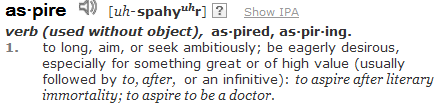


Take a look at those definitions (from dictionary.com and Google, respectively)—longing, aiming, seeking, directing ones hopes. Some synonyms provided by Google are "yearn" and "strive." Notice a pattern? There’s a lot of dreaming, but none of those words involve taking action.

Now let's look at Google's definition of "writer."



I especially like that first definition—a person who has written a particular text. That's it. Not a person who has published x-number of books or a person who has made x-dollars writing—a person who has written.

Put the two together, and what do we have? Someone who longs or aims to write. The implication of such a combination is clear—the definition of an aspiring writer is someone who wants to write, but doesn't.

Now I know that's not what most people mean when they say they're an aspiring writer. In most cases, they're thinking more of the second definition of writer—someone whose job it is to write. By "aspiring writer," in most cases, they really mean "aspiring published writer," which is another thing entirely.

But an "aspiring writer"? It doesn't exist. Because you can't be a writer if you don't write, and if you write, you're not aspiring to do so at all—you're actually doing it. You've already met your goal. You're already a writer.

If you write, then you're no longer aspiring—you are doing. It doesn't matter if you haven't finished a novel, or if you've never been published, or if you're thirteen or eighty-four—if you write, and you love to write, then you are a writer. Period.

Aspire to be published, or to make a living with your writing, or to sell x-number of copies or make x-number of dollars with your writing. Aspire to be a bestseller, or to have your book on the shelves at Barnes & Noble, or to get an agent at your favorite agency.

But don't aspire to write. Just sit down and do it.

What do you think about the term "aspiring writer"? Have you ever defined yourself as one? Share your thoughts in the comments below!

On Reading "Bad" Books

Photo credit: Wiertz Sébastien on Flickr
So there's been this belief going around for some time now that the quality of books—especially popular books—has been decreasing over time. It's this idea that the books people enjoy reading today are somehow lesser than the novels that were popular twenty, fifty, even a hundred years ago. 

And it bothers me. 

It bothers me that people look at Twilight and The Hunger Games and Harry Potter and even Fifty Shades of Grey and say things like, the garbage that people read nowadays, and this book will never stand up to x-classic, and it bothers me that there's this belief that the books people enjoy reading now are somehow worth less than what people used to read. 

I'm not going to try to tell you that Twilight was written with the same literary finesse as Great Expectations or Brave New World—that's obviously not the case—but I truly don't believe that makes it a lesser book, and furthermore, I don't think that makes anyone who read Twilight and loved it a lesser reader for enjoying it. 

Regardless of what you think about these massively popular books, they accomplished something that shouldn't be overlooked—they got people reading. I've heard people say, I don't usually like reading, but I read Twilight (or Hunger Games or Harry Potter) and loved it. I know people who rarely read, who picked up novels that others like to call "garbage" and guess what? Not only did they enjoy it, but they realized reading isn't so bad after all. They realized the right book can actually make the reading experience—*gasp*—enjoyable. 

I picked up the Twilight series in 2010, long after the crazy fandom had already stated and the first two movies had already been released, and I realized as I was reading in public that I felt self-conscious. I was getting looks and I felt the need to defend myself and say, "What? I haven't read the series yet," and people seemed relieved when they found out I wasn't re-reading the series, as if that would be something horrific. And even then, the insinuation that I should be somehow embarrassed about reading the series in public bugged me, because no one should feel that way reading a book.

And now it's happening again, except this time it's with Fifty Shades of Grey. And I'll admit—I was tempted, especially at first, to think, why in the world are people reading that? How did that get popular? But the fact of the matter is, people who don't normally read very often are reading—and enjoying—the series, and even if I won't be picking up the book next time I head to the bookstore, maybe it'll remind people that reading isn't so bad after all. Maybe it'll make people who don't often read pause before they dismiss the idea of picking up another book. 

I'm not saying that you have to enjoy every popular series that is released—or even that you have to read every massively successful book out there—I know I haven't, and I have no plans to do so. All I'm saying is that this idea floating around that so-called "garbage" books are somehow damaging our culture or aren't worth the time spent to read them needs to stop. All I'm saying is that we should celebrate the fact that people are reading, even if we don't necessarily agree with what they're reading.

All I'm saying is a book is a book, and if it gets people reading, that's good enough for me. 
 
What do you think about reading so-called "bad" books? Do you agree with the stigma? Why or why not?

Do You Really Want Overnight Success?

Photo credit: Mark Morgan Trinidad B on Flickr
J.K. Rowling. Stephanie Meyer. Suzanne Collins. Amanda Hocking. These are the names of authors who have often been described as overnight successes. Writers who leaped from the depths of the unknown to making a fortune with their words. 

Now while I largely don't believe that the overnight success as we like to imagine it exists (Nathan Bransford wrote a fantastic post about it here), the idea of sudden, massive success with an author's debut novel is one that many writers dream about while pounding away at their books. The idea of achieving celebrity-like author status with your first book is a tempting one, even if you're probably more likely to win the lottery and get struck by lightning at the same time. 

But all that talk about so-called overnight success has got me thinking—is it really something that we should strive for?

I'm not going to pretend that there aren't any pros to achieving massive success with your first published book: I imagine the financial security alone is a pretty fantastic plus, and it certainly can't feel too terrible to walk into a bookstore and see your book highlighted on the shelves. Depending on your personality, the hoards of raving fans that can't get enough of your books is also a pretty nice side effect of being a highly successful author. 

Yet there's a dark side that people don't often like to talk about, namely, pressure and expectations.

I imagine achieving massive success with your first book feels pretty great—more likely than not it way outdid your expectations for the kind of success you'd achieve with your first novel, and it can't feel too horrible to see just how many people really enjoy your words. 

The thing is, however, no author wants to be a one-hit wonder. And if you're writing a series, you now have hundreds of thousands of people waiting for the incredible new book that you might not have written yet. Suddenly you have an audience—a publisher expecting your work to give them another boost in sales—who have probably already paid you a nice sum of money for the next book, and readers clinging to every update on the sequel. You have people counting on you, who fully expect books two to be as wildly successful as the first one was. 

And chances are, once you've made it that big, it will be pretty successful, but it's still a lot to handle while you're trying to write, and it's a pressure that will follow you for the rest of your career as an author. 

Look, I'm not saying it isn't nice to make millions with your writing, and I'm not saying it's absolutely impossible to do so (we all know it isn't impossible). All I'm saying is working your way up to a successful career with an accumulation of mid-listing, then more successful novels with the experience of publishing book after book behind you and a slowly growing, but loyal fan base supporting you isn't a bad way to do it. All I'm saying is overnight success might not be the dream without a single downside we like to imagine it to be. 

All I'm saying is be careful what you wish for and don't sweat it if you don't get it. There's more than one way to the top.

What do you think? If you could choose, would you pick overnight success or a gradual accumulation of success? Why?

How (Not) to Get Traditionally Published

Photo credit: 401(K) 2012 on Flickr
After releasing the most fabulous tips you've ever read on how to become a Kindle bazillionaire (you're welcome) I thought it only fair to share ten incredible secrets on how to become traditionally published.

You can thank me when you're swimming in a pool full of Benjamins made completely out of your royalties.

10 Secrets to Traditional Publication*:
  1. Send out query letters immediately after finishing your first draft. Everyone knows first drafts are the essence of brilliance and must not be tampered with or else risk diminishing its sheer genius. Send out those query letters ASAP!

  2. Write a query letter like this. You'll have agents fighting each other and begging to represent you by the end of the week.

  3. Only write about vampires. Everyone knows that every other genre is dead and barely worth mentioning. Don’t waste your time writing about anything else. 

  4. Don't show anyone your work before sending out query letters. The last thing you want is for someone to steal your idea and make millions. Millions that you deserved.

  5. Beta readers and critique partners are overrated. When I say don't show anyone your work, I mean anyone (except maybe your mother)—the risk is simply too high, and chances are they won’t understand your ingenuity anyway. Besides, you don't really need critique partners anyway; you're a genius.

  6. Spend lots of time in coffee shops telling everyone about your brilliant book that's going to be published and become an instant classic and sell bajillions. Use words like "fiction novel" so that everyone knows you're serious.

  7. Don't read a single book on writing craft. The ingenuity of your style is something you're born with; you don't need to read writing books to improve your writing because your writing is already the essence of perfection.

  8. In fact, don't read anything. No other book can even compare to the incredible novel that you've written.

  9. Call highly successful writers like Stephen King and J. K. Rowling to let them know that their run on the New York Times bestseller list has been fun, but there's a new writer in town. It's only fair that you give them the heads up.

  10. Do all of the above before writing a single word. The genius is inside you. You better let people know early on that there's an incredible masterpiece on the way that's going to change the face of publishing.

That about covers it. If you follow those 10 easy steps you will be well on your way to becoming the next great writer. You better start emptying your pool—you're going to need the room for the extra cash you'll have lying around.

*= Yay for sarcasm! Please don't do any of these things, ok? It won't make you rich and famous. Nowhere near.

Now it's your turn to share your wisdom. What incredible tips would you add to the list?

On Writing Your First Novel

Photo credit: dixieroadrash on Flickr
An interesting question is sitting in my inbox, today.

As I’m sure most of you know, despite popular belief outside of the publishing world, it’s common knowledge amongst writers that most times, the first novel you write will not be the first novel you get published—that the debut novel is very rarely the first novel the author ever wrote, it’s just the first to hit the shelves.

With that in mind, one of you wonderful readers asked how you choose which story to write first, especially when you know the first novel you write will likely remain unpublished.

Now that’s a bit of a tricky question, because while it’s true that something like 95% of the time, that first novel will end up trunked and likely later be referred to as a practice novel, that doesn’t mean you have to mentally doom your first novel to be just a practice novel.

What I mean is this—yes, chances are that first novel is going to be a practice novel and it’s not unlikely that your second and third novels may also end up in the drawer, however, you should still believe in every novel you write. You should still love the idea and the characters and be passionate about your story before you commit it to paper, even if you know it’s probably not going to get published.

I’m going to take it a step further, and you can feel free to disagree with me here, but who cares if your story is going to get published? Knowing that it’s probably not going to see the limelight doesn’t mean you have to love that story any less than the ones with publishing potential. Just because 95% of authors don’t get their first book published doesn’t mean you should treat your first novel like a throwaway book before you’ve even written it.

I guess what I’m saying is this: just because you’re pretty sure your first novel isn’t going to be the one, doesn’t mean you shouldn’t treat it like it might be. Because no, most writers don’t get their first novel published, but that doesn’t mean it never happens. That doesn’t mean it’s impossible. That doesn’t mean your first novel is doomed before you even start.

But if you treat it like it’s doomed? Well, then you’re just setting yourself up for a self-fulfilling prophecy. Because it won’t be nearly as good the story you might have written had you believed in it in the first place.

I hope this doesn’t sound harsh, because I don’t mean it to be. All of this is just a long way of saying that if you have multiple ideas for a first novel and you love them all enough to eventually turn into a book and you’re worried about automatically dooming the first book into the drawer before you even begin—don’t. Don’t worry about publishing, or what’s going to happen to the book when you’ve finished, or if you’ll ever be able to get an agent with it, or if it’ll sell a single copy online. Don’t worry about any of those things, in fact; don’t even think about those things.

Just write the book that you want to write and worry about the rest later. For now, just enjoy the ride.

What do you think about writing the first novel? I’d love to hear your thoughts and tips.     

Discussion: What’s Your Favorite Part of the Writing Process?

Photo credit: Léoo on Flickr
If you had asked me what my favorite part of the writing process was when I first began writing, I would have answered it without a second thought—first drafting. I loved everything about the first draft, from the discovery of new characters and places, to experiencing the journey alongside my characters, to the wonderful feeling of accomplishment upon writing THE END on the last page. In my mind, no other writing process beat the thrill of a first draft.

Now don’t get me wrong—I still love first drafting for all of the same reasons and more, but over time I’ve come to realize that first drafting is no longer my favorite part of writing: revision is.

It feels like a strange confession considering it wasn’t that long ago that I was still trying to teach myself to learn to love the editing process, but I can honestly say that my view on a process that I once dreaded has changed entirely.

Because yes, the discovery process is easily one of my favorite aspects of writing, and I love meeting new characters and worlds with new rules and norms, but there’s something even more satisfying about diving into the story and really getting to know everything about it. I love learning all about my characters and watching them come to life on the page a little more after each revision. I love taking a rough draft full of potential and excitement and carving it into something better—into a fully realized story with depth and nuances and characters and situations brimming with so much energy that they feel real.

I love writing. And I adore revision because it reminds me of why I love writing so much in the first place. It reminds me that all of the time and effort I’ve put into this WIP is worth it, because I can see my work improving before my very eyes.

So while for me, first drafting is fun, revision has become even more exciting. And that’s fine by me.

Let the discussion begin: What is your favorite part of the writing process and why?

Character Names: How Do You Choose?

Photo credit: Chapendra on Flickr
During Friday's discussion on first drafts, one of you fantabulous readers asked about the process of choosing character names, and it occurred to me that I'd managed to go all this time without talking about naming characters. Silly of me, I know, especially considering how important it is to choose names for the stars of your story.

For me, the process of naming characters varies from character to character. Sometimes I come across a name that I love and I build a character around the name, while other times I work out just about everything about the character and still don't have a name by the end of my brainstorming.

Naming characters isn't always as simple as it sounds, because there are many different factors that must be considered when choosing a name, such as...

  • Setting. Are you writing a fantasy novel based in a time period similar to the medieval times? Then your main character's name probably shouldn't be Cayden Smith or Taryn Brown or Xander Johnson. The names you choose for your characters should fit in naturally with the world you've created. Severus Snape, Sirius Black and Remus Lupin all sound like they come from the same world as do Katniss Everdeen, Peeta Mellark and Finnick Odair. Try putting any one of them into the cast of, say, The Lord of the Rings, and they would sound pretty strange standing next to Aragorn son of Arathorn, Frodo Baggins and Samwise Gamgee.   

  • Meaning. How much stock you give the meaning of your character's name will vary from person to person, but as we get to choose everything about our characters, it's not uncommon for writers to take a good look at the meaning of a name before choosing one. If you're unsure about the meaning of a name, here are a lot of great websites that will show you tons of information about names including 20000-names and behindthename

  • Personality. Regardless of whether you want the name to fit your character or if you want your character's name to act as a contrast, personality must also be taken into account. The names you choose should fit your characters one way or another. 

Of course there are other factors to consider as well
sometimes, for example, characters will choose to change or shorten their names or have their names shortened for them, which often signifies a shift in the character (i.e.: Beatrice to Tris in Divergent by Veronica Roth or Augustus to Gus in The Fault in Our Stars by John Green). Other times a character will lie about their name or choose to rename themselves entirely, which also brings attention to their new chosen name.

Naming your characters is a process that should be given plenty of thought, and it's not always an easy decision, but with the help of some brainstorming, research and sometimes feedback, you'll know when the right name for your character has presented itself.

How do you choose names for your characters? Do you have any character naming tips? 
Related Posts Plugin for WordPress, Blogger...