Showing posts with label Your First Novel. Show all posts

Vlog: What if Your Writing Sucks?

This vlog isn't as mean as it sounds, I promise. 

Writing is hard, and dealing with self-doubt about our writing is even harder. It's not at all uncommon for writers to think their work isn't really that great—so what do you do then?


RELATED LINKS: 


How do you handle self-doubt about your writing?

Twitter-sized bites: 
"Once you see the flaws in your writing...you can start to work toward making it better." #vlog (Click to tweet
"You aren't any better or worse than anyone else for taking longer or shorter to get your skills publication ready." (Click to tweet
Worried that your writing isn't any good? @Ava_Jae vlogs about why that conclusion is actually a good thing. (Click to tweet)

On Writing Your First Novel

Photo credit: dixieroadrash on Flickr
An interesting question is sitting in my inbox, today.

As I’m sure most of you know, despite popular belief outside of the publishing world, it’s common knowledge amongst writers that most times, the first novel you write will not be the first novel you get published—that the debut novel is very rarely the first novel the author ever wrote, it’s just the first to hit the shelves.

With that in mind, one of you wonderful readers asked how you choose which story to write first, especially when you know the first novel you write will likely remain unpublished.

Now that’s a bit of a tricky question, because while it’s true that something like 95% of the time, that first novel will end up trunked and likely later be referred to as a practice novel, that doesn’t mean you have to mentally doom your first novel to be just a practice novel.

What I mean is this—yes, chances are that first novel is going to be a practice novel and it’s not unlikely that your second and third novels may also end up in the drawer, however, you should still believe in every novel you write. You should still love the idea and the characters and be passionate about your story before you commit it to paper, even if you know it’s probably not going to get published.

I’m going to take it a step further, and you can feel free to disagree with me here, but who cares if your story is going to get published? Knowing that it’s probably not going to see the limelight doesn’t mean you have to love that story any less than the ones with publishing potential. Just because 95% of authors don’t get their first book published doesn’t mean you should treat your first novel like a throwaway book before you’ve even written it.

I guess what I’m saying is this: just because you’re pretty sure your first novel isn’t going to be the one, doesn’t mean you shouldn’t treat it like it might be. Because no, most writers don’t get their first novel published, but that doesn’t mean it never happens. That doesn’t mean it’s impossible. That doesn’t mean your first novel is doomed before you even start.

But if you treat it like it’s doomed? Well, then you’re just setting yourself up for a self-fulfilling prophecy. Because it won’t be nearly as good the story you might have written had you believed in it in the first place.

I hope this doesn’t sound harsh, because I don’t mean it to be. All of this is just a long way of saying that if you have multiple ideas for a first novel and you love them all enough to eventually turn into a book and you’re worried about automatically dooming the first book into the drawer before you even begin—don’t. Don’t worry about publishing, or what’s going to happen to the book when you’ve finished, or if you’ll ever be able to get an agent with it, or if it’ll sell a single copy online. Don’t worry about any of those things, in fact; don’t even think about those things.

Just write the book that you want to write and worry about the rest later. For now, just enjoy the ride.

What do you think about writing the first novel? I’d love to hear your thoughts and tips.     

Why Writing Books Are Essential for Writers

Photo credit: Goodreads
It goes without saying that most writers are also pretty avid readers (and those who aren't read anyway, or at least they should). While writers don't often have to be reminded to read books in their favorite genre or whatever genre they write in, it can sometimes be easy to forget another very important genre that all writers should be frequenting, namely, writing books.

Books on the craft come in all shapes and sizes—from enormous writing kits, to pocket-sized writing prompts and tips. Some cover a huge gamut of writing topics, while others focus on a specific aspect of writing like dialogue or plotting. What kind of writing book you choose will depend on your current goals or obstacles that you're trying to overcome, but the point is that you read them and, even more so, you actually do what they say.


What I mean is most writing books (and IMO, the best of them) include various exercises and prompts so that you can practice the new techniques and tips introduced throughout the book (a great example of this is The Fire in Fiction by Donald Maass, as I mention later), and if you don't do any of them, then you've basically wasted your money buying the book to begin with.


Because the point of reading writing books isn't so that they look pretty on your bookshelf (although if they do, I suppose that's a bonus)—it's to improve your writing. It's to learn new techniques and tips that will ultimately lead to tighter, better-written manuscripts. But reading writing books without applying what you've learned is like taking a class and completely ignoring everything that's said—in which case you would have been better off staying home.


But if you read books on the craft carefully and actually do the exercises and apply the techniques to your work and—dare I say it—re-read them and highlight especially relevant information, I think you'll find that you'll get a lot out of the experience, and, better yet, your writing will start to improve.


Now that's not to say that by reading writing books you're guaranteeing publication or a best-selling indie title—regardless of what anyone tells you, there's never a guarantee like that in this field (or any field, for that matter). But if you want to improve your odds and you want to become a better writer, I can't recommend writing books enough.


Now this post would be pretty useless if I didn't give any examples of great books on the craft, so here are my top five favorites, in no particular order. I've also included the subtitles as they effectively summed up the purpose of their respective books:

  1. The Fire in Fiction by Donald Maass— "Passion, purpose and techniques to make your novel great."

    I actually wrote a review that explains in better detail why I enjoyed this one so much, but in short, it covers a large variety of writing topics and the exercises are fantastic.

  2. Plot & Structure by James Scott Bell—"Techniques and exercises for crafting a plot that grips readers from start to finish."

    This is one of the many writing books from the Write Great Fiction series and it's one that's pretty well known for its great techniques and insight on plotting. Great for plotters and pantsers alike.

  3. Revision & Self-Editing by James Scott Bell—"Techniques for transforming your first draft into a finished novel."

    This is also part of the Write Great Fiction series, and it's one that I found so incredibly helpful that I re-read it with a highlighter. Not only does it have fantastic advice and tips on how to revise your manuscript, but it has great quotes throughout the book with little extra nuggets of wisdom.

  4. Characters, Emotion & Viewpoint by Nancy Kress—"Techniques and exercises for crafting dynamic characters and effective viewpoints."

    This is another from the Write Great Fiction series that I found so helpful that I re-read it with a highlighter in hand. The sub-title describes it pretty well, but this book is chock full of character development gold.

  5. Your First Novel by Ann Rittenberg and Laura Whitcomb—"A published author and top agent share the keys to achieving your dream."

    You don't have to be writing your first novel to benefit from reading this one. Although it's a little outdated as it was written before the indie explosion, it still has great advice on getting your book written, and fantastic insight behind the traditional publishing curtain and what exactly an agent does.
Writing books are a hugely important resource for writers— one that every writer would benefit from taking advantage of.

So those are my top five favorite writing books. Now it's your turn: do you read books on the craft? If so, which are your favorite? If not, why not?

How to Plot with Flashcards

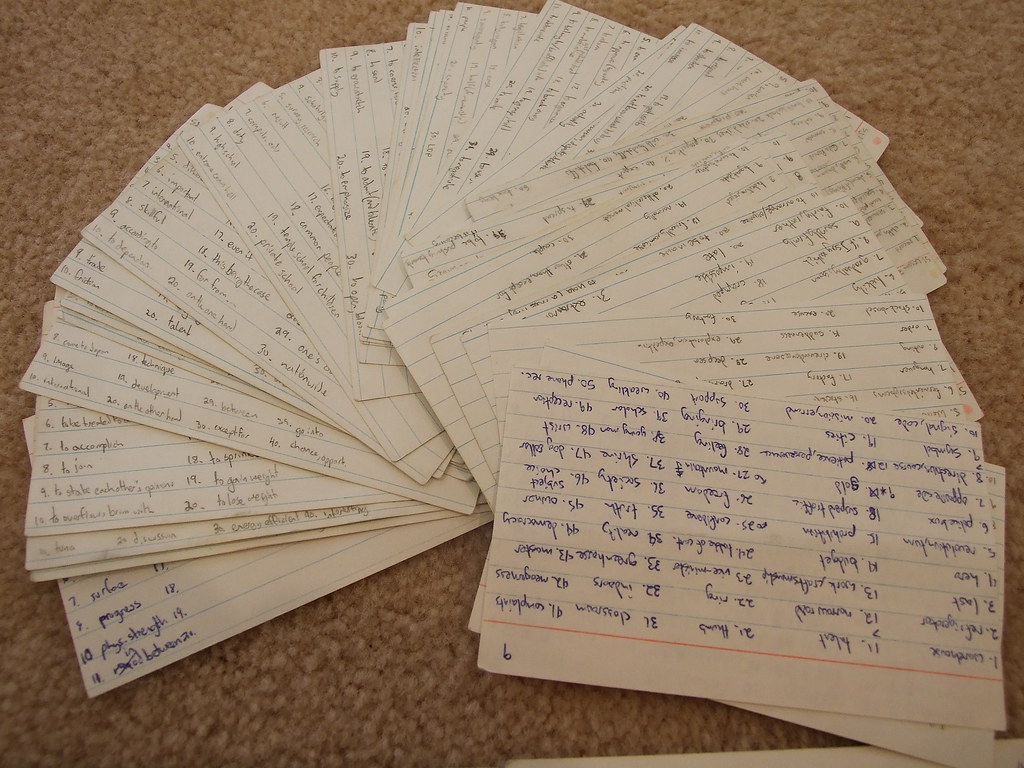
Photo credit: konrad.lawson on Flickr
Once upon a time I read Your First Novel 
by Ann Rittenberg and Laura Whitcomb. I felt a little silly buying it because at the time I’d already written four novels so it wasn't really going to help me write my first, but hey. Why not?

It was full of useful information for both pre-publishing and after publishing (although it was written before the explosion of e-books, so I suppose it’s a little out of date in that sense, but it’s still useful if you'd like to try to get an agent). The most useful technique I got from it however, has nothing to do with agents.

It’s a plotting technique. With flashcards.

So I don't remember the exact method the book uses (it’s been a while since I've read it), but I've found that the flashcard method is very useful, which is why I'm sharing it with you.

SO. How to begin? 

Step 1: Build MOUNT DOOM (with flashcards, of course).

Step 2: Get your handy-dandy writing pencil. Or pen. Or crayon or marker or Sharpie or lipstick tube, whatever suits your fancy, really.

Step 3: Plot! Plot like the wind! It doesn’t matter where you begin, just take a flashcard and write down a scene idea. It could be something short like, “Katie kicks a clown in the shin at her birthday party.” or something much more complex like, “Alfredo discovers his albino gerbil is really an alien that’s going to take over the world with his army of adorable fuzzy creatures and tries to tell his mother but all she does is give him a handful of prayer beads.” Ok, so that wasn’t that complex, but you get the idea.

Step 4: Keep writing flashcards. The book recommends you have at least twenty before you try to start writing your novel because chances are you don’t have a fully fleshed-out story if you can’t even come up with twenty scenes. I agree. Write as many flashcards as you can. The more the merrier.

Step 5: SPREAD ‘EM (the flashcards, I mean). If you have a hugenormous desk or table, spread your flashcards out there. Otherwise spread them out on the floor, it’s just as effective. They don’t even necessarily have to be in order, the idea is to just look and see what you have so far.

Step 6: Line them up! Ok, I know I just said order doesn’t matter, but that was Step 5. This is Step 6 and now order matters (don’t question my logic). Once you have them organized, take a look at your time line. Ask yourself what you could add. Are there any gaping holes in your plot? Do you have two or three slow scenes in a row? Is there enough leading up to the climax? For some reason, looking at it visually like this helps me see flaws in my plot faster than just writing up an outline.

Step 7: KEEP. WRITING. FLASHCARDS. I know you can add more in there. Try to shove in at least five more. You can always take them away again later.

Step 8: Numbers! Once you’re satisfied with the order of your scenes, go through and write a number at the bottom based on their order (the first card is 1, the second 2… so on and so forth).

Step 9: Throw them in the air and do the IT’S RAINING FLASHCARDS dance! Ok, not really. But shuffle them. And if you want to shuffle them by throwing them in the air and rolling around in flashcards, that’s totally cool, too.

Step 10: Re-organize! Take a look at your random order. Obviously some scenes will need to be in the beginning and some in the end, but can you keep any of the new arrangements? What would happen if you kept mixing your scenes up? Try experimenting as you put them back in order—flip some scenes around and play with them until you’re happy with your new order.

Step 11: Now go write.

So that’s it guys, the flashcard method unveiled. Give it a try! Maybe you’ll like it as much as I do. Or maybe you’ll have fun dancing in a papery rain. Either way it’s worth a shot.

I’ve shared my method, let’s hear yours! What techniques do you use to plot?
Related Posts Plugin for WordPress, Blogger...