On Dealing with Rejection

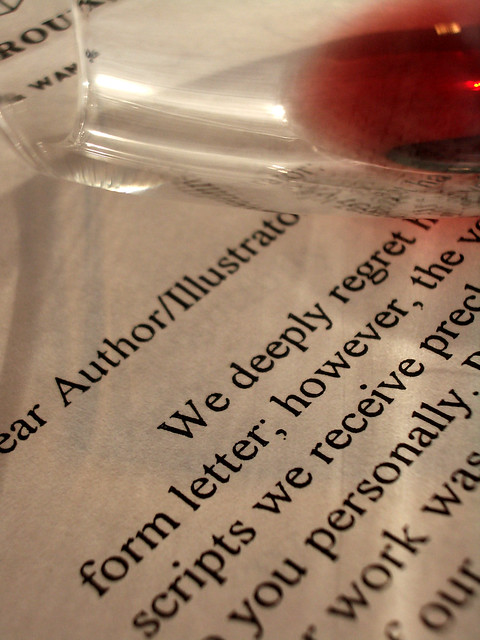
Photo credit: BookMaMa on Flickr
When I first set out to become a writer so many years ago, there were four words that I heard over and over again, four words that reappeared everywhere I turned: develop a thick skin.

At the beginning of my journey I had this hope, you see. This flutter inside me that secretly wished I wouldn't have to, that whispered maybe not me. I clung on to that hope, and when my very first query letter brought back a request for a partial, I was ecstatic. I thought maybe I would be an exception, maybe, just maybe, I would be the writer that didn't have to deal with rejection.

I didn't send out any more query letters. I waited.

My first rejection arrived in the mailbox many weeks later. It was a heavy thing, literally, because it was attached to the first fifty pages I had printed out and sent to New York, now returned to me in a large yellow envelope. It was a nice rejection, personalized with a little feedback on why the agent had passed, but it didn't hurt any less. To my inexperienced eyes, a rejection was a rejection and the hopeful whisper died.

Since then, over the course of many years and manuscripts, I've collected more rejection letters than I care to count. But I'm not here to whine about rejection, in fact, I am, in a way, grateful for them. Because while they were difficult lessons to learn, dealing with rejection has taught me a few things:

  • Not all rejections are created equal. There's a world of difference between a form rejection letter and a personalized one. Personalized rejections mean it was a near-miss, it means the agent (or editor) took the time to personally write you a rejection letter rather than doing the easy thing and sending a quick form rejection. True, they both mean "no," but the latter is a subtle way of saying you're almost there. Keep going. 

  • Rejections aren't the end. I know sometimes it doesn't feel like it, but life goes on after five, ten, fifty, a hundred rejections. Rejections don't mean that you're a terrible writer, or that you'll never be published, or any of those awful doubts that tend to creep in upon receiving bad news about your writing. Every writer has dealt with rejection of one form or another and the best thing you can do is keep going. Keep writing. 

  • For the writer, rejections are a part of life. Believe it or not, post-publication writers still receive rejections—they're called bad reviews, and even the legendary New York Times Bestselling authors receive them pretty regularly. As harsh as it sounds, the rejections that you receive while querying are teaching you an important lesson—they're teaching you how to develop a thick skin and continue working when the stones are being thrown. They're teaching you how to ignore the negativity and keep pushing forward. 

These are lessons that are essential if you want to be a successful writer, and for that, I'm grateful. No, it's not easy, and truth be told, those rejections start to get heavy after a while, even when they're not attached to fifty pages of the manuscript that you poured your heart into.

But despite all that, I honestly believe that in the end, we'll all be better for the experience.

Have you dealt with rejection? What did you do to help you get through it?

Self-Publishing: It’s Not a Backup Plan

Photo credit: luipermom on Flickr
I’ve noticed a trend on the web as of late, or at least, I’ve noticed it in the comments here at Writability, and it’s something I think is worth discussing. You see, oftentimes when talking about the very real possibility of not getting published (whether it’s a WIP or at all), invariably, people will say something to the effect of well, there’s always self-publishing and I die a little inside every time I see it.

Now don’t get me wrong, it’s not that I don’t think self-publishing is a valid option—quite the opposite, in fact. The problem is that a lot of writers view self-publishing as a backup plan should their attempts to traditionally publish fail, and truthfully, I don’t think that’s the right way to look at it.

Self-publishing isn’t meant to be a Plan B just as the e-book marketplace isn’t meant to be a last-ditch effort to sell failed manuscripts. Because it’s technically possible to go indie completely on your own, people sometimes take self-publishing lightly, but the decision to self-publish should never be based solely on the fact that you couldn’t sell your novel traditionally.

The hard truth is this: if you find that you can’t sell your manuscript through traditional means, there’s likely to be a reason for it. Now, sometimes it’s because you didn’t try long enough, or the market isn’t right for your manuscript, or you still haven’t developed strong query letter writing skills. Many times, however, it’s simply because you’re just not ready.

I know, no one wants to hear that. No one wants to be told that they aren’t ready for publication, because in the moment, you feel like you’re ready (otherwise you wouldn’t be trying to get published in the first place). No one wants to hear that they need more time to hone their writing skills, or that they’re going to have to spend even more time revising their already revised-to-death manuscript, but guys, sometimes that’s just the truth. It’s not pretty. It’s not fun. But if you can accept that you need more time to become a better writer or write a better manuscript before attempting to publish again, you may very well save yourself a major heartache.

Because the truth is, if your manuscript isn’t ready to be traditionally published, then it’s not ready to be self-published, either.

Deciding to go indie is a big decision. Self-publishing is a lot of hard work: it takes a monetary investment to do it right (editors and cover artists aren’t free), and the hardest work has only just begun when you finally do hit “upload.” It’s an enormous investment and when done correctly with a well-polished manuscript, you can certainly reap some significant rewards. Done incorrectly, however, and you’re only hurting yourself in the long run.

I know it’s not easy to wait, especially when the power to publish is literally just a few mouse clicks away. I know it’s not simple to say I’m not ready to be published yet, and I know it’s far from painless to put a manuscript that you truly loved and had dreams for in the drawer. I know that.

But I also know that dealing with the repercussions of self-publishing before you’re ready isn’t easy, either. And that’s a heartache that you can save yourself from if you give yourself more time to improve and reach the level you’ll need to be at to finally publish.

No, it’s not easy, but no one ever said this writing thing would be. But then again, you didn’t choose this path because it was a simple one, you chose it because you’re a writer, and that’s what you do.

What do you think? Have you ever considered self-publishing a backup plan?

When Writing, Cannibalize Everything

Photo credit: Jody Art on Flickr
It happened again! One of you fabulous readers (thank you, Robin) asked a question I haven’t yet answered that I thought most certainly merited a post (yay!). The question was this:
“I read your post about reading what you write, and coming to love your genre. So I was wondering, what if one incorporates other genres and mediums? One of my WIPs is a YA-fantasy adventure with a lot of fairytale elements, but I've taken what I learned reading horror (mostly of Poe) to create dread in my story, and I've paid attention to cinematic techniques seen in films by Studio Ghibli to create an endearing and living world. What is your perspective on cross-referencing genres and mediums?”
I’m sure most of you have heard that you should write what you know. While I partially agree with that (more on that topic some other time), I think it applies especially well when referencing incorporating what you have learned from creative mediums, whether writing, movies, music, etc. You see, I’ve written in the past about why it’s so important for writers to be well-read, and this question right here is one of the many reasons why.

While I tend to read a lot of YA and some MG novels, within those age groups I read from various genres: paranormal fantasy, straight fantasy, sci-fi, dystopian, etc. And from every book that I’ve read, regardless of the genre, I’ve learned something—whether it’s the importance of voice, or including poetry in prose, or what a good opening and memorable characters look like. And when I write and revise, I make a point to look back on those lessons and continue to learn new ones from whatever books I read throughout the course of the year.

One of the most important tasks a writer has is to absorb everything possible—what rain feels like in November when you’ve forgotten an umbrella, how that movie gave you the chills, why that book was so gripping that you stayed up until three in the morning on a work night to finish it, how that song makes you pause every time it comes up on your playlist. Nothing is sacred to the writer—not that terrible cut that required stitches, or your first kiss, or the first time you laid eyes on your newborn. Writers make note of and store their experiences for writing reference later on.

In short, writers cannibalize everything. Or at least, they should. And when it comes to genre, I don’t believe it’s any different.

Let’s think for a moment: when is the last time you read a book or watched a movie that was 150% one genre? Nearly every non-romance genre has some sort of romantic subplot (even The Lord of the Rings which is as straight fantasy as it gets has romance) and many non-mystery novels have some sort of mysterious intrigue and so on. Don’t believe me? Let’s take a look at a couple novels.

  • Across the Universe by Beth RevisAcross the Universe is undoubtedly a YA Sci-Fi novel, but it certainly cross-references other genres as well, the most obvious of which include a romantic subplot and murder mystery. That doesn’t make it a mystery or romance novel, but it still has elements of those genres. To further draw a point, it’s listen on Amazon under “Teens > Mysteries” and at Barnes & Noble.com under “Teens- Romance & Friendship” and “Teens- Science Fiction.” 

  • The Fault in Our Stars by John Green—I would have thought that The Fault in Our Stars would be listed under YA Contemporary, but I’ve found that it is often listed under romance. Regardless, it has elements of romance, realistic fiction, humor and even tragedy. That doesn’t mean you’re going to find it in the Humor section at Barnes & Noble (if you do, it’s been terribly misplaced), but you can’t deny that elements of those genres exist within the novel. It’s listed on Amazon under “Teens > Love & Romance” and at Barnes & Noble.com under “Teens: Realistic.” 

Just two examples of many, but the point is this: genre is rarely cut and dry and you certainly shouldn’t be afraid of drawing from absolutely everything you’ve learned along the way. Your writing will be better for it.

How do you pull from other genres, mediums and experiences in your work? What multi-genre novels can you think of as examples?

NaNoWriMo Winner? Hold On to that Novel!

Photo credit: theurchiness on Flickr
Now that the NaNoWriMo frenzy has ended, many writers around the world are happily sitting on sparkling new novels, still steaming from the presses. For many, December is an exciting time—after all, with a new manuscript under their belts, there are more than a couple dreamers out there with their eyes on the magical "p" word: published.

Unfortunately I'm going to have to rain on that parade a little bit—at least, for the time being.

It's no secret that many NaNoWriMo winners feel tempted to immediately publish (or try to publish) their freshly written novels—hell, with five free CreateSpace copies of their NaNo novels given to all winners, the temptation to hit "upload" or begin querying instantly is indisputably there. But it's a temptation that you absolutely must resist.

You see, there's this tricky little tidbit of information about writing that many writers, especially new writers, sometimes overlook: your first draft is never meant to be your final draft. Never. Never never never. Did you get that? Your first draft is NOT equal to your final draft.

Usually this is the time when I say there are very rare exceptions, but I'm going to go out on a limb and say that there are no exceptions for this rule—even the most beautifully written first drafts (i.e.: first drafts written in a span of much more than thirty days) need some form of editing. Sorry, guys.

I've said it before and I'll probably say it again in the future, but I'm glad that self-publishing wasn't a thing when I wrote my first novel. More than glad—relieved—because as the impressionable, young, dreamy-eyed new writer that I was, I'm not sure how well I would have resisted the temptation had it been a legitimate form of publishing at the time like it is now. Because as a new writer, I hadn't yet learned just how terrible first drafts tend to be, and I hadn't yet accepted that when writers talk about massive revisions, they often mean necessary massive revisions, and no, you are not an exception to the rule.

That being said, I'm not saying that your NaNoWriMo novel is terrible, or that it's never going to get published, or anything like that. Many NaNoWriMo novels have in fact been published and there's certainly nothing stopping you from joining the ranks. But these novels all have something in common—their respective authors spent a considerable amount of time and effort editing them. They didn't send out query letters to agents on December 1st, or upload them to Amazon moments after writing "The End."

If you're a NaNoWriMo winner or a writer who just recently completed a novel—congratulations! You just achieved something great and you should be proud of yourself. I hope you've celebrated appropriately and given yourself a nice, good pat on the back.

I also hope you've put your novel away and distracted yourself with something else.

Post novel-completion time is not the time to publish your work, nor is the time to immediately start editing. Now is the time to rest, develop some distance from your work so that you can actually effectively edit and be proud of your accomplishment. Now is the time to read some really great novels, and watch movies, and brainstorm your next work or write something new. But any thoughts you have of publishing your new novel? Yeah, put those away for many more months. You have plenty of work to do first, after you've developed the proper distance from your writing.

Then, when you're ready, you can dive into some edits and second and third and fourth drafts. Take your time and make your work as good as you possibly can—the publishing world will still be there when you're finally ready to give it a try.

Have you ever been tempted to publish or query too early? Did you give in to your temptation? Share your experience in the comments below!

How to Write When You Don’t Want To

Photo credit: Nenyaki on Flickr
As writers, we often like to fantasize that every day is a fabulous writing day—the kind of day where the moment we sit down, the words just come pouring out (and beautifully, I might add) until we’ve written a couple thousand words with minimal effort. We like to pretend that every time we sit down to write, we’re magically imbued with that can’t wait to write excitement, and as we open up that WIP, the dam of ideas breaks and floods us with perfect plot potential.

Unfortunately, that’s not really the case.

While writers do love to write (otherwise we wouldn’t want the title of “writer”), it’s not necessarily a requirement to love writing every day. The fact of the matter is, every writer has ups and downs—days that the writing comes easily and we can’t get enough, and days where we’d rather do just about anything else.

The ugly truth is this: some days, we just don’t feel like writing. And you know what? That’s ok. We’re permitted to have a couple off days here and there. It’s when the off days begin to accumulate, or they come at particularly inopportune times (i.e.: right before a deadline) that we have to take action.

The thing is, there isn’t a magical spell or special technique that can immediately money-back-guarantee make us want to write again, nor is there a button we can press that’ll instantaneously fulfill our daily writing quota—it’s up to us to get our butts back in gear and pound out a new chapter or scene or page despite not wanting to. It’s our responsibility as writers to write on the good days, the slightly more difficult days, and especially on the bad days.

So what can you do to jumpstart your writing when you’d rather be doing just about anything else?

  • Find inspiration. Inspiration doesn’t always just make itself known to us—sometimes we have to go after it with a pitchfork. Try reading a good book, or listening to music, or finding inspiring pictures online (Pinterest and tumblr are great for that). The key to this step however, is this: if you don’t find it, that’s not an excuse to skip writing. 

  • Remind yourself why you love your story. I read this guest post by Stephanie Perkins on Natalie Whipple’s blog a while back about creating a love list for each of your WIPs, and I think it’s a great idea. In short, you write a list of elements that you love about your story and add to it as you continue to work on your WIP. Looking back on or creating a list like that is a great way to spark that excitement again. 

  • Write anyway. Even if the above two steps don’t work for you, there comes a time when you have to sit down in that chair and write despite not wanting to. No, it probably won’t be the best thing you’ve ever written and no, it probably won’t be the most enjoyable writing sprint you’ve ever had, but that’s not the point—the point is that you get words on the page and continue to progress through the massive task of completing a novel. Don’t check Twitter or Facebook or tumblr (or whatever social media site you enjoy). Don’t watch TV or catch up on your Hulu queue (as tempting as it is). Just get your butt in that chair and write. 

You’ll be glad you did.

Now it’s your turn: What tips do you have for writing when you don’t want to?

Discussion: What Do You Love to Write About?

“Love. Fall in love and stay in love. Write only what you love, and love what you write. The key word is love. You have to get up in the morning and write something you love, something to live for.” –Ray Bradbury (via Brainyquote
Photo credit: Bethan on Flickr
Like most art, writing is fueled entirely by our passions. Our obsession with translating imaginary worlds, people and situations into words on the page—our want—no, need—to create something out of nothing. But while we writers all share a passion for creation with words, what exactly it is that we like to create—that is, what we like to write about—varies greatly from writer to writer. 

The important part isn’t what we write, per say—it’s that we write whatever it is that we love to write about. For some, that’s contemporary romances with quirky characters that have readers laughing and crying throughout the course of the novel; for others it’s action-packed with paranormal or magical elements that awe or terrify our readers. Sometimes it’s lighthearted stories about growth and development, and other times it’s much heavier themes about loss and death. There isn’t a right or wrong answer—there is only passion.

I can’t stress enough how important it is to write what you love. Forget genres or what’s currently trending on the marketplace or what’s been popular in the past—the best thing you can do for yourself and your future readers is to write something that you’re passionate about, because the first step to getting your readers to fall in love with your story is to love it yourself.

Identifying elements that you love to write about is a fantastic way to kick off brainstorming for new projects or to re-infuse current WIPs with that new WIP excitement you had when you first began writing. I dare you to create a list of elements you love to write about and not want to write about it.

As for me, I love to write about deeply conflicted characters. I love exploring (and exploiting) inner demons, and overcoming impossible odds, and fighting not just external forces, but internal battles as well. I love writing about relationships—both romantic and not—about the impossible, the improbable and the so-called non-existent. I love to write about characters who haunt me long after I’ve finished writing for the day, I love to test the boundaries of their strength, their will, their self-preservation and their love.

And in the end, after I’m sure they hate me for it, I love making them stronger from their experience.

That’s a sample of my love list—now I want to hear yours: what do you love to write about?

Character Development: Make Them Angry

Photo credit: joshjanssen on Flickr
You probably don't need me to tell you that a story without emotion isn't a story worth reading. Emotion is an integral part of who we are as humans—everything from sadness to excitement, happiness to fear, influences who we are and changes the way we experience our everyday lives.

Humans are emotional, and in order to ensure that our stories are interesting and our readers connect with our characters, our characters must be emotional as well. Emotions are a key part of character development, and I'd like to focus on one of my favorites to write: anger.

Anger is an interesting emotion—it fuels us with a particular type of energy that demands action, and it can affect characters in many different ways. For some, it clouds judgment and incites violence, for others it inspires an unquenchable motivation, and still for others it pushes them into deep, dark places. I like to make my characters angry for a couple reasons:

  • It's a particularly strong and passionate emotion. You can be a little sad (disappointment), slightly excited (anticipation), sort of afraid (nervous) and kind of happy (optimistic). It’s not often, however, that you feel slightly angry. Anger demands energy and passion in a way that many other emotions don't, and for that reason alone it can be a fantastic tool for character development and plot progression. 

  • It tests a character's self-control. Anger often makes us want to do things we normally wouldn't even consider doing. Whether or not our characters act on these impulses truly tests the bounds of their self-control and ability to think clearly under times of high stress. 

  • It often fuels action. This is closely tied to the last point, but depending on a character's level of self-control, anger can often fuel action—and usually not the kind of action that you look back on proudly, which makes for great plot. 

  • It reveals quite a bit about the affected character. One of the many reasons I believe strong emotions like anger are closely linked to character development is because how they react to the emotion and what causes the emotion speaks volumes about the character. What makes your characters angry? Is it something personal, like betrayal, or something more global, like injustice? Knowing what triggers these powerful emotions is absolutely essential to effective character development. 

Making your characters angry is a fantastic way to move the plot forward, push your characters into making mistakes, develop them, and (not the least of which) make for some interesting scenes. Once you've figured out how to set your characters off, make sure you build opportunities into your plot to infuriate them. Your plot will thank you.

How do you use character anger in your writing?
Related Posts Plugin for WordPress, Blogger...