Showing posts with label love your villain. Show all posts

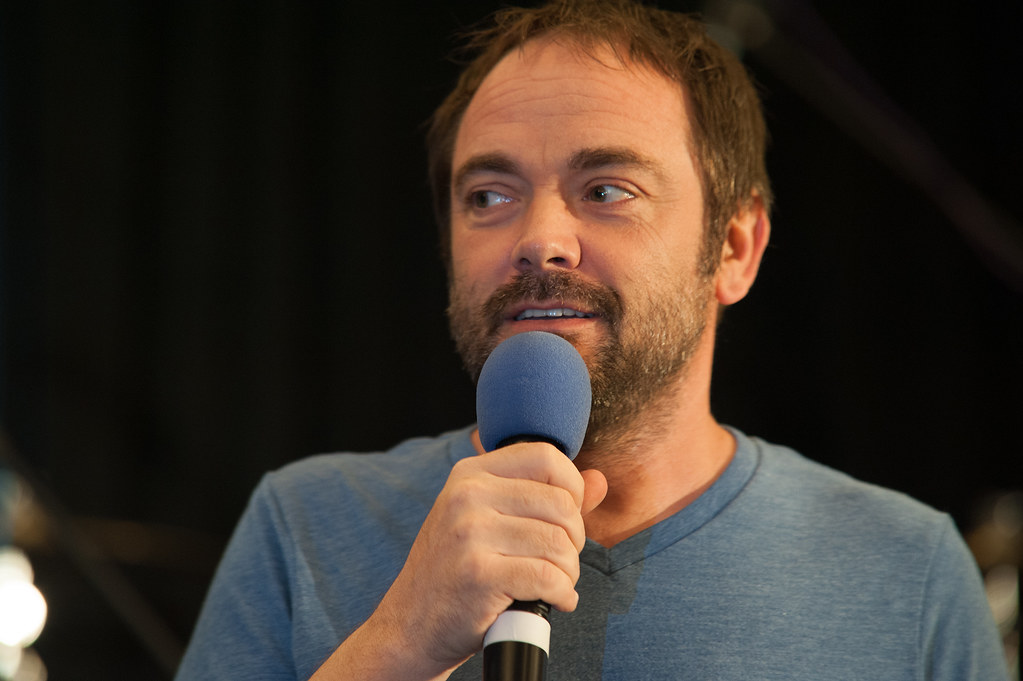
Let’s Talk About Crowley

Photo credit: drkold on Flickr
So it’s nearly Halloween, and as tends to happen every year I’ve come to realize I hadn’t really posted anything Halloween-y this month. But as Writability has had several Halloweens, I’ve already posted about writing fears (debunked), rounded up my excellent villains posts, and talked about scary books. Which has left me all month trying to answer to annual question of “what will I post about around Halloween?”

I was coming up empty until last night when, starting Season 10 of Supernatural, it occurred to me that what was become one of my favorite characters is most definitely a villain.

So let’s talk about Crowley.

For those of you who do not watch Supernatural (and if you don’t—why not?), here is a brief, mostly non-spoilery rundown: Crowley is introduced as a crossroads demon (a demon who makes deals with people, usually to give them something they really want in exchange for their soul ten years later), who gleefully maneuvers a homophobic man into kissing him (crossroads demons seal all of their deals with a kiss). From there, over the course of many seasons, he gradually moves up (or down?) the demon hierarchy until he becomes a very important person of evilness.

Crowley does some pretty despicable things throughout his time on the show, including kidnapping and torturing people—some of which are characters we like, double-crossing the protagonists several times over, and manipulating just about everyone all to serve his own interests. On paper, Crowley is not a character to gravitate towards.

But on the other hand, he also has some…shall we say endearing traits? For example, his nonchalant attitude, the way he nicknames Sam “Moose” and Dean “Squirrel” (I don’t know why, but I can’t hate it), his never-ending sarcasm and dry British humor, the way he’s always one step ahead (have I mentioned lately I love smart villains?) and let’s not forget that along the way, he does actually help the protagonists…who then go ahead and try to kill him anyway many times, because he’s a demon. And evil. So.

On top of that, Crowley also has one trait that really stuck out to me most: he never breaks his contracts. Does he create loopholes? Absolutely. But he keeps to his word down to the letter. I won’t go as far to say that he’s honorable, but there’s something to be said for a character that keeps to their word.

So basically, what I’m saying here is as evil of a character as Crowley is, he has depth. He’s not one-sided—something that really comes into play when spoilery things happen in Seasons 8 and 9 and, I’m assuming, 10. By now, at the beginning of Season 10, I can no longer deny that he’s grown on me as a character, and for reasons I won’t get into because spoilers, he’s even become sympathetic.

It will probably not surprise you to hear that I really enjoy writing (and reading, and watching) multi-dimensional, and when possible, sympathetic, villains. Because for me, at least, while I do occasionally enjoy villains who are indisputably one-sidedly evil, the ones that surprise me with other sides of their personalities and even force me to like them (because, curse them, sometimes they have moments that are so damn likable) are frequently the ones that stick with me long after they meet their demise.

Assuming they meet their demise at all, that is…

Do you enjoy multi-dimensional villains? Who are some of your favorites?

Twitter-sized bites:
How do you make villains likable? @Ava_Jae analyzes one of SPN's most popular villains, Crowley, to answer. (Click to tweet)  
Like layered villains? @Ava_Jae talks about her favorite SPN villain Crowley and explores what makes him likable. (Click to tweet)

Writing Excellent Villains Round-Up

Photo credit: Annoying Noises on Flickr
So Halloween is next week, and so is NaNoWriMo, which means now is the perfect time to talk about villains. Right? Right. 

But first, story time. 

Once upon a time, baby writer Ava thought that in order for villains to be truly villainous, they had to be super 666% evil with metaphorical twirling mustaches and maniacal laughing fits that they practiced in their (evil) mirrors. She was convinced that the best bad guys were just that—super dripping-with-evil bad. 

She was wrong. By a lot, really. 

As it turns out, I’ve found that some of the most interesting characters, whether antagonist or protagonists, aren’t completely good or completely evil—they’re gray characters. And so I wrote a post on writing gray characters

It’s also important, when developing and writing your characters, especially if you want them to feel “real,” is to figure out what they want and what their motivation is—something, I think, that’s especially important for protagonists and antagonists. It also helps to know what your characters are afraid of, because yes, even your villain has fears, too. (Or at least they should). 

Finally, I’ve learned along the way that if you don’t love your villain, chances are your readers won’t love him (or even remotely like him), either. 

Also, for fun, here are my top five favorite villains.

Now go forth and write excellent villains! 

What tips do you have for writing great villains? 

Twitter-sized bites:
In preparation for #NaNoWriMo & Halloween, @Ava_Jae shares helpful links for getting your villains right. (Click to tweet)  
Brainstorming your antagonist for an upcoming WIP? Writer @Ava_Jae shares helpful links on writing villains. (Click to tweet)

Vlog: How to Make Your Villains Awesome

Today's vlog is about sexy villains! Or Vampire Diaries. Or Klaus. Or something.

Happy viewing!


Twitter-sized bite:
Do you have trouble writing villains? Writer @Ava_Jae vlogs about how to make them memorable. (Click to tweet

How to Write a Great Antagonist

Photo credit: _Teb on Flickr
So while working on my last couple manuscripts, I’ve been thinking a lot about antagonists. Specifically, on antagonists that I really actually love.

I already wrote a post listing my top five favorite antagonists (spoiler: they include the fabulousness that is the Darkling, Warner, Khan, Moriarty and the Graceling baddie), but as a writer, I’ve known for a while that I wanted to write antagonists that I cared about just as much as I did the protagonist.

Happily, I’ve started to work toward exactly that, and I’ve been picking up a couple tips along the way:

  1. Get to know them (and love them) first. This, by far, has been the biggest help to me in writing antagonists I care about. By thinking of them as characters first, rather than the evil force that makes my protagonist’s life difficult, I’ve been able to connect with them better in the brainstorming stages, so that when they arrive on the page, I don’t see them strictly as the evil obstacle.

  2. Understand their motivation. The thing about the antagonist, is most times, they don’t think they’re doing the wrong thing (or if they recognize what they’re doing is wrong, they have a way to justify it to themselves).

    Very few people do evil for the sake of doing evil. The choices they make are based on beliefs, experiences and some kind of worldview that shapes their way of thinking and ultimately influences their decisions. By understanding why your antagonist does the things he (or she) does—and even better, why he thinks what he’s doing is the right choice—your antagonist will turn out to be a much more interesting and developed character, than they would have otherwise.

  3. Make them sympathetic (or at least understandable/relatable). This is related to the last point, but not entirely the same. Lately I’ve been thinking about what my antagonists’ lives are like off-screen (or off the page). Who do they care about? What do they like to do? What are they afraid of? What do they dream about? What secrets do they hold dear to them? Even if most of this information never comes up in your manuscript, knowing the bigger picture of your antagonists’ lives can give you plenty of opportunity to make them a little more relatable or human, so that the readers don’t view them as just the opposing force. 

  4. Make them formidable. There are few things more disappointing than an awesome bad guy who is easily defeated. You antagonist should be a major obstacle for your protagonist—the hero of your story should struggle to overcome him. In order for us to truly appreciate the protagonists victory, his journey there has to be a struggle, and the moment that your protagonist fights the antagonist should be a battle that won’t easily be forgotten. 

  5. Avoid the clichés. Basically, everything in that linked post is what you should avoid if you want your antagonist to be taken seriously. Evil monologues, twirling mustaches and maniacal laughter are best saved for the corny movies. 

So those are my tips for writing a great antagonist, now I want to hear from you: What tips do you have for writing awesome baddies? 

Twitter-sized bites:
Do you struggle when writing antagonists? Writer @Ava_Jae shares 5 tips that may help. (Click to tweet)  
"Very few people do evil for the sake of doing evil" and other antagonist-writing tips from writer @Ava_Jae. (Click to tweet)

My Top Five Favorite Villains

Photo credit: Med PhotoBlog on Flickr
So it’s October and I haven’t posted a single tidbit about Halloween or creepy things or even fears for crying out loud, so today I’m going to amend that. With villains. Specifically, my favorite ones. 

To quote one of my favorites listed below (bonus points if you know who), every fairy tale needs a good old fashioned villain. Villains make our protagonists fight for their happy ending, and truth be told, without them, there wouldn’t be much of a story. 

So without further ado, here are my top five favorite villains (in no particular order): 

  1. The Darkling. (The Grisha Trilogy by Leigh Bardugo) So the Darkling wins my favorite antagonist ever award. He’s got that I know I shouldn’t like you and yet I can’t help it type appeal, he’s powerful, intelligent and best of all, he’s sympathetic. You know he’s horrible and probably a little crazy and yet the thought of him dying is not a happy one. At least, not to me. 

  2. Graceling’s antagonist. (The Graceling Realm Trilogy by Kristin Cashore) Seeing how a large portion of Graceling is about figuring out who the antagonist is, I’m not going to spoil it and give this person’s name. But I will say this antagonist is twisted in a way that never stops being intriguing, and the more I got to know him, the more I wanted to know more. 

  3. Warner. (The Shatter Me Trilogy by Tahereh Mafi) Ahhhh, Warner. I have to admit, in Shatter Me, I wasn’t 100% sure why Warner had such an enormous fan base—I mean, yes, he was a great villain, but why all the swooning?

    Then I read Destroy Me. And Unravel Me. And now I am 100% in camp swoon over Warner.

    Again, what really drew me to him was the more I read about him, the more I began to understand him and the more he became a sympathetic antagonist. And I find that the more I understand about an antagonist, the harder it becomes to root for his demise, and to me, that’s a good thing. 

  4. Khan. (Star Trek: Into Darkness variety) I’m not going to pretend to be a Trekkie, because I’m not, but if there’s one thing that I love, it’s smart characters—particularly of the ridiculously smart variety. And this is no different for antagonists. So basically that whole Spock/Khan trying to outwit each other bit was my favorite thing ever. (Plus that scene on Kronos? Awesome).

    Back to smart antagonists: the reason I like them so much is because they’re genuinely difficult to beat. They don’t make stupid self-dooming mistakes, and they certainly don’t make it easy on the protagonist, which makes me that much more nervous for the protagonist and that much more desperate to find out how they finally defeat the antagonist.  

  5. Moriarty. (Sherlock variety) Basically everything I said about Khan applies to Moriarty. Except on top of being a genius, he’s crazy eccentric, definitely a tad bit creepy and is totally unpredictable. I’d probably love him for any one of those traits, but combined altogether? Yes, please. 

Who are your favorite villains from books, TV shows, movies, etc. and why? 

Twitter-sized bites: 
Who are your top five favorite villains from books, TV shows, movies, etc.? Join the discussion at @Ava_Jae's blog: (Click to tweet
Personalized tweet: [INSERT FAVORITE VILLAIN NAME] is my favorite villain—who is yours? Join the discussion at @Ava_Jae's blog: (Click to tweet)
 

Loving Your Villain

Photo credit: Martin Cathrae on Flickr
I’m going to do this thing where I give you guys a tip I’m going to start taking myself. As of right now.  

Not too long ago I wrote about getting to know your characters. Today I’m going to be a little more specific. Getting to know all of your characters is excruciatingly important, we know this. Knowing every intricate little detail about your protagonist and second lead pretty much goes without saying. We know we need to know everything about those guys because we spend the most time with them.

But the villain…he tends not to get as much love.

As you probably can guess by the first sentence, I am guilty of this in many of my WIPs. I usually start with good intentions—in two out of the last three WIPs I wrote I went in thinking ok, this time I’m going to make my antagonist sympathetic. It’s going to happen!

But then it doesn’t happen.

See, it turns out villains don’t magically become sympathetic (shocker, right?) They’re the villain—they don’t want your pity, they want your respect, your fear, those kind of delicious goodies. But sympathy? Villains scoff at sympathy.

They also tend to make you—the writer—forget that they were supposed to be multi-faceted at all. They want to be evil.

For me at least, the problem was that I didn’t love my villain enough. I loved my protagonist, I loved my second lead, I even loved some minor characters. But the antagonist? Well, yeah, he was cool too. But did I love him? Not really. I just needed him. You know, for conflict.

So now as I’m brainstorming again, I came to a stunning revelation. I already knew that I needed to give my antagonists more attention before I starting writing—that much was obvious. But I came to realize that not only do I need to love my villain, I need to love him more than my protagonist.

Now before you burn me at the stake for heresy, hear me out.

You’re predisposed to love your protagonist—if you don’t, you have a bigger problem on your hands you should probably fix, but nine out of ten times loving your protagonist isn’t an issue. It’s also pretty easy to love your second lead, especially if said lead will be involved in a romance with your protagonist (which, let’s face it, happens a lot.)   

But your antagonist. Falling in love with your villain takes a little extra work. You see, you’re predisposed not to love your villain. After all, your protagonist hates him and in the end (in most situations) your villain will fail. Why would give a character that’s going to fail (or possibly even die) in the end extra affection? Especially after all the crap he’s putting our MC through!

The answer is simple: if you don’t love your villain, your writing will show it. Your antagonist will have one side: EVIL, and fall under the category of stereotypical bad guy. Why? Because you didn’t spend enough time getting to know his other side.

Take a look at your villain. Do you know his family? Does he have siblings? What are his dreams? What does his mother think of him? What is his guilty pleasure?

Spend some time with your antagonist. Let him tell you all about himself, get to know him and don’t stop until you absolutely love him.

Because once you love your antagonist, something funny happens—you want your readers to love him too. And you’ll make sure they do.

Bet you guessed this question: who are your favorite villains? I’m going to remember to answer this time—I love many killers from Ted Dekker’s thrillers (like Boneman’s Daughters, Adam, The Bride Collector and The Priest’s Graveyard). All have really excellent villains.

Related Posts Plugin for WordPress, Blogger...