Showing posts with label fast-drafting. Show all posts

Vlog: 4 Fast Drafting Tips

Want to try fast drafting but not sure where to start? Today I'm sharing my top four fast-drafting tips.


RELATED LINKS:


Have you ever tried fast-drafting? 

Twitter-sized bite:
Want to try fast drafting but not sure where to start? @Ava_Jae vlogs about her top 4 fast drafting tips. (Click to tweet)

Writing is Never a Waste

Photo credit: Image Catalog on Flickr
So while I’ve not (yet) seen it this year, whenever NaNoWriMo comes around, there tends to come a group of people who go on about how NaNoWriMo (and fast-drafting, in general) is a waste. They argue that anything written that quickly must be junk, that few people come out with anything decent out of NaNo, and that “word vomit” isn’t really writing.

Literary elitism aside, I feel like now is a good time to talk about something very near and dear to my heart, namely: writing is never a waste.

I’ve talked before about practice novels and immediately trunking manuscripts, so I won’t reiterate those posts. But as someone who has indeed put away a lot of manuscripts without attempting to edit them, who writes posts three times a week and still has to write essays for school, someone who does a lot of writing year-round even when I’m not working on a book—I can firmly say every bit of writing you do, whether’s it’s fanfiction, non-fiction, NaNoing, or something else, absolutely works toward making you a better writer.

There are so many novel-writing lessons you can really only learn by writing a novel, and another one, and another one. Every fanfic, blog post, essay, or article you write helps you further hone your voice and practice how to manipulate words, and sentences, and paragraphs to get your point across the way you want to.

The truth is, the only way to really learn how to write is to write. And if NaNoWriMo is the device that gets you to sit down and put words to paper, then don’t let anyone tell you it’s a waste—even if you never look at that NaNo book ever again after November 30th.

Writing, in all of its forms, methods, and strategies, can only help you hone your craft. And maybe when you NaNo or fast-draft, the words you put down aren’t as polished you’d like to see in a final draft, but the thing is, they’re not supposed to be. In writing, no matter how quickly or slowly you write, nothing is perfect the first time.

But even if you don’t go back to make those words better in the future, know that you haven’t wasted your time. That practice you got while throwing those words down is invaluable and can only help you in the future.

What do you think? Is writing ever a waste?

Twitter-sized bite:
Why @Ava_Jae says writing is never a waste of time regardless of type of writing or what happens to the MS. (Click to tweet)

Vlog: To NaNo or Not to NaNo?

NaNoWriMo is upon us! And some of you may still be undecided about whether or not to participate—which is okay! If that's you, here are some things you may want to consider before deciding.

To NaNo, or not to NaNo? That is the question.


RELATED LINKS: 


Have you NaNoed before? What was your experience like?

Twitter-sized bites:
Not sure whether or not you want to NaNo? @Ava_Jae vlogs about some things you may want to consider. (Click to tweet
Undecided about whether to NaNo? @Ava_Jae vlogs about her experience & some determining factors. #NaNoWriMo (Click to tweet)

Ten Keys to Fast Drafting

Photo credit: stevendepolo on Flickr
So we have approximately 22 days until NaNoWriMo! Which means, of course, that a lot of people are thinking about fast drafting because fast drafting is how you NaNo. So.

As I’ve mentioned here before, I’m a permanent fast-drafter. Regardless of the month or day of the year, when I work on a first draft, I blast through it as quickly as possible. It usually takes me roughly three to six weeks (then again, I tend to write lean first drafts), but I’ve been known to finish more quickly or slowly. Depends on the manuscript, but either way I have quite a bit of experience with first drafting. And so I’m sharing my personal fast-drafting rules.

Like any writing “rule” these of course are subject to change and can certainly be broken, skipped or ignored outright if they don’t work for you. The only real wrong way to fast draft is to, um, not fast draft.

So all of that said, here we go:

  1. Have a plan. While this doesn’t work for everyone, many fast-drafters swear by outlining if only because it cuts out the time spent wondering where the manuscript is going or accidentally writing yourself into a corner. Personally, knowing where I’m going next has helped me tremendously in terms of writing quickly because when I always know where the story is going it helps me to keep forward momentum. That being said…

  2. Be flexible. Sometimes my characters will completely ignore what I had planned for a scene and do something totally different. 10/10 times what I come up with while I’m writing is better than what I originally planned. Some of my biggest twists and greatest moments of characterization have come out of these spontaneous, unexpected detours, so in short, if you find your characters start taking you off the beaten path, don’t fight them. Your subconscious—and your characters—know what they’re doing.

  3. Write in spurts. My #1 not-so-secret secret to writing thousands of words in a day? It’s writing in thirty minute spurts. Again, this doesn’t necessarily work for everyone, but when I set a timer for thirty minutes and watch my word count go with either Write or Die, my Scrivener doc or—something I haven’t tried yet but can’t wait to experiment with soon: mywriteclub’s online word sprints—it really pushes me to get the words down quickly without thinking too hard about the quality of said words. Which is key because…

  4. Don’t worry if it sucks. Writing quickly doesn’t automatically equate to sucky writing, but it might. And seriously, that’s beyond okay. First drafts are allowed to suck. I usually think my first drafts are junk while I’m writing, and sometimes when I re-read parts I agree, but many times I realize it’s not quite as bad as I thought. So just get the words down and don’t worry about whether or not it’s any good until later. 

  5. Don’t look back. Part of not worrying about whether or not what you wrote is any good is making a pact not to go back and edit anything until after you’ve finished writing. I generally find it’s best not to re-read more than a couple paragraphs (to remember where I left off), and even then I often just do a brief skim, if that, before I dive in again. The temptation to edit, otherwise, is too strong. 

  6. Don’t censor. Even when I know it’s not true, I like to write my first drafts pretending that I am the only person who will ever read it ever. This means I don’t censor anything—language, sentences I think are stupid, dialogue that is definitely dumb, questionably acceptable content, etc. First drafts should be free and loose and fun—you can always cut whatever you think is necessary later on. 

  7. Leave blanks (if needed). That time that I finished NaNoWriMo stupidly quickly I used this method. I’ll be using it again, because sometimes the last thing you want is to stop in the heat of a scene to figure out what that rando’s name is going to be and totally mess up your momentum. 

  8. Have a daily/weekly goal. Keeping on task is pretty important when you’re fast drafting, and especially when you’re NaNoing. I like to build a buffer into my daily goal which then gives me room to take a break when I need to, or else I just write more than I need to early on when I tend to have the most enthusiasm and momentum. But at any rate, when you figure out good daily or weekly goal for yourself, do whatever you can to keep yourself on track. 

  9. Interact with other writers. Last time I did NaNoWriMo, interacting with other writers is a big part of the reason I blew my goal out of the water and finished really early. Events like NaNoWriMo are fantastic because there are so many excited, enthusiastic writers who are all embarking on the same goal, which means there are plenty of people to word sprint with and cheer each other on. And that alone, honestly, can be incredibly awesome for motivation.

    But even if you’re fast-drafting when it’s not NaNo season, talking to other writers online and finding people who are also writing can be really encouraging. 

  10. Celebrate milestones. What milestones you celebrate are up to you, but make sure you celebrate! 10,000 words is my first big milestone because that’s when I call a writing experiment an official WIP (anything I abandon before that I don’t consider an actual WIP). But with NaNo, every 10,000 words, or the 25,000 milestone, or whatever you decide is a milestone worth celebrating is one you should be proud of. Because celebrating the little steps along the way can give you the boost of happy energy you need to get to the next one. 

Have you ever fast-drafted? Will you be NaNoing this year? What tips do you have?

Twitter-sized bites:
Considering fast-drafting? @Ava_Jae shares ten tips for getting through a first draft quickly. (Click to tweet)  
Gearing up for NaNoWriMo? @Ava_Jae shares ten keys to fast drafting. (Click to tweet

Vlog: How to Survive NaNoWriMo Week 2

It's week TWO of NaNoWriMo! And I've got some tips to help you get one week closer to your NaNo goal of awesomeness. :)


RELATED VLOGS: 

Are you participating in NaNoWriMo this year? 

Twitter-sized bite: 
It's NaNoWriMo week 2 & @Ava_Jae has some tips to help you get one week closer to your goal! (Click to tweet)

Vlog: Top 5 NaNoWriMo Tips

NaNoWriMo starts THIS WEEKEND. And so in today's vlog I'm sharing my top five NaNoing (or general fast-drafting) tips.

Twitter-sized bite: 
Getting ready for #NaNoWriMo? @Ava_Jae shares 5 tips to help you reach your NaNo goal. (Click to tweet)

Helpful Camp NaNo Links

Photo credit: hoosadork on Flickr
It’s July 2nd! Which means NaNoWriMo has started! Or at least, Camp NaNoWriMo has.

Since I am indeed participating in Camp NaNo this year (for the first time ever—eep!) I thought it’d be a great time to share my fast-drafting and NaNo posts all in one convenient area for your browsing pleasure.

So here we go!

Before you start (it’s totally not to late to jump in, by the way!):

During NaNo:

Good luck to all participants and happy writing! 

Twitter-sized bite: 
Are you participating in #CampNaNoWriMo? Writer @Ava_Jae shares some helpful links with NaNoing tips for you. (Click to tweet

Speed & Quality: Not Mutually Exclusive

Photo credit: Steve Rhodes on Flickr
When writing about fast-drafting, I’ve often said it’s ok to write badly. I’ve said first drafts are ugly about 95% of the time, and it’s totally fine to write something that you tear apart later, and it’s normal (and completely acceptable) if your first draft sucks.

All of that is true.

But the bit I didn’t cover is just because you finish a draft quickly—even insanely quickly—doesn’t mean it’s going to suck. Just because you speed through a first draft like it’s your job doesn’t mean that what you’ve written is guaranteed to be total word vomit.

I say this, because I’ve heard of writers online getting crucified for finishing 50k in a couple days. I’ve seen some truly amazing people write 100,000 words or more in a week, and then feel discouraged because other writers accuse them of cheating or say that what they write must be total garbage and other rather unpleasant (and untrue) accusations.

Look, the thing about fast-drafting, or first drafting in general, is that your first draft is likely to be ugly. It’s likely that you’ll read it back and cringe in certain spots and it’s likely that when you read it back, you’ll destroy it with a red pen.

But are first drafts guaranteed to be horrible? Not at all. Even first drafts written a couple days can be relatively clean (relatively, because all drafts need work).

The truth is this: every writer is different. Some writers slam out a pretty cleanish draft in a few days and the rest of us envy their ability, but the thing is, it’s not impossible, and it’s not cheating.

Some writers take years to write a first draft, and the draft comes out ok. Or it comes out terrible. Or it comes out wonderful. All of these writers are equally awesome.

Some writers take a couple months to write a first draft, and the draft comes out average. Or it comes out horrible. Or it comes out clean. All of these writers are equally awesome.

Some writers take a few days to write a first draft, and the draft comes out meh. Or it comes out ugly. Or it comes out sparkling. All of these writers are equally awesome.

No two writers work the same way—hell, many writers don’t even work the same way with different manuscripts.

Fun fact: the fastest I’ve ever written a full first draft was in roughly three weeks (though this may change with this NaNo WIP, but I digress). When I read it back a month later, I’d expected it to be pretty rough—after all, I’d never finished a full manuscript in three weeks before (my previous record had been somewhere around a month), so it made sense that this WIP would be a little uglier than usual.

Except it wasn’t. To this day, that draft is the cleanest first draft I’ve ever written.

This NaNo draft, meanwhile? I’ll be the first to admit it’s going to get torn apart in edits and revisions. And that’s ok. Every MS is different.

My point is this: just because something is written quickly doesn’t mean it’s not written well. That’s not to say it’ll be perfect—nothing is perfect in the first draft stage—but writing quickly doesn’t automatically mean writing badly.

Speed and quality are not mutually exclusive. Every writer is different and it doesn’t matter whether it takes you two days or two years to finish a first draft, or if you need three rounds of revision to make it shine, or twenty before it’s presentable. Your process is yours and yours alone.

Own it. Keep writing. Ignore the haters. And know that you, writer, are amazing.

What is your first draft process like? 

Twitter-sized bites: 
"Just because something is written quickly doesn't mean it's not written well." (Click to tweet)  
Are all first drafts guaranteed to be horrible? Here's why one writer doesn't think so. (Click to tweet)  

How I Won NaNoWriMo in 9 Days

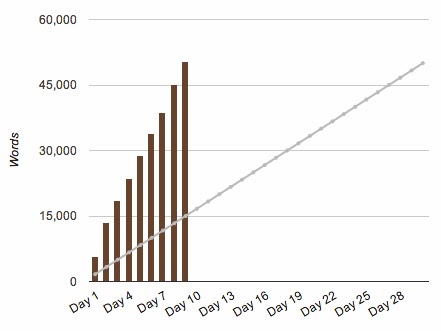
So this is my NaNoWriMo word count progress chart:


Or at least, that’s what it was on Saturday after I hit 50k.

So statistics! We like statistics. Here’s how my nine day breakdown went:
Day 1: 5,731 words written, 5,731 total.
Day 2: 7,724 words written, 13,455 total.
Day 3: 5,150 words written, 18,605 total.
Day 4: 5,145 words written, 23,620 total.
Day 5: 5,130 words written, 28,750 total.
Day 6: 5,056 words written, 33,806 total.
Day 7: 5,002 words written, 38,808 total.
Day 8: 6,251 words written, 45,059 total.
Day 9: 5,237 words written, 50,296 total. 
Daily average: 5,588 words.
Now, I wasn’t originally planning on writing 5k a day. My goal on November first when I started NaNoing was 2k a day, which is my normal writing goal when I first draft in any other month. I know from experience that I can maintain 2k a day pretty consistently, and it would bring me to 60k at the end of the month, which was fine by me.

But on day one I blew way past 2k and hit 5k with relative ease. I was hyped on NaNo and excitement and everyone was sprinting and I thought, why the hell not? and I kept writing way past my goal.

Day two I still said my goal was 2k. Then I started writing and got really excited again and Emmy Neal challenged me to be ambitious after I was tired and I thought, fine fine I’ll do it and I wrote until my brain collapsed at close to 8k.

Day three I hit 5k again and it occurred to me that I could probably keep doing this 5k a day thing and finish even faster than I thought. And my NaNo graph was telling me that at this pace I’d finish on November 9th or 10th and the competitive part of me didn’t want to see my daily average output drop so…I didn’t let it drop.

By day five I was no longer in denial. I knew my new goal was 5k a day, and more than that, I wanted to finish the entire book before the end of the month—or even better, before Thanksgiving because Black Friday is Get Assassin’s Creed 4 day and all bets are off after that. So.

That’s my current goal, and with 50k in the pot, I’m more than halfway there.

Being that this is the fastest I’ve ever sped through 50,000 words, there are a couple things I did (and didn’t do) to move the process along:

  • I turned my MS into mad libs. Well, not really—I just used a lot of placeholders. I’ve never used them before, but I’ve had some of you wonderful readers recommend them to me, and boy am I glad because they saved me a lot of getting stuck in mid-sentence upon realizing I don’t know a minor character’s name. Or the name of a town. Or an object. Or just about any world building or character-oriented detail that I’ve yet to work out. Instead of pausing to figure it out, I inserted a big fat (NAME) or (TOWN) or whatever other placeholder fit the particular situation. I have a lot of blanks. A lot. But it’s ok, because those are the sort of details I can work out in future drafts. 

  • I committed writing sins. I told instead of showed. And used filter phrases like nobody’s business. And summarized in places that would probably be better served without summary. And named emotions. And probably broke plenty of other writing rules I’m not thinking of at the moment. And as I continue writing the 30-some-odd-k left of this WIP, I’ll continue to do so.

    Why? Because this is a first draft, and the point of the first draft isn’t to get it perfect, it’s to get it done. 

  • I deviated from my outline. I tend to look at my outline as more of a guide than a strict rulebook. So far at least, everything’s gone mostly as planned, but characters have thrown major curveballs my way and scenes have turned out entirely different than the way I imagined them, which is totally a-ok with me. They usually turn out better than I expected, anyway. 

  • I made notes as I went along. Lots of them. Mostly to correct things, sometimes to remind me to fix something while I revise in the future, sometimes to brainstorm future potential possibilities. Most of these notes won’t really be looked at until I start my second draft in the future, but they’ll serve as good reminders for elements that need adjusting or expanding later on. 

  • I wrote in spurts. This doesn’t work for everyone, of course, but I’ve found that I write best in thirty-minute spurts. With Write or Die, I can usually pound out 1,000 words in that timeframe (and oftentimes if I hit the end of the timer and haven’t reached 1k, I’ll keep going until I do). Then I’ll take a break and browse Twitter, or eat, or stretch, and come back for another round. Rinse and repeat. 

  • If I still had the energy, I wrote beyond my goal. It helps to be ahead for those days in the future when the writing isn’t being so nice. Or you’ve had a long day and you’re tired. Or you can’t find the time. Or you just really want a day off.

    If you have the time and the energy to keep going beyond your goal, go for it. You’ll be glad you did later. 

  • I slacked off on my reading. At the end of the day, after writing 5,000 words and staring at the screen for hours, I didn’t often feel like looking at more words. I’ve already met my reading challenge of the year, and once I finish writing I’ll be right back to my normal pace, but my reading output definitely slowed down, because I often needed a break from letter combinations.

And that is, in a nutshell, how I managed it. Now to get back to writing.

Note: If you want to read a really impressive story, check out Taryn Albright who hit 50k in three days. Yeah. You read that correctly. I bow to her wordage mastery.

Are you doing NaNo? How are you progressing? And if not, are you writing/editing/otherwise? 

Twitter-sized bites:
One writer shares her process for completing #NaNoWriMo in 9 days with tips for fast-drafting. (Click to tweet
Why committing writing sins and deviating from your outline are a-ok while fast-drafting. (Click to tweet)

Helpful NaNoWriMo Links

Photo credit: mpclemens on Flickr
It’s the first day of NaNoWriMo! Which means, if you’re participating, and you’re here reading this post, you’re probably procrastinating. Or taking a break. Or procrastinating.

So short post today, because you should be writing. And so should I.

But that’s ok! Because in honor of thousands of writers around the world jumping in full steam ahead and making words happen today, I’ve decided to share some links with helpful NaNoWriMo tips, both from the archives here at Writability and from across the interwebs.

So here we go!

For those still not sure whether or not to participate (it’s not too late!)

For those in the WriMo trenches:

Good luck, my fellow NaNoers! Remember that Write or Die is your friend, the writing community is here to cheer you on, and above all—keep writing! 

Twitter-sized bites: 
In honor of #NaNoWriMo, here are some tips compiled from the interwebs and Writability. (Click to tweet)  
Are you participating in #NaNoWriMo? Here are some motivational links and tips compiled just for you. (Click to tweet

How to Fast Draft

Photo credit: Chapendra on Flickr
On average, it takes me about three to six weeks to complete a first draft.

To be fair, with two notable exceptions, most of my first drafts are on the slim side, from about 40 to 65k (though I usually aim for more than that in later drafts). But as far as first drafting goes, I am, what many would consider, a fast drafter.

So why do I tell you this? Because NaNoWriMo is nearly here. And reaching 50k at the end of the month, my friends, requires fast drafting.

So for those of you who are new to the mystical ways of writing faster than the Energizer bunny on speed, here are five quick tips to help you get through your first draft quickly.

  1. Plot first. If you’re a committed pantser, then more power to you. It’s not impossible to fast draft without some sort of outline, but if you’re open to plotting before you begin, I highly recommend it. Why? Because put simply, it’s a hell of a lot easier to write quickly when you know where you’re going. 

  2. Don’t look back. No really. Don’t. The key to fast drafting is to turn off your editing brain and write. If you want to make 50k by the end of the month, you don’t have time to fix that terrible first chapter or rewrite that cringe-worthy scene. Right now, you don’t need to worry about writing well—you just need to write. That’s it.

    It’s ok to write badly. I promise. Worry about making the words pretty while you’re revising. For now, just get the bones down. 

  3. Write or Die. If you’ve read my blog before, you know about my love affair with Write or Die. I won’t rave about it yet again here—all I’ll say is if you’re even the tiniest bit prone to getting distracted and/or staring blankly at the screen, unsure of what to write, then I dare you to try Write or Die just once. 

  4. Word wars. If you’re on Twitter, chances are you’re going to find more than a couple writers who are participating in NaNoWriMo, or are otherwise writing. We writers love to tell Twitter when we’re actually being productive, and I’ve found that a great motivator to write quickly and stay focused is to have word sprints or word wars with other writers. Check out hashtags like #wordmongering, #amwriting and #NaNoWriMo to find other writers who are getting some words down. 

  5. Daily writing goals: stick with them. And this is the holy grail of fast drafting rules: make a daily writing goal and do everything you can to meet it. For NaNoWriMo, your daily writing goal will likely be 1,667 words (assuming you plan to write every day). If you have Scrivener, you can set a goal and time frame and every day it’ll recalculate the words you need to write to complete your goal (which is pretty shnazzy if I do say so myself). If you don’t have Scrivener and you miss a day, don’t fret—just recalculate your daily writing goal and keep writing. 

So those are my fast-drafting tips, now I want to hear from you: what tips do you have for NaNoWriMo (or fast-drafting in general)?

Twitter-sized bites: 
Getting reading for #NaNoWriMo? Here are five quick tips for your future fast-drafting needs. (Click to tweet)  
Gearing up for #NaNoWriMo? Fast-drafter @Ava_Jae shares five tips for reaching the elusive 50k in 30 days. (Click to tweet)

Pre-NaNoWriMo Tips

Photo credit: mpclemens on Flickr
It’s October! Or, almost anyway, as it’ll be October tomorrow. Or if you’re reading this a day beyond posting, then it is October. But I digress.

What’s so special about October, you ask? Well, of course, it’s the month before NaNoWriMo (National Novel Writing Month, A.K.A.: Lock Self Into Writing Cave And Write Like Hell Month), also known as NaNoPrepMo, at least in my head.

As most of you know, NaNoWriMo starts on the first of November and lasts until the end of the month, in which many writers (hopefully) emerge exhausted and pale with 50,000 shiny new words written (or tan and full of energy with 50,000 new words, in which case the rest of us are jealous).

I may very well write a post later about why you should consider participating, but today I want to talk about how to best prepare for the big event.

  • Decide on an idea. This kind of goes without saying, but the sooner you think of your NaNo novel idea, the more time you’ll have to let it develop before the mad dash of November. And you’ll be writing so quickly come November, that you’ll be glad for every iota of pre-decided information you have. 

  • Start plotting. If you’re a pantser, then you’re probably going to skip this step. But if you’re even slightly open to plotting (even a very flexible, loose plot), then I highly recommend that you try plotting in advance. As a regular fast-drafter, I can tell you that the best tip I’ve ever received on fast-drafting is to know what you’re writing. Just about every time I’ve ever encountered writer’s block, it was because I didn’t know what was next, or how to connect the dots between two plot points (in which case I plotted in more detail and voila! The words returned).

    Point is, when you’re writing like a speed demon for NaNoWriMo, it’ll be much easier to keep the pace if you actually know what happens (or at least have a vague idea). Whether it’s flashcard plotting, a brief list of events or a twenty-page outline, NaNoWriMo will be so much smoother if you get your events in order before the race begins. 

  • Tell family/friends about your November plans. We writers tend to withdraw in November. We sneak away to our caves and shoot daggers (with our eyes, of course) at anyone who dares interrupt our precious writing time. Letting your friends and family know in advance about why you’re going to disappear for thirty days can help save you some aggravation and disappointed people. 

  • Connect with fellow NaNo writers. Do you have a Twitter? If you don’t, I recommend getting one and searching hashtags like #NaNoWriMo to find fellow NaNo writers. It’s early, but people are already thinking about it (like me), and you’ll be glad for the support of your fellow exhausted/excited/slightly crazed writers come November. 

  • Familiarize yourself with the website.  I’m not sure when exactly, but the website occasionally goes down before the big event to prepare the servers and give the site a fresh upgrade. That’s normal, so don’t panic when it happens.

    But until then, it doesn’t hurt to set up your account and browse through the site, just to get to know it if you don’t already.

    UPDATE: The blackout has happened and the shiny new website is up! Have fun exploring. :) 

  • Investigate distraction-free writing tools. Like Write or Die. Or Freedom. Or Write or Die. (Have I mentioned how much I love Write or Die?) They come in handy when you're trying to write quickly.

  • Mentally prepare yourself. In order to reach the goal of 50,000 words and claim your NaNoWriMo victory, you’ll need to write 1,667 words a day, assuming you write every day of the month. 1,667 words isn’t all that bad, and some days you’ll fly through them and roll right into 2 or 3k. But there are days when you’re going to be exhausted, when time is really short, when every word is fighting you, and those are the days you need to be prepared for.

    It’s ok to miss a day. It’s also ok to get stuck and write terribly and cry over your keyboard.

    Here’s what you’re not going to end up with at the end of the month: a masterpiece. You’re writing the first portion of a book (50k isn’t usually a full-length MS, although it can be depending on the category/genre) in a month. It’s going to be messy and occasionally ugly and embarrassing. And that’s totally ok.

    The point isn’t to come out of NaNoWriMo with a gleaming, beautiful draft. The point is to get the first portion of a draft finished, so that you can complete your book and then revise it later.

    You’re writing the bare bones. They aren’t going to be pretty, but they don’t need to be. 

  • Get excited. You’re going to write a book. Or a portion of one, anyway. You. A book. Yours. It’s something to be excited about, it’s something to celebrate, even if the writing is so horrendous that you cringe when you read it back. NaNoWriMo is exhausting, yes, but it’s also exciting because you’re doing something that millions of people only ever dream about—you’re writing a book, and it’s all yours.

For those who have (or are going to) participate in NaNoWriMo, what do you do to prepare? 

Twitter-sized bites: 
Considering #NaNoWriMo this year? Here are some steps you may want to take before November. (Click to tweet)  
Gearing up for this year's #NaNoWriMo? Writer @Ava_Jae shares some tips to help you prepare for the big event. (Click to tweet
Related Posts Plugin for WordPress, Blogger...