Showing posts with label The Fire in Fiction. Show all posts

Vlog: What if Your Writing Sucks?

This vlog isn't as mean as it sounds, I promise. 

Writing is hard, and dealing with self-doubt about our writing is even harder. It's not at all uncommon for writers to think their work isn't really that great—so what do you do then?


RELATED LINKS: 


How do you handle self-doubt about your writing?

Twitter-sized bites: 
"Once you see the flaws in your writing...you can start to work toward making it better." #vlog (Click to tweet
"You aren't any better or worse than anyone else for taking longer or shorter to get your skills publication ready." (Click to tweet
Worried that your writing isn't any good? @Ava_Jae vlogs about why that conclusion is actually a good thing. (Click to tweet)

Why You Need to Stop Rewriting

 “Every time my computer has ever crashed in the middle of writing an unsaved scene, and I had to rewrite it all from word one, it’s turned out better. There’s a lesson in that, and I think it’s this: I don’t need a muse; I need a less dependable computer.” –James V. Smith, Jr. from The Writer’s Little Helper.
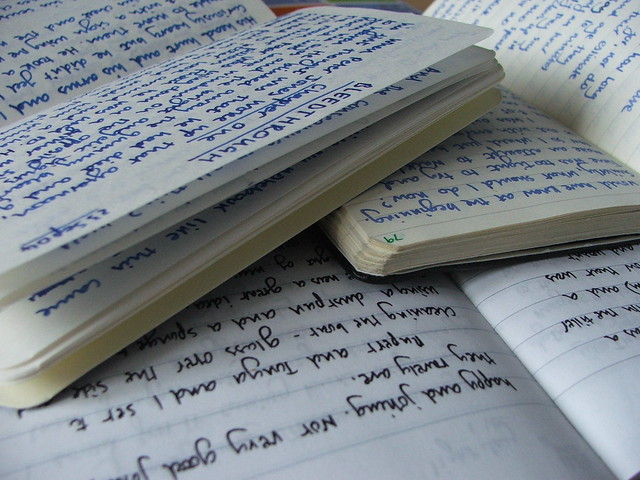
Photo credit: Abizern on Flickr
The very first writing book I ever purchased was The Writer’s Little Helper by James V. Smith, Jr. When I came across the quote I started this post off with, it stuck with me. I thought it was an interesting observation, although I secretly hoped it was one I’d never have to make myself. Over the years I did a lot of writing and editing and even some rewriting, and as I tried to rewrite sections of my WIP, I would occasionally think back to that quote and silently thank my computer for not crashing on me so I had something to reference while I was rewriting.

Then, as I continued reading books on the craft, I started to notice a pattern.

In many of the exercises that included completely rewriting a scene in The Fire in Fiction by Donald Maass, one of the steps included a variation of, “Without looking at your original draft, rewrite this [x]” (x being passage, scene, exposition, etc). And in Plot & Structure byJames Scott Bell, these two quotes stuck out to me:
“Let your characters have their way. Let your secret life be lived. Then at your leisure, in the succeeding weeks, months or years, you let the story cool off and then, instead of rewriting, you relive it.” –Ray Bradbury (page 173)
“Relive your scenes. Not rewrite. Relive.” –James Scott Bell (Page 203)
I have to admit, I initially resisted the thought of reliving versus rewriting scenes, but this really hit home for me when one of my critique partners suggested I rewrite a scene from my last WIP. Even though I’d already rewritten it, I took her advice and rewrote the scene again and submitted it to her to take a look at once more to see if it had improved. I was hoping she would say it was better so I could move on, but she didn’t. She suggested I rework it. Again.

I’m not going to pretend I wasn’t frustrated. I was. But as I sat down with my notebook to try to rewrite the scene yet again, I remembered what I’d read about reliving the scene rather than rewriting it—and at this point, what did I have to lose? So I did. I relived it and got the new version of the scene on paper. And while the scene played out the same way, it was different this time. I felt more directly connected to my protagonist’s experience and the writing showed it.  

So when my hard drive died the other day and I lost a new WIP idea I was working on (which I hadn’t backed up yet), I’ll admit I was less than happy. I may or may not have even written a few passive-aggressive tweets and Facebook posts about it. But part of me instantly remembered the quote I started this post off with, and I thought, well, I guess now I’m going to find out how true it is. So I replotted everything and started over. And I have to say, even if I do manage to get those files back, I don’t think I’ll need them anymore.  

Have you ever tried reliving a scene? If so, what was your experience? If not, do you think you will? 

Why Writing Books Are Essential for Writers

Photo credit: Goodreads
It goes without saying that most writers are also pretty avid readers (and those who aren't read anyway, or at least they should). While writers don't often have to be reminded to read books in their favorite genre or whatever genre they write in, it can sometimes be easy to forget another very important genre that all writers should be frequenting, namely, writing books.

Books on the craft come in all shapes and sizes—from enormous writing kits, to pocket-sized writing prompts and tips. Some cover a huge gamut of writing topics, while others focus on a specific aspect of writing like dialogue or plotting. What kind of writing book you choose will depend on your current goals or obstacles that you're trying to overcome, but the point is that you read them and, even more so, you actually do what they say.


What I mean is most writing books (and IMO, the best of them) include various exercises and prompts so that you can practice the new techniques and tips introduced throughout the book (a great example of this is The Fire in Fiction by Donald Maass, as I mention later), and if you don't do any of them, then you've basically wasted your money buying the book to begin with.


Because the point of reading writing books isn't so that they look pretty on your bookshelf (although if they do, I suppose that's a bonus)—it's to improve your writing. It's to learn new techniques and tips that will ultimately lead to tighter, better-written manuscripts. But reading writing books without applying what you've learned is like taking a class and completely ignoring everything that's said—in which case you would have been better off staying home.


But if you read books on the craft carefully and actually do the exercises and apply the techniques to your work and—dare I say it—re-read them and highlight especially relevant information, I think you'll find that you'll get a lot out of the experience, and, better yet, your writing will start to improve.


Now that's not to say that by reading writing books you're guaranteeing publication or a best-selling indie title—regardless of what anyone tells you, there's never a guarantee like that in this field (or any field, for that matter). But if you want to improve your odds and you want to become a better writer, I can't recommend writing books enough.


Now this post would be pretty useless if I didn't give any examples of great books on the craft, so here are my top five favorites, in no particular order. I've also included the subtitles as they effectively summed up the purpose of their respective books:

  1. The Fire in Fiction by Donald Maass— "Passion, purpose and techniques to make your novel great."

    I actually wrote a review that explains in better detail why I enjoyed this one so much, but in short, it covers a large variety of writing topics and the exercises are fantastic.

  2. Plot & Structure by James Scott Bell—"Techniques and exercises for crafting a plot that grips readers from start to finish."

    This is one of the many writing books from the Write Great Fiction series and it's one that's pretty well known for its great techniques and insight on plotting. Great for plotters and pantsers alike.

  3. Revision & Self-Editing by James Scott Bell—"Techniques for transforming your first draft into a finished novel."

    This is also part of the Write Great Fiction series, and it's one that I found so incredibly helpful that I re-read it with a highlighter. Not only does it have fantastic advice and tips on how to revise your manuscript, but it has great quotes throughout the book with little extra nuggets of wisdom.

  4. Characters, Emotion & Viewpoint by Nancy Kress—"Techniques and exercises for crafting dynamic characters and effective viewpoints."

    This is another from the Write Great Fiction series that I found so helpful that I re-read it with a highlighter in hand. The sub-title describes it pretty well, but this book is chock full of character development gold.

  5. Your First Novel by Ann Rittenberg and Laura Whitcomb—"A published author and top agent share the keys to achieving your dream."

    You don't have to be writing your first novel to benefit from reading this one. Although it's a little outdated as it was written before the indie explosion, it still has great advice on getting your book written, and fantastic insight behind the traditional publishing curtain and what exactly an agent does.
Writing books are a hugely important resource for writers— one that every writer would benefit from taking advantage of.

So those are my top five favorite writing books. Now it's your turn: do you read books on the craft? If so, which are your favorite? If not, why not?

My (Short) Review: The Fire in Fiction by Donald Maass


Let me start off by saying I need to find some books that are less than five-star amazingness, because you guys are going to start to think I’m a softie that gives everything five stars. I’m not. I promise.

But guys, The Fire in Fiction by Donald Maass deserves those five stars.

I’ll admit that I caved into buying this one because it was one of those books I suspected I should read and never really got around to picking up, but now Borders is going out of business and I figured well, what better time than now? So I bought it. And I read the first chapter. And I had a serious facepalm Why-did-I-wait-so-absurdly-long-to-read-this-book?-moment.

So without further ado, this is the Goodreads summary:

“How do widely published authors keep their stories burning hot? Learn how to supercharge every story with deep conviction and, conversely, turn fiery passion into effective story. The Fire in the Fiction shows you not only how to write compelling stories filled with interesting settings and vivid characters, but how to do it over and over again. With examples drawn from current novels, this inspiring guide shows you how to infuse your writing with life.”

I mean it when I say my only regret was not reading The Fire in Fiction sooner. The advice is fantastic and the exercises at the end of the chapter are more useful than I can even describe. I haven’t done all of them yet, but I definitely will.

So if you’re looking for a good writing book, I highly recommend this one. It covers everything from deepening characters (yes, even your moustache-twirling antagonist) to writing interesting description to weaving tension throughout your prose. It’s a fantastic read, and one I intend to go through again with a highlighter or two.

So there you are, another book on craft to add to your TBR pile. What are some of your favorite writing books? 
Related Posts Plugin for WordPress, Blogger...