Showing posts with label Shadow and Bone. Show all posts

Vlog: Harry Potter Spells Book Rec Tag

Slightly longer vlog today because my CP Vicki Leigh tagged me in a Harry Potter spells book rec tag! And so I thought I'd have some fun and join along.

Happy viewing!


THE BOOKS:


Twitter-sized bite: 
Writer @Ava_Jae participates in a Harry Potter spells book rec vlog tag. Have you read these awesome books? (Click to tweet

Vlog: #YAforHaters: 5 Book Recs

It's my 500th post! And I'm spending it talking about my favorite thing ever: books. Specifically, awesome books.

In concordance with Megan Whitmer's fabulous #YAforHaters vlog tag, as well as the awesome Twitter tags #PromoteaYAInstead and #NoShameYA, I'm sharing five books I'd recommend to those who haven't read YA or say they don't like YA.

Enjoy!


What books would you recommend to those who haven't read YA or say they don't like YA? 

Twitter-sized bites: 
Writer @Ava_Jae joins @MeganWhitmer's #YAforHaters vlog tag & shares 5 books she'd rec to YA newbies or haters. (Click to tweet
What books would you rec to YA newbies or haters? Writer @Ava_Jae shares her 5 picks: #PromoteaYAInstead #NoShameYA (Click to tweet)

Mini Book Reviews: INK and SIEGE AND STORM

So it’s been a long time since I’ve reviewed (or should I say raved?) about some books I’ve read recently, and so I’d like to share with you two equally fantastic books that have jumped onto my favorites list.

Firstly, a book I just finished a couple days ago: Ink by Amanda Sun

The Goodreads summary:

Photo credit: Goodreads
“On the heels of a family tragedy, the last thing Katie Greene wants to do is move halfway across the world. Stuck with her aunt in Shizuoka, Japan, Katie feels lost. Alone. She doesn’t know the language, she can barely hold a pair of chopsticks, and she can’t seem to get the hang of taking her shoes off whenever she enters a building. 
Then there’s gorgeous but aloof Tomohiro, star of the school’s kendo team. How did he really get the scar on his arm? Katie isn’t prepared for the answer. But when she sees the things he draws start moving, there’s no denying the truth: Tomo has a connection to the ancient gods of Japan, and being near Katie is causing his abilities to spiral out of control. If the wrong people notice, they'll both be targets. 
Katie never wanted to move to Japan—now she may not make it out of the country alive.”

So I’ve been interested in Japan and Japanese culture for some time, so when I heard about this YA Fantasy set in Shizuoka, I was immediately intrigued. The Japanese backdrop in Ink was so beautifully incorporated that I wanted to hop on a plane and visit immediately after finishing the book. Add in a unique mythology, hot Japanese boys, kendo, a pace that has you flipping pages quickly, and a complicated, realistic romance to boot, and I didn’t hesitate to give it five stars.

As a side note, I actually recommend picking up the print copy of this book. Not only is the cover (and texture of the cover) entirely perfect, but there are sketches throughout the book including little flip-the-page type animations in the corners of the pages that were really nice finishing touches that would not have been the same in an e-copy.

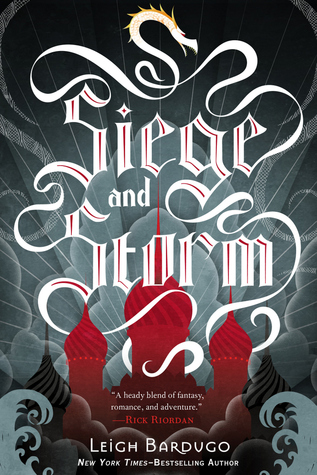
Now the wonderful Siege and Storm by Leigh Bardugo.

The Goodreads summary:

Photo credit: Goodreads
Darkness never dies. 
Hunted across the True Sea, haunted by the lives she took on the Fold, Alina must try to make a life with Mal in an unfamiliar land. She finds starting new is not easy while keeping her identity as the Sun Summoner a secret. She can’t outrun her past or her destiny for long. 
The Darkling has emerged from the Shadow Fold with a terrifying new power and a dangerous plan that will test the very boundaries of the natural world. With the help of a notorious privateer, Alina returns to the country she abandoned, determined to fight the forces gathering against Ravka. But as her power grows, Alina slips deeper into the Darkling’s game of forbidden magic, and farther away from Mal. Somehow, she will have to choose between her country, her power, and the love she always thought would guide her—or risk losing everything to the oncoming storm.”

First and foremost, if you like YA Fantasy and haven’t read Shadow and Boneyou need to go to your nearest bookstore or grab your e-reader and buy it immediately. The Grisha trilogy is one of my favorite YA trilogies of all time. The Russian-based fantasy backdrop combined with steampunk elements, an intensely epic magic system and an antagonist that you’ll love as much as you hate are just some of the reasons that I’ve fallen so deeply in love with this series.

I actually meant to review Siege and Storm ages ago, but at any rate, I loved this book. As you probably guessed from the above, it’s the sequel to Shadow and Bone and it certainly did not disappoint. I loved the new characters, the romance is complicated and sometimes ugly and always wonderful, and to say it’s an exciting read is an understatement.

Both of these books really helped to satisfy my fantasy fix, and I couldn’t recommend them more.

Have you read either of these books? Do you have any recommendations for me? Share your thoughts in the comments below! 

Twitter-sized bites: 
Looking for great YA Fantasy reads? Don't miss INK by Amanda Sun & SIEGE AND STORM by Leigh Bardugo! (Click to tweet
Looking for a great read in an exotic setting? Check out these fabulous YA Fantasies! (Click to tweet)  

Book Beginnings: Where to Start?

Photo credit: Mine
I’ve been doing a lot of editing and critiquing lately. Between working on my WIP, reading for CPs and being semi completely addicted to Write on Con’s critique boards, I’m not exaggerating when I say I’ve spent several days switching between several forms of critiquing and editing. 

I’m not complaining—I love it. But because of that, I’ve read a fair share of opening scenes lately that reminded me of the importance of starting your novel in the right place. 

Deciding where to start your book can be a difficult task. Oftentimes, new writers especially will fall into the trap of starting their novels too early, dumping a load of backstory at the beginning before the action starts. While this can be useful for first drafts to help the writer understand more about the story, when it comes to revised drafts for the readers, it’s often necessary to cut the backstory and weave it throughout the prose. 

The key to starting your novel in the right place is to start the first scene right at the cusp of where the story begins. 

That may sound obvious, but it actually requires you to think about where your story starts. Usually, and most effectively, this is right before the inciting incident—that is, the event that changes the course of your protagonist’s life. 

Let’s take a look at a few published novels and analyze where their respective authors began their stories: 

Inciting Incident: When Alina’s convoy is attacked in The Fold, she unwittingly awakens a dormant power that she never knew she had.  
Where the story starts: Alina and the convoy are about to enter The Fold. 
Inciting Incident: Katniss’s sister is chosen during The Reaping to enter The Hunger Games, so Katniss takes her place to save her life.  
Where the story starts: Her last hunting expedition just before The Reaping. 
Inciting Incident: Hazel meets Augustus Waters, the boy who turns her life upside down (in a good way).  
Where the story starts: At the Cancer Support Group, just before Hazel meets Augustus. 
I think the pattern here is pretty clear. 

Identifying the right place to start your novel is easier than you might think—once you’ve established your inciting incident, all you need to determine is where to start that gives your readers just enough information about your character and their surroundings to care when the incident arrives. 

Because just at the moment when your readers begin to connect to your characters is when you want to throw your characters into the event that will change everything for them. 

How do you determine where to start your story? 

Twitter-sized bites: 
Does your novel start in the right place? Writer @Ava_Jae discusses how to determine a good place to begin. (Click to tweet) 
The right book beginning is key to hooking your readers. Did you start your novel in the right place? (Click to tweet)

Writing Tip: Describe with Telling Details—Setting

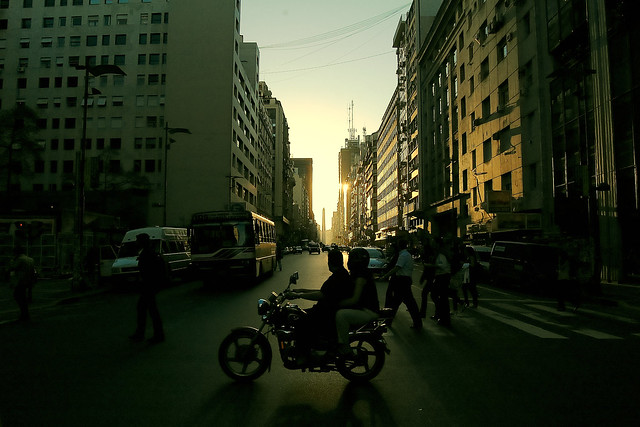
Photo credit: Armando Maynez on Flickr
I've often found that you can tell a new writer from an experienced one by the way they handle description. 

New writers often feel as though they have to describe everything. They go on paragraph after paragraph (or even several pages) going through every last minuscule detail of every setting (and/or every character), oftentimes stopping the action altogether to paint a perfect picture of the character’s surroundings. 

To be fair, it’s an easy mistake to make, and one that I readily admit I made with my first novel. You see, writers understand how important it is to paint a picture for the reader and make the setting come alive. What many new writers often mistakingly believe, however, is that they must describe the hell out of everything in order to make the readers see. 

But the truth is, that’s not the case at all. You don’t need to describe everything in order to create full images for the reader—you just need to describe a couple important telling details. 

What I mean by important telling details are specific aspects of your setting that embody the spirit of the surroundings. Ideally, you’ll want details that appeal to all five senses (although you don’t need to use all five at once). 

Because I’m about to re-read Shadow and Bone by Leigh Bardugo before reading the sequel Siege and Storm, I thought I’d show you a great example of an effective description of one of the many places the main character Alina encounters in the richly decorated world that Ms. Bardugo created. And I’ve bolded examples of telling details: 
“For a moment, all my fear disappeared, eclipsed by the beauty that surrounded me. The tent’s inner walls were draped with cascades of bronze silk that caught the glimmering candlelight from chandeliers sparkling high above. The floors were covered in rich rugs and furs. Along the walls, shimmering silken partitions separated compartments where Grisha clustered in their vibrant kefta. Some stood talking, others lounged on cushions drinking tea. Two were bent over a game of chess. From somewhere, I heard the strings of a balalaika being plucked. The Duke’s estate had been beautiful, but it was a melancholy beauty of dusty rooms and peeling paint, the echo of something that had once been grand. The Grisha tent was like nothing I had ever seen before, a place alive with power and wealth. 
Shadow and Bone by Leigh Bardugo, page 40. 
One paragraph. That’s all Ms. Bardugo uses to describe the bulk of the Grisha tent, and yet I think we can agree that by the end of the paragraph, you have a great sense of not only Alina’s current surroundings, but how it differs from the surroundings she’s accustomed to (ergo: the Duke’s estate). 

The fact of the matter is, you don’t need very much to build a rich setting. You just need to describe a handful of the right details and let the reader fill in the rest. 

What are some of your favorite settings from books? Do you remember any of the telling details that made it stand out to you? 


Twitter-sized bites: 
Is describing everything necessary to paint a rich setting for the reader? One writer says no. (Click to tweet).  
What are telling details and why are they important? Writer @Ava_Jae explains. (Click to tweet)
Related Posts Plugin for WordPress, Blogger...