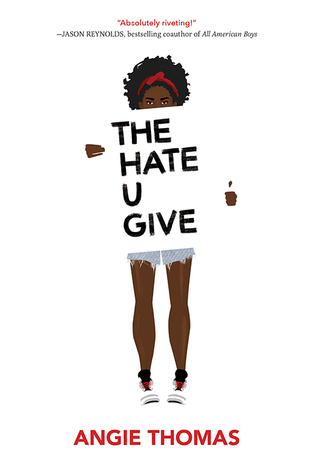
Book Review: THE HATE U GIVE by Angie Thomas

Photo credit: Goodreads
Whenever you have books that are really, really hyped, you run the risk that the hype might inflate everyone's expectations so much that the book has trouble living up to them.

That wasn't remotely the case with Angie Thomas's The Hate U Give.

Before I reiterate what everyone else is saying (that you need to read this book immediately), here's the Goodreads summary:
"Sixteen-year-old Starr Carter moves between two worlds: the poor neighborhood where she lives and the fancy suburban prep school she attends. The uneasy balance between these worlds is shattered when Starr witnesses the fatal shooting of her childhood best friend, Khalil, at the hands of a police officer. Khalil was unarmed. 
Soon afterward, Khalil’s death is a national headline. Some are calling him a thug, maybe even a drug dealer and a gangbanger. Starr’s best friend at school suggests he may have had it coming. When it becomes clear the police have little interest in investigating the incident, protesters take to the streets and Starr’s neighborhood becomes a war zone. What everyone wants to know is: What really went down that night? And the only person alive who can answer that is Starr. 
But what Starr does—or does not—say could destroy her community. It could also endanger her life."
So I'd actually started The Hate U Give a little earlier than I'd originally planned because the other book I was reading wasn't grabbing me as much as I'd like. That wasn't an issue here—I was immediately sucked into Starr's voice, and world, and the characters of her life. The Hate U Give juggles several conflicts in Starr's life—the conflict inspired by the Black Lives Matter movement, of course, with witnessing Khalil's murder, but also her half-brother and friend living with an abusive father—the neighborhood's most dangerous gang leader, a friend who gets into a dangerous situation, Starr juggling the disparity of going to a private school where she's one of the only Black kids and then going home to her neighborhood, that as dangerous as it can be is her home, her secretly dating a boy from her school, and her PTSD from witnessing her best friend's death. Not to mention the conflict of trying to decide whether to speak up or whether to hope no one outside of Starr's family ever learns she's the one who witnessed Khalil's death.

All of these conflicts in Starr's life may seem overwhelming—and for her, at times, they are—but the way they're written always makes sense as one conflict blends into another into another. Altogether it creates an incredibly compelling plot that keeps you turning the pages, because truly, there are no dull moments.

Then there's the voice. Starr's voice is so powerful, and honestly, The Hate U Give serves as an excellent example of why #ownvoices books are just better when it comes to portraying different marginalized groups. From the constant code-switching, to the cultural nuances, to even the way Starr thinks just felt so incredibly raw, like I was reading a real person's thoughts transcribed unfiltered onto the page. I had the undeniable sense while reading that this book wasn't written for me—and that was a good thing.

To say The Hate U Give is eye-opening and unforgettable is an understatement. I'm not at all surprised it debuted #1 on the New York Times bestseller list and I fully expect to see it win loads of awards, because this book is that powerful and that good.

All in all: read it. And any time you hear someone disparaging the Black Lives Matter movement, give them this book. I really do believe it could change hearts, minds, and lives.

Diversity note: Most of the characters, including the protagonist, Starr, are Black.

Is this book on your TBR? The answer better be yes. ;)


Twitter-sized bite:
.@Ava_Jae gives 5 stars to THE HATE U GIVE by Angie Thomas. Is this powerful YA on your TBR? (Click to tweet)

5 Essentials to Establish Before You Start Plotting (or Writing)

Photo credit: E V Peters on Flickr
So you have an inkling of a story idea with some vague images, lines, or concepts, and the time has come to turn that into a workable plot or (if you're a pantser) a draft. But how do you turn a vague idea into a structured story? It starts with establishing some essentials before you dive into the plot.

(P.S.: As always, these are suggestions and I'm in no way suggesting it's impossible to plot or pants without them. But establishing these upfront can certainly make the process a little smoother—and easier.)

  1. The basic premise. What is your book about? What elements does it involve? This is a pretty obvious starting point because it'd be difficult to start plotting or writing a book without a premise in mind. A general idea of the what is important as you get started—even if that what is still pretty vague, it helps to start here so you can flesh that out before you dive in.

  2. Your characters' goals. Knowing your main characters' goals upfront is absolutely essential to making sure you don't accidentally write a passive character. This means knowing what your character wants to accomplish on page one and what they want to accomplish near the end (because those things can change!). It's okay if your characters' goals evolve throughout the course of the book—the important thing is that you make sure they always have some kind of goal they're striving for—in every single scene. Because if your characters don't have a goal, chances are likely they'll lose their agency because they won't be pushing for anything—instead, the plot will be pushing them around. 

  3. The opposition to your characters' goals. Of course, there's no story if your characters can easily accomplish their goals. Knowing what the opposition is to your characters' goals and what will make it difficult for them to accomplish what they want is important to establish the foundation of the conflict—and conflict, of course, is essential to any story. 

  4. What's at stake? Relatedly, knowing what's at stake is important when considering your characters' goals, because with little at stake, your character isn't risking much, and thus there isn't much making your story compelling. Consider both what's at stake in the macro sense (saving the world) and what's at stake personally for your character (saving their sister, for example). By establishing the stakes early on and making them personal, you'll make it much easier both for yourself while you're writing and your future readers to connect with the protagonist and care about the protagonist's journey. 

  5. The general setting. While you don't have to have every world building element established upfront (I certainly don't), it's always a good idea to have a basic understanding of the setting. Where is your story located? What basics do you know about this setting? The setting is great to keep in mind as you plot or pants especially because it can play a role in the plot if you let it. 

Once you've established these five essential elements, you have enough to start considering the story as a whole—whether that means brainstorming and plotting in earnest or jumping into a draft is up to you. All the other details—more information about your cast of characters, narrators, tense, POV, the structure of the story itself—will fall into place as you push yourself to consider the story more deeply. But once you have these five essentials in place, you've got a pretty good foundation to build the rest of the story on.

What else do you consider before plotting (or pantsing) a WIP?

Twitter-sized bites:

Think you might be ready to start plotting but aren't sure? Author @Ava_Jae talks 5 essentials to establish first. (Click to tweet)
Think you might be ready to start pantsing your WIP but aren't sure? @Ava_Jae talks 5 essentials to establish first. (Click to tweet)

On Writing #ownvoices Intersections

Photo credit: Sebastian Hillig on Flickr
One of the projects I'm working on right now is the most #ownvoices manuscript I've ever written. It's been both a challenge and interesting to work on, because writing one aspect of marginalization is hard enough, but this WIP has several intersections—like me.

As sometimes emotional and scary the process has been so far, it's also been somewhat cathartic. On more than one occasion I've experienced something related to one of my identity aspects—whether a microaggression or related life experience—and then I sat down and added it (or something close to it) to my manuscript to better flesh out the everyday experiences someone like me deals with.

Of course, the responsibility weighs pretty heavily as I write. Writing an #ownvoices manuscript isn't all sunshine and butterflies—it requires reflecting deeply on your own experiences, including experiences you don't really want to dwell on, considering any internalized -isms and -phobias you may have honestly and making sure it doesn't show up in your writing, and eventually getting feedback from others in the communities you're representing to make sure nothing damaging slipped in.

Then of course, there's knowing your experience isn't everyone's experience, so even things you pull from your life may feel inauthentic to someone else in your community. And there's being aware of the responsibility you're picking up, especially when you're representing an underrepresented community with your book. There's knowing the way you write it and portray these identity aspects is the difference between a kid one day seeing themself in your writing, or your writing doing undo harm to the reader who absorbs something damaging from your words.

All in all, I've been taking my time with this one because it's not something I want to rush. There are too many details to get right and ways it could go wrong. But as challenging as the experience has been so far, it's also been rewarding. Because one day I may be able to introduce the world to a character with intersections like mine—and maybe it'll speak to another reader out there like me too, who hasn't seen more than occasional fragments of themself fully represented yet, if at all.

And that's pretty darn cool.

Have you worked on any #ownvoices projects? 

Twitter-sized bites:
.@Ava_Jae talks working on an intersectional #ownvoices WIP, and the responsibilities involved. (Click to tweet)

Vlog: First Person Dos and Don'ts

By request, today I'm talking about Dos and Don'ts when writing in first person. And bonus, nearly all of them apply to other perspectives, too.


RELATED LINKS: 


Have you ever written first person? 

Twitter-sized bite: 
Struggling with the 1st person POV in your WIP? Author @Ava_Jae vlogs some dos and don'ts. (Click to tweet)

Discussion: What Are Your Favorite MG Reads?

Photo credit: Valerie Everett on Flickr
I've kind of made a pact with myself that I'd like to read more Middle Grade this year, in large part because even though most of what I read is YA, my experience with MG has always been positive. From Artemis Fowl, to the Percy Jackson series, to The False Prince trilogy, to George, and The Last Great Adventure of the PB&J Society, I've really yet to pick up a Middle Grade book I didn't enjoy.

My knowledge of Middle Grade books, however, is super limited. I've got quite a few excellent ones on my TBR, like The Gauntlet, Ravenous, Furthermore, The Lost Hero, The Sword of Summer, The Pants Project, Finding Perfect, Some Kind of Happiness, Amina's Voice, Love Sugar Magic, and Escape from Aleppo, but as I'd like to expand my Middle Grade repertoire, I figured what better way than to ask.

So who are your favorite MG authors? What are your favorite MG books? I'm especially trying to focus on MG reads with marginalized characters, if at all possible, but I'm pretty open to anything as long as it's well-paced. Shout out your recs!

Twitter-sized bite:
What are your favorite MG reads and authors? Join the discussion on @Ava_Jae's blog. (Click to tweet)

On Writing Food

Food is one of my favorite parts of world building, both when I'm reading and writing. I think this is partially because food, at least for me, has always been the most visible part of my cultural identity—the Caribbean Cuban food I grew up with had always been something that set me apart from my (mostly white) peers, and it's something heavily celebrated in my family. We love our food.

A post shared by Ava Jae (@ava_jae) on

So I suppose it's not really a surprise I've found food so fun to read and write about, because I understand how intimately food ties into identity and culture. And honestly, it's just a plain fun part of world building.

What your characters eat will largely depend on their environment, culture, and economic status, so their food can say a lot about them. In Beyond the Red for example, Eros's first exposure to the luxurious, imported food Kora regularly eats is a huge reflection of the two very different lives they led before their paths crossed. In a WIP I'm working on with Cuban and Mexican characters, where their cuisine intersects and diverges is a marker of the way cultures in proximity interact and influence each other.

The nice thing about writing food is you can usually slip it in naturally without much effort—after all, characters have to eat. Meal times provide a great opportunity to build the character's world and culture and subtly reveal details about them. What's their favorite food? What do they hate to eat? Do they like to savor their food, or do they just eat whatever because they have to? Food can be a point where your characters come together or diverge depending on what you want to accomplish with it.

Finally, food provides an easy place to put details that can give the world a sense of verisimilitude. After all, every place on earth has some kind of local cuisine—and your world should be no different.

How do you use food in your writing? 

Twitter-sized bite:
What do your characters eat? Author @Ava_Jae discusses this fun aspect of world building and how it can be used. (Click to tweet) 

One Year Later

A year ago today, my first-ever published book, Beyond the Red, was officially out in the world.

Wow.

It's pretty amazing to think about, and a lot has changed since then. My publisher bought the rest of the trilogy, Into the Black (out this Fall) and The Rising Gold (out Fall 2018). I did my first-ever mini book tour with some author friends, taught at a conference and did my first signings, school and library visits. I graduated college, started freelancing, cried over an election, reconnected with family members I'd never met, got sick a lot, became more politically active, briefly worked in a bookstore, started new medication, and more. I wrote three manuscripts in a year, one of which was revised and turned into my editor, the other which is in the revision process, and a third I'll look at later. I'm looking into major life changes, filling out more applications for things than my brain wants to handle, got into my first-ever car accident (I'm okay!) and finally got the laptop I'd been saving forever for.

It's been a whirlwind of a year. And looking back, there isn't much I can point to and say I wish I'd done differently.

In that time I've learned a ton. About publishing, about writing, about myself and my limits and what I can push myself to do. I've been trying to learn to be patient with myself as I try to navigate life with a body I can't always trust. And I've been trying to pace myself, especially lately, while mentally juggling more projects and deadlines and life things than I know what to do with. Some days are easier than others, but the important thing is I'm progressing and I'm proud of the books I'm working on. I can't wait to share them with you guys.

It's been a year since my debut and what a year it's been. And I'm looking forward to many, many more.

What has your last year been like? 

Twitter-sized bite: 
A year after debuting, author @Ava_Jae looks back. (Click to tweet)
Related Posts Plugin for WordPress, Blogger...