Showing posts with label ideas. Show all posts

Vlog: On Book Ideas and Organization

Answering more related AMA-week questions! This time on idea generation and keeping track of ideas for your WIPs.


RELATED VLOGS:


How do you keep track of your ideas?

Twitter-sized bite:
How do you keep track of your ideas? @Ava_Jae shares their strategy in today's vlog. (Click to tweet)

On Trusting Your Story Ideas

Photo credit: Pimthida on Flickr
I used to toss a lot of my story ideas.

Sometimes, they never made it past infancy, just a scribbled note I'd look at later, grimace, and say nah before moving on to something else. Sometimes I'd experiment and write a chapter or two before losing interest, or I'd plot the entire thing and write a chapter or two before realizing this wasn't going to work.

Because of that, I didn't trust my ideas, not really. I knew chances were more likely than not that they wouldn't work out, that I'd lose interest or the idea would fall flat on its face. It's why, to this day, I consider a WIP just an "experiment" until I've hit 10,000 words.

But it occurred to me recently, though I wrote three manuscripts last year, and I'm in the middle of one now and have another I want to write before the year is out, I haven't tossed an idea out in a while.

Part of that, surely, comes from the fact that three of those—one I wrote last year, the one I'm working on now, and the one I want to work on next—were born from proposals, one to my publisher and one to something else. Writing the proposal for Into the Black and The Rising Gold last year, I was pretty scared of what would happen if I began writing and things fell apart—but the proposal, and the commitment to the proposal when my publisher accepted the sequels, has forced me to trust those ideas from the onset in a way I never had before.

Luckily—or maybe because of this forced trust—Into the Black's first draft went off without a hitch. I had a blast writing that book and it was equally enjoyable revising it. I can honestly say it's probably my favorite thing I've ever written. And now as I draft The Rising Gold with that same sort of confidence, I haven't once doubted whether the story would hold up as I wrote, and while I have some other insecurities with that book, there's no question in my mind that I'll finish it (which is good, since not finishing it isn't really an option at this point).

Similarly, the other manuscript I wrote a proposal for went much the same way. Though I've only drafted a chapter of it, that chapter came so easily—it flowed beautifully and the voice just clicked and I know when I finally get back to it, I won't have a problem picking up where I left off. I'm confident in that toddler of an idea in a way I hadn't been before.

I think part of this may be that I know what I like to write now. The Rising Gold is my seventeenth manuscript, and at this point in my writing journey, I'm very clear about the things I want to be writing about, even if how those things fit into a story-shaped thing isn't always immediately obvious. But I know the things that excite me, and the types of characters I want to populate my worlds with. So maybe having that foundation clear, of knowing what I enjoy writing and what I want to do more of, has allowed me to avoid the ideas that I'll get bored with and mosey away from.

I'm not 100% sure when the shift happened, but I am, slowly, learning to trust my ideas more than I have in the past. And it's a journey I look forward to continuing, one step at a time.

Do you trust your story ideas? 

Twitter-sized bite:
Do you trust your story ideas? Join the discussion on @Ava_Jae's blog. (Click to tweet)

How to Think Up Book Ideas

Photo credit: mathieuhervouet on Flickr
While for some writers book ideas pour endlessly out of the universe, for others coming up with an idea they want to write can be a little more complicated.

I fall somewhere in the middle of the spectrum, closer to the "complicated" end. For me, book ideas are a little harder to come by than my friends who often have more than they know what to do with, but on the other hand it's been over a year since I've really struggled to think of a book idea. Which is fine—everyone works differently and has different writerly seasons and all that.

But for those who find it a little more challenging to come up with book ideas, this is for you.

  • Ask, "what do I want to write about?" I'm very much a list person, and my "what do I want to write about?" list is easily my favorite to work on. Right now my list includes lots of Latinx, chronically ill, and nonbinary characters largely because I want to read much more of those characters having adventures with leads me to...

  • Consider what books aren't out there enough that you want to read. This is actually what lead me to come up with the Beyond the Red trilogy. I wanted YA on another planet that included a POV of the natives from the world, plus all the things I love reading about—monarchy, fantasy politics, sci-fi tech, etc—and from there the story grew. I also love doing this because it pretty much guarantees you're going to love whatever you end up with. :)

  • Pay attention and ask questions. Sooo many stories start out of questions, and a great way to figure out which questions to ask is to pay attention to the world around you. Whether that means consuming art (movies, books, music, TV shows, games, etc.), keeping on top of current events, experiencing new things or places or something else, story ideas can come out of everyday experiences if we let them.

  • Consider what you loved about your favorites. Whether it's masterful world building, a certain type of character, a feeling you had while watching/reading, or something else, a great way to learn is to take note of what makes you love your favorites. Then, when you're ready to write your own, consider how to apply those lessons into your writing and sources of inspiration.

So those are a couple tips for coming up with book ideas—what would you add to the list?

Twitter-sized bite:
Struggle to come up with book ideas? Author @Ava_Jae shares 4 tips for brainstorming ideas. (Click to tweet)

Vlog: Don't Worry About Idea Stealing

I semi-frequently hear from new writers who are too nervous to get critique partners because they worry about their book ideas being stolen. So here's why I don't think you have to worry about it.


RELATED LINKS: 


Did you worry about this before working with critique partners for the first time? (I know I did.)

Twitter-sized bite:
Too worried about idea stealing to enter a pitch contest or work w/ a CP? @Ava_Jae says not to worry about it. #vlog (Click to tweet)

Vlog: How to Pick Your Next Book Idea

Choosing your next book idea can be difficult when you have several ideas competing for your attention. Today I'm sharing some tips for picking (and sticking with) the right one.


RELATED LINKS: 


How do you choose a book idea?

Twitter-sized bites: 
Have many WIP ideas but don't know which to write first? @Ava_Jae vlogs about deciding which idea to pick. (Click to tweet
On choosing a WIP idea, seeing it through, and resisting Shiny New Idea Syndrome. #vlog (Click to tweet)

Vlog: How to Get Book Ideas

For me, figuring out the next book idea can often be the hardest and scariest part of the writing process. But here are some steps as to how I approach it: 


RELATED LINKS: 


How do you approach developing book ideas? 

Twitter-sized bites: 
Writer @Ava_Jae vlogs about the scariest part of her writing process: figuring out the next book idea. (Click to tweet)  
Struggling to get ideas for your next book? Writer @Ava_Jae vlogs her idea-generating process. (Click to tweet)

How Important is Originality?

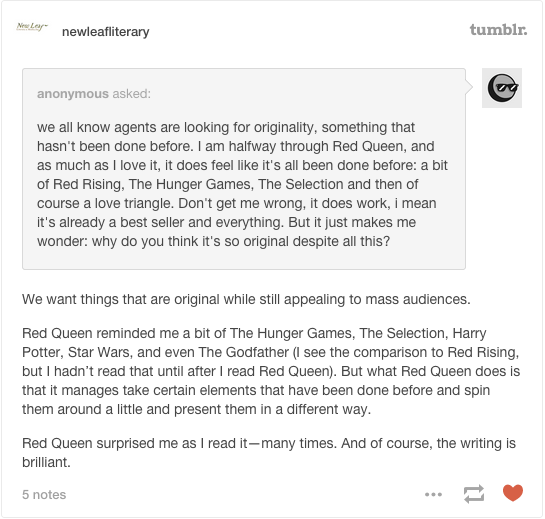
So not too long ago, while scrolling through my endless tumblr feed, I came across this answered question posed to the New Leaf Literary tumblr by an anonymous person:


So, right. Originality.

I haven’t read Red Queen yet, but this discussion often comes up when a book blows up big time, and I think it’s an interesting one to consider. Just how important is originality?

It’s no secret that The Hunger Games starts off very much like “The Lottery.” Twilight was hardly the first popular vampire book, Fifty Shades of Grey was originally Twilight fan fiction, and Harry Potter was not the first book about wizards or boys in boarding school.

So why did they become so popular? There are a lot of reasons to be sure, but a large part of it is very much what the lovely person behind the New Leaf Literary tumblr said: they took “certain elements that have been done before and [spun] them around a little and present[ed] them in a different way.”

Photo credit: martinak15 on Flickr
Guess what? There are a lot of books out there that could be presented as Hunger Games meets x. Or Divergent meets y. Or Game of Thrones/ Star Wars/ Orange is the New Black/ The 100 meets xyzabc. And you know what? That’s okay, because each of them take those familiar elements and incorporate them in very different ways. They’re similar without being too similar; they show us the familiar and twist it with something new.

This is why book comps can be so great in a query—they show agents and editors the potential marketability of a project by showing something familiar readers have responded to in the past mixed with whatever your spin is.

The key, of course, is to remember that you don’t want to write a rip-off of something else. Besides the obvious moral issue, that’s not what anyone wants, and that’s not going to sell. Instead, x meets y references elements of those comparisons.

I’m going to use my book as an example. When I was querying Beyond the Red, I pitched it as The Girl of Fire and Thorns on a technologically advanced alien planet. I wasn’t saying that I plucked Elisa from the world Rae Carson created and threw her into a sci-fi setting (I didn’t). Instead, I was referencing similar elements—an otherworldliness, a desert setting, and monarchies/rulers. There are similarities without going anywhere near the line of “too close.”

Stories inspire stories, and when you dig down to the heart of a narrative, many of them have been told time and time again. That’s to be expected, and it’s okay because readers gravitate to them over and over again.

So I guess the point I’m trying to make is not to stress if your book has some similar elements to another story, or if a book releases that sounds somewhat similar to the one you’re working on. As long as your book isn’t too similar (i.e.: has the same plot, or you purposefully lifted characters or something that you would obviously know wasn’t you—that's called plagiarism and is so not what I'm talking about), you should probably be in the clear. If anything, it may even help you in the long run.

What do you think? How original are original ideas?

Twitter-sized bite:
How original are original ideas? Join the discussion on @Ava_Jae's blog. (Click to tweet)

Writing Discussion: Are You an Idea-Generating Machine?

Photo credit: avianto on Flickr
I’ve always been slightly envious of writers who have so many ideas they can’t decide what to write. Writers, who after finishing a manuscript, debate between writing awesome book idea one, or fabulous book idea two, or maybe shiny book idea three.

I would like to have that problem, but most times, that’s not the case.

Now that’s not to say that I never have any ideas at all—like most writers, I keep an ideas list and jot down snippets or a character or scene or premise as it comes to me. But most of the time, out of the many scribblings I put down, I’ll pull out maybe one or two lines to explore further. And after that exploration, more times than not, I’ll decide it’s not strong enough and move on.

For me, coming up with a novel-worthy idea takes time. A lot of it. Oftentimes I’ll brainstorm something for days, then decide it’s not strong enough. Or I’ll brainstorm, love the idea, start writing it and immediately realize it’s not going to work. Or I’ll brainstorm, love the idea, start writing it, and lose interest a few thousand words in.

All are scenarios that happen pretty frequently while I’m working. I have loads of documents and notebooks full of what I call explorations—partially baked ideas that I tried out, then lost interest in.

Very rarely will I come up with more than one novel-worthy idea at the same time, or even within a couple weeks of each other. And as scary as it is sometimes, particularly when I’ve started querying and I’m blindly grabbing at ghostly wisps of an idea, I’m ok with it.

Part of me wishes it was different—I would love to have a folder of ready-to-go novel ideas so I could jump right into a new idea after finishing one. But that’s just not the way I work, at least, not right now. Everyone’s process is different, and it’s ok.

But I won’t lie—sometimes I finish a book and start querying and a part of me wonders if I’ll ever come up with a good idea again. Sometimes I’ll scrap idea after idea and a little panicky voice whispers this is it. You’ve run out of good ideas. 

But the thing is, I’ve been through that frustrating between-WIP stage enough times to know it’s not true. Sure, sometimes it takes longer than I’d like, but inevitably the ideas do develop, the characters start to come alive, and a new story forms.

And every time it does, I smile smugly at that panicky part of myself and get to work.

That’s my process—now I want to hear from you: do you generate several ideas at once? Or do you take more time to develop an idea?

Twitter-sized bites: 
What is your book idea generation process like? Join the discussion at @Ava_Jae's blog. (Click to tweet)  
Do you have loads of book ideas, or does it take you longer to generate them? Join the discussion. (Click to tweet)

Discussion: Do You Finish Every Novel Idea You Start?

Photo credit: gadl on Flickr
Confession time again: I have started several novels that I never finished.

Considering I’ve often written about finishing your novels and just getting the words down and worrying about the rest later, this may be a little surprising to some of you. But it’s true, and it’s something that I’m actually quite unashamed of.

Most times, these starts are a false start of sorts—more of an exploration of an idea than an actual attempt at writing out a novel. But I have fully plotted WIP ideas from start to finish, written a page or two, then decided I didn’t want to write it after all. On two occasions, I have written more than a couple thousand words, then realized with some disappointment that it wasn’t working.

So there. I’ve said it: I don’t finish every novel idea that I start.

The thing is, that initial writing for me is part of the exploration process. I could have plotted out my most epic novel yet, but if the voice of the protagonist doesn’t work for me, I immediately lose interest and move on to something else. For me, character is king, and if I don’t find an intriguing voice to tell the story, then it’ll remain a snippet of writing and some jotted down ideas.

This is why I don’t really call a first draft an actual draft or WIP until I’ve hit 10,000 words. Even that isn’t necessarily a guarantee that this is a novel I’m going to finish, but the odds are astronomically higher after that milestone because I’ve gotten a good feel for the characters and usually if I’ve made it that far, I know something’s there.

Now, I’m well aware that not everyone works the same way I do, and so I want to hear from you: what is your exploration process like? Do you finish every novel idea that you start? 

Twitter-sized bites: 
Do you finish every novel idea you start? @Ava_Jae doesn’t, and here’s why. (Click to tweet)  
Why one writer doesn’t call a WIP an actual draft until she’s written 10,000 words. (Click to tweet)

Writing Discussion: Where Do Your Novel Ideas Begin?

Photo credit: Paumadou on Flickr
From the outside, novel-writing appears to be a somewhat nebulous process. Writers wrangle stories from sheer imagination and layer them with complexities and emotions, plot twists and character arcs that leave readers craving more.

The inception of that novel idea is often regarded with some wonder, even to writers. For some, the idea begins as a sentence, or a scene, or a world or situation. For others it begins with a character, or a line of dialogue, or a stray echo after a dream.

I’d like to hear from you: where do your novel ideas begin?

I am absolutely a character-based writer. Every one of my WIP ideas has started with a character, with a world and situation built around them. I find it very difficult to build a character to fit a story—instead, the story evolves from the character.

This is likely a large reason why I tend to neglect setting in my first drafts—I focus instead on learning about my characters, what makes them tick, what makes them them and worry about nailing down a setting in future revisions. Of course not all writers work like that, but character to me is the heart and soul of the novel. I could have a fantastic premise, but if I don’t have equally spectacular character to go with it, the idea fizzles away.

I’m well aware, however, that there are many writers who function quite differently—writers who create an intricate, interesting setting and fantastic premise long before they begin to think about who populates the world. And then there are writers who work somewhere in between—those who develop the two simultaneously and integrate them at the same time.

So now you tell me, writers: where do your novel ideas begin?

How to Think of Blog Post Ideas

Photo credit: Cayusa on Flickr
For roughly a year and a half now, I’ve written blog posts three times a week. I haven’t made any changes to the blogging schedule because I believe it’s important as a writer and a blogger to post consistently, and as of yet, I’ve never missed a day. I’ve also never run out of ideas.

Well.

That last part is a little misleading. Saying that I’ve never run out of ideas makes it sound like over the course of the last year and a half, I’ve never had a day where I wasn’t sure what I was going to post about, which is nowhere near the truth. I have, in fact, often had days where I stared at the screen, wondering how in the world I was going to come up with and write a post over the course of the next twenty-four hours.

But being the stubborn, stick-to-the-schedule person I am, I’ve always managed to wring a topic out of the air, one way or another.

The truth is, there’s nothing mystical about thinking up blog post ideas. While some days I’m lucky and the idea will just make itself known to me with little effort on my part, most days I have to go looking for ideas. Lucky for me, I have plenty of sources of inspiration all around me. Such as…

  • The blog archives. For those of you who run a blog, I highly recommend keeping a blog archive list. The funny thing about blog archives, is that while I originally created mine to make it easy for readers to dig through my old posts, I soon realized it was just as useful for me as it was for my readers.

    You see, when your posts start reaching triple digits (and even before that), it can start to become a little tricky to keep track of what you’ve written about and what you’ve missed. When I’m searching for blog post inspiration, I nearly always start by scrolling through my archives: not only does it keep me from unintentionally rewriting an old post, but it gives me a general idea as to what areas I could explore more in, and what areas are already well-saturated with posts.

  • The brainstorming list. I’ve written in the past about how helpful it is to keep a running list of ideas (both for writing and blogging), and this is a large part of the reason why. When I’m low on ideas and searching the archives isn’t helping, I often turn to my brainstorming list and either spend some time thinking up new ideas, or choose one that I’ve already thought of but haven’t written about yet.

  • Life. You’d be surprised how many ideas you can generate just from your everyday life. I’ll often turn to a problem I’ve recently encountered in my WIP, or a stage of writing I’m in, or a book I’ve recently read to try to think up of some blog post ideas. Another great life source is current events: whether in publishing or just a topic that’s trending online (that’s related to whatever you post about, of course), writing about current events or topics is a great way to tap into a collective discussion online. 

These are just a couple examples of places I find blog post inspiration from—now I want to hear from you. Where do you find blog post or writing inspiration?

Writing Tip: Keep an Ideas List

Photo credit: La Famille Rapp on Flickr
So you're away from your computer and you get an idea for not one—but two fantastic blog posts. You write the first one as soon as you get to your computer and smile happily because you already know what you're going to write in a couple days for the next post.

A few days later you sit down in front of your computer and realize you've completely forgotten what you were going to write for that second post.

That definitely didn't happen to me this weekend because I keep a running ideas list and I would never neglect to write an idea down before I forgot it. *ahem*

Regardless of whether or not the aforementioned example is in fact based off of recent experience, I'm sure many of you have had something similar happen—and if not with blogging ideas, then with WIP or otherwise writing-related ideas.

An ideas list is a simple and helpful tool that can be used for various aspects of your writing career. I tend to keep two runnings lists: one for blog post ideas and one for WIP ideas. The format, how often you use it, and how often you refer back to it is up to you, but the only rule is this: don't censor yourself.

You see, the ideas list is a sort of never-ending brainstorming sheet. Whatever bits and pieces of inspiration you get—whether it's a full-fledged concept for a new WIP, or a wisp of an idea for a character, can be added to the list for future use. Don't worry about something sounding silly or overly-ambitious—no one else will ever see the list, and just because you write it down doesn't mean you have to go with it. The point is to keep track of your ideas while you have them, so you have something to springboard off of later on when you're fresh out of inspiration.

That way, when you realize you've forgotten that awesome idea that hit you while doing dishes yesterday morning, you won't have to worry because you've already written it down.

Do you keep an ideas list or something similar?

Short Story or Novel Idea: How Do You Tell?

Photo credit: tosaytheleast in Flickr
Every so often one of you amazing readers will suggest a blog post topic I haven’t covered yet (which is fantastic, by the way) and I’ll ramble on about how awesome you guys are for being such interactive and invested readers and then get to the point of the post. 

As you might have guessed, this is one of those posts.

This time, however, I’d like to hear from you guys. Because while I have some ideas on the topic, I don’t really write all that many short stories, and truth be told, it’s been a couple of years since I’ve written one (which, come to think of it, should be remedied), but I suspect some of you lovely readers are more recently acquainted with the short story writing experience. So. Here we go.

The proposed question, as many of you astute readers probably inferred from the title, was how to tell the difference between an idea better suited for a short story than a novel.

I find this question to be particularly interesting because it’s been a long while since I’ve really even allowed myself to consider whether or not an idea would be appropriate for a short story—to me, it’s been more of a question of whether or not I could write an entire novel based on whatever premise rose from the depths of my mind, and those that failed the idea worthiness test of time were labeled unworthy and discarded and ignored. I kind of imagine Odin’s booming voice as he screams, “YOU ARE NOT WORTHY,” at Thor, but that’s beside the point. 

Getting back to the question, though, once you’ve determined whether your idea is worth writing about at all (again, the test of time is a good indicator), a large part of the difference between short story ideas and novel ideas is the scope. 

You see, novel ideas have to be big—and I don’t mean that they have to have explosions and ridiculously awesome action scenes—I just mean that while you’re working with your new idea, you have to be able to develop enough nuances, subplots and layers to sustain 80,000 (or however many) words. And sometimes, especially if you’re a pantser, it’s a little hard to tell if your idea is going to survive three hundred-some-odd pages or if you’re going to hit page fifteen and say, “You know what? Maybe this idea isn’t worth a novel after all.” But the first step in answering the question of whether or not your idea is enough to sustain a novel, lies, I believe, in determining the scope of your idea.

Let’s take a look at an example.

The Hunger Games is big. There’s no way Suzanne Collins would have been able to as effectively fit all the setup, relationships, celebrity status of the tributes, horror of the games, rebellion against the Capitol and repercussions thereof in fifteen pages (and I don’t mean written in summary-like synopsis form, I mean written as an actual story).

However, way before The Hunger Games was the short story The Lottery written by Shirley Jackson in 1948, which certainly has many similarities to the beginning of The Hunger Games (you can read it for free online, if you’re interested). The difference between the two? You guessed it—the scope of the idea.

While The Hunger Games included various subplots (i.e.: the Katniss-Peeta-Gale love triangle, among others) as well as an in-depth look at the glamorization of the hunger games in the Capitol that only made the brutality of the games (in my opinion) that much more powerful in its effect on the reader, The Lottery included set-up, foreshadowing, some characterization and, erm, the results of the lottery (you’ll have to read it if you haven’t already to know what I mean). The former was way too big to be shoved into a short story format, while the latter fit very comfortable in a little over 3000 words.

So, in short, the main difference to me between a short story and novel idea lies in the scope of the idea. If you think you can fit it in fifteen pages, then it’s probably not worth dragging out into three hundred; but on the other hand if you think it might be difficult to condense into a shorter story without losing anything, you might want to consider writing a novel (or at least a novella) instead. 

Those are my thoughts, but how do you tell between a short story and novel idea? Have you ever had a short story turn into a novel, or a novel idea become a short story, instead? 

Writing Dangers: Shiny New Idea Syndrome


Photo credit: louvecienne on Flickr
So that wonderfully fantastic thing happened again when one of you amazing people suggested a topic that I could have sworn I’d covered, except it turns out I’d only ever touched on, because when talking about discipline, one of you lovely commenters (you know who you are—thank you!) posted this:
“I don’t know if you’ve ever discussed this already, but one thing I thought might be interesting, is your views on when to start new stories. Such as, you are working on one novel and have another great idea. Do you keep finishing the first one and then work on the second even if your enthusiasm dips or do you start the new one immediately and use that enthusiasm to your advantage?”
I think this is a fantastic question because there is little doubt in my mind that most writers (if not all) experience what I like to call Shiny New Idea Syndrome at one point or another throughout their writing careers.

For those of you who aren’t acquainted with this beast, Shiny New Idea Syndrome occurs when you’re in the middle of a WIP, and suddenly—BAM—a brand new tantalizing idea sneak-attacks you and starts whispering things like, don’t you want to write me? or hey, hey, why won’t you take a break from that other story and try something new? You know you want to, and makes you wonder why you’re even bothering with this other WIP when that Shiny New Idea is so much better.

Once Shiny New Idea Syndrome has attacked, a writer is faced with two options: continue with the first WIP and remember the Shiny New Idea for a later WIP, or put the first WIP aside and start writing the Shiny New Idea immediately.

As our fantabulous commenter mentioned, some writers worry that if they continue with their first WIP and leave the Shiny New Idea for later, their enthusiasm for the new project will fade, making it more difficult to write later on. And while this is a perfectly legitimate fear because yes, that does tend to happen with some ideas, I truly believe that if when the time comes to sit down and put the Shiny New Idea to paper, you’re no longer excited about the project, then it probably wasn’t a strong enough idea to be written into a novel in the first place.

I’ve talked about this before, so I’m not going to go into detail again, but in short, writing a novel is a very involved process that takes huge amounts of time, and if you can’t maintain enthusiasm for a new project idea while finishing a WIP you already started, then chances are you would have found it difficult to maintain that enthusiasm through the long months (or years) it takes to write and revise and revise and rewrite and edit a novel.

If, however, you do finish the first project and the Shiny New Idea is still there, tapping you on the shoulder and demanding that you get to work, then I’d say that’s a pretty good sign that you have something good on your hands. Something that isn’t just a fleeting temptation. An actual, lasting novel-worthy idea.

Because the real danger of the Shiny New Idea Syndrome is this: oftentimes writers find when they switch projects to satisfy a Shiny New Idea, part-way through that new WIP another Shiny New Idea comes along that’s so much better than the one you’re working on now, and before you know it you’ve started four new projects and haven’t finished anything.  I hear about this from writers all the time, especially new writers who haven’t finished a project before because Shiny New Idea Syndrome is a sneaky little thing.

That’s not to say that Shiny New Idea Syndrome doesn’t ever give you good ideas—it can certainly drop a perfectly sound novel-worthy idea into your mind. But I truly believe the first test of its novel worthiness is whether or not you can sustain that new-idea enthusiasm even if you don’t immediately begin writing it.

Because a truly novel-worthy idea will still be there waiting for you when you finish your first project.

So that’s my take on Shiny New Idea Syndrome. What do you think? If a Shiny New Idea hit you while working on a project, would you continue with the first project or start working on the new one? Have you ever experienced Shiny New Idea Syndrome?

Is Your Idea Novel-Worthy?

Photo credit: qisur on Flickr
When it comes to ideas for a novel, there are many different approaches that writers take. Whether it's keeping a notebook or box full of snippets of ideas that are written down regardless of how much sense they make or how ridiculous they are, or storing ideas away in your mind while working on a WIP, every writer has his own method of idea keeping.

Many writers will eventually find that they have more ideas than they know what to do with. Their idea box is overflowing with scraps of paper begging to be remembered or their brains are bursting at the seams with stories that could be interesting to pursue.

But how do you know if any of those ideas are novel-worthy?

I came across this tweet the other day via @4KidLit that I thought summed it up particularly well:


It really is that simple.

Writers will encounter thousands of ideas within a lifetime—snippets of an image, fragments of a character, a haunting scene, interesting line of dialogue or intriguing thought—and no one has enough time to turn every idea into a novel. But the truth is, not every idea has enough substance to be turned into a fully plotted story, and that's ok.

Because the ideas that are novel worthy demand to be written. While other ideas fade with time, a novel-worthy idea will haunt you day and night. Rather than disappearing with time, it'll grow and develop into something complex, something that can't be ignored, something that has to be written.

Those are the ideas that you need to pursue.

Writing a novel is tough. It takes months, even years to turn a first draft into a polished, readable story and throughout that time if you aren't passionate about your idea, the novel will never reach completion. Writing a novel is an exhausting thing, which is why those other ideas, those non-novel-worthy ones will fade with time. Because if the idea hasn't fully captivated the writer, there's little chance it'll contain the spark it needs to captivate the reader.

So next time you're unsure whether or not your latest idea is novel worthy, give it some time. You'll know it's right when the idea refuses to leave you alone.

Writers: how do you tell if an idea is novel worthy? 
Related Posts Plugin for WordPress, Blogger...