Showing posts with label The Girl of Fire and Thorns. Show all posts

Writing Tip: Describe with Telling Details—Character

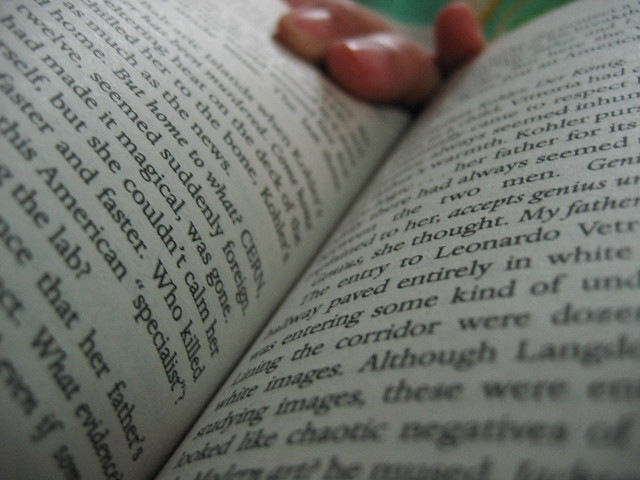
Photo credit: horizontal.integration on Flickr
On Wednesday, I covered the importance of telling details when writing description for settings. Now I want to discuss an equally important type of description that also relies (when done well) on the same kind of details.

I’m sure you’ve all come across a passage, whether in your writing or someone else’s, in which a character was meticulously described from the specific tint of his eyes to the size of his nose and the make of the shoes on his feet. And chances are, the description started to lag and didn’t really leave a lasting impression, despite everything the writer threw at you. 

The problem wasn’t that the character wasn’t described enough, in fact, it was the opposite problem—the character was drowning in so much description that nothing could stand out and leave an impression. 

That’s why a few telling details are always better than paragraphs upon paragraphs of listed descriptions. If you use too much description, your readers won’t be able to pick out what physical markers are unique to your characters—but by utilizing a couple telling details instead, you’ll paint a picture of your characters much more effectively.

Let’s take a look at some examples. In both excerpts, the respective protagonists are seeing a love interest for the first time, and both authors do an excellent job characterizing them with just a couple specific details.  
“A boy was staring at me. 
I was quite sure I’d never seen him before. Long and leanly muscular, he dwarfed the molded plastic elementary school chair he was sitting in. Mahogany hair, straight and short. He looked my age, maybe a year older, and he sat with his tailbone against the edge of the chair, his posture aggressively poor, one hand half in a pocket of dark jeans.” 
The Fault in Our Stars by John Green, pages 8-9.
What really seals the description here? To me, it isn’t his mahogany hair that makes the image—it’s his “aggressively poor” posture and the way his long form dwarfs the plastic elementary school chair. Those are the kinds of details that you want focus on when describing your characters. 

Next example:
“I turn toward my new husband. My cheeks are hot; I know they will be blotchy and shining with sweat when he lifts the shield from my face.  
He releases my hand. I clench it into a fist to keep from wiping it on my terno. I see his fingers on the hem of my veil. They are brown and thick with short, clean nails. Not scholar’s hands, like Master Geraldo’s. He lifts up the veil, and I blink as cooler air floods my cheeks. I peer up at the face of my husband, at black hair that sweeps back and curls at his neck, at brown eyes warmer than cinnamon, at a mouth as strong as his fingers.” 
The Girl of Fire and Thorns by Rae Carson, page 14.
What I love about this excerpt is that our very first impression of her new husband isn’t his stunning good looks—it’s his fingers and clean nails as he grasps her veil before lifting it over her face. I also love the way that Ms. Carson reminds us of his fingers by comparing the strength of his mouth to the strength of his hands at the end of the paragraph.  

So those are two examples of excellent use of telling details while describing characters, but now I want to hear from you. Do you use telling details when describing characters? Any examples you’d like to share from your work, or books that you've read?

Twitter-sized bites: 
Do you use telling details to describe your characters? Here's why you may want to. (Click to tweet
Are you drowning your readers in description? Here's how to make your character descriptions pop. (Click to tweet)

How to Make Your Readers Believe Anything

Photo credit: seasonal wanderer on Flickr
I’ll admit the title sounds a little ominous, like I’m about to spill the secrets of world domination, and in a way I suppose I am—dominating the world of literature, at least.

Regardless of however the title may or may not sound, I’m not really referring to mind control—I’m referring to suspension of disbelief.

As writers, you have the unique ability to make anything possible. You aren’t bound by laws of physics or reality or even time—whatever you can imagine, you can create on the page. Dragons, zombies, angels, horned beaver-goats—writers set the rules to the worlds that they create.

But as Aunt May so famously told a young Spiderman: with great power comes great responsibility.

With every book (or series) you write, you set up the rules of that reality. Whether it’s literary fiction, epic fantasy, sci-fi, paranormal, etc., it’s your job as the writer to establish some form of boundaries and guidelines. In the Harry Potter series, for example, J.K. Rowling established early on that even the most powerful wizards prefer performing magic with wands, while in Eragon (Christopher Paolini), magic was performed without the use of any wands whatsoever and in The Girl of Fire and Thorns (Rae Carson), magic could only be performed with the aid of the rare Godstone.  

The key is to set up rules that fit with whatever genre you write in. Readers of fantasy expect a certain amount of, well, the fantastic—whether its dragons, magic, elves, all of the above or something entirely different—there are expectations within the genre that you as a writer in that genre have to adhere to. If The Lord of the Rings ended with an alien invasion or a stampede of pink squirrels made of sugar, readers would riot because it completely breaks the rules that J.R.R.Tolkein so carefully established.

Beyond world rules however, writers have the important job of ensuring that their characters don’t act out of character, and thus break the readers’ suspension of disbelief. If Katniss, for example, started flirting with Cato because he was cute, or Harry Potter decided to join Voldemort and become a Death Eater, to say that they’d be breaking character would be a huge understatement.

There are two very simple things writers must do to ensure suspension of disbelief:

  1. Set up the rules. Establish (or hint at) world rules quickly, as well as the rules (or personalities) of your characters.

  2. Stick with them.

It’s ok to occasionally break a rule, but make sure it’s justified—establish a new rule that renders the broken rule obsolete, or give a character a motivation for his otherwise unbelievable action, but make sure it’s fully explained in your book, or risk losing that suspension of disbelief.

Have you ever read a book that shattered your suspension of disbelief? What do you think caused it? What’s your favorite example of suspension of disbelief? 

Mini Book Reviews


I haven’t done a book review in a while for a couple of reasons, but I thought it’d be fun to give a couple of short book recommendations based on what I’ve been reading as of late, rather than writing many separate reviews for every book I read.

So! Based on what I’ve read so far this year, the first book I’d like to recommend to you is The Girl of Fire and Thorns by Rae Carson. Before I get into what I thought about it, here’s the Goodreads summary:

Photo credit: Goodreads
“Once a century, one person is chosen for greatness. 
Elisa is the chosen one.  
But she is also the younger of two princesses, the one who has never done anything remarkable. She can't see how she ever will.  
Now, on her sixteenth birthday, she has become the secret wife of a handsome and worldly king—a king whose country is in turmoil. A king who needs the chosen one, not a failure of a princess.  
And he's not the only one who seeks her. Savage enemies seething with dark magic are hunting her. A daring, determined revolutionary thinks she could be his people's savior. And he looks at her in a way that no man has ever looked at her before. Soon it is not just her life, but her very heart that is at stake.  
Elisa could be everything to those who need her most. If the prophecy is fulfilled. If she finds the power deep within herself. If she doesn’t die young.  
Most of the chosen do.”

So I don’t usually read high-fantasy, but I gave this one a shot and I’m certainly glad I did. The Girl of Fire and Thorns really surprised me. Elise, the protagonist, defied the gorgeous-model-like-looks that many YA novels feature, and starts off, in fact, as a rather overweight teenager with a remarkably low self-esteem. That in itself caught my interest and following her story and watching her develop as a character was a real treat. I’ll admit that some of the more fantastical elements took a little adjusting, but The Girl of Fire and Thorns surprised me with many-a-plot twist that I definitely didn’t see coming (which is a rare thing, I might add) and actually got me to exclaim out loud while reading…twice.

In my book, that means I really enjoyed it, and thusly I recommend it to you.

The second book is actually a series that I haven’t finished yet, but judging by the first one and a half books, I can already tell it’s a series I’m going to have to finish.

What series, you ask? None other than The Iron Fey series by Julie Kagawa. The Iron King is the first of the series and this is the Goodreads summary:

Photo credit: Goodreads
"Meghan Chase has a secret destiny; one she could never have imagined.  
Something has always felt slightly off in Meghan's life, ever since her father disappeared before her eyes when she was six. She has never quite fit in at school or at home. 
When a dark stranger begins watching her from afar, and her prankster best friend becomes strangely protective of her, Meghan senses that everything she's known is about to change. 
But she could never have guessed the truth - that she is the daughter of a mythical faery king and is a pawn in a deadly war. Now Meghan will learn just how far she'll go to save someone she cares about, to stop a mysterious evil no faery creature dare face; and to find love with a young prince who might rather see her dead than let her touch his icy heart."

First and foremost, I’d say this is definitely a girl book and although there are a couple of things that irked me along the way, I’ve really been enjoying the series. Once again, it’s a little out of my normal reading genre (and the first faerie book I’ve read since Artemis Fowl) but after seeing it repeatedly mentioned on Goodreads I thought I’d give it a try and now I’m hooked. The faery world Kagawa created is just remarkable, there’s never a dull moment in the plot and the characters are memorable, to say the least.

So that about covers it. Happy reading!

What’s the best book you’ve read this year so far? 
Related Posts Plugin for WordPress, Blogger...