A World Without Bookstores?

Photo credit: phototakeouterBX on Flickr
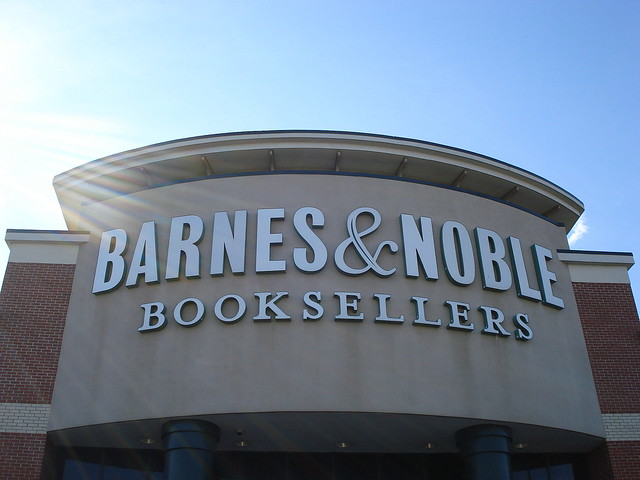
A couple days ago, some disheartening news about Barnes & Noble was unleashed upon the literary world. In short, Barnes & Noble has suffered some very serious losses last fiscal quarter, giving many a sense of saddened deja vu. Because we’ve seen this before, and it didn’t end well for Borders. 

While I’m still holding out hope for a Barnes & Noble recovery, it does make me wonder what would happen if the last major chain bricks-and-mortar bookstore went under. 

While a world without bookstores would certainly make me very sad, I do believe that the book world would survive. Readers would continue reading and writers would continue writing—they’d just go about getting their books a little differently. 

I imagine a world without bricks-and-mortar bookstores would create an enormous push for online retailers like Amazon, as well as further encourage sales of e-books and e-readers. The print market would likely take a hit, as the physical shelf space would decrease dramatically, and readers would be faced with the choice of waiting a week for their print book to arrive, or waiting thirty seconds for their e-book to download. 

The literary world would change, certainly, but I believe wholeheartedly that it would evolve and survive. 

What we would lose, however, is the experience of a bricks-and-mortar store. Gone would be the days of browsing shelves of freshly-printed possibilities with a cup of coffee in hand. We would no longer be able to walk into a physical store dedicated solely to showcasing and selling stories. 

As someone who still feels a nostalgic sort of sadness every time I pass a closed ex-Borders store, I would without a doubt be heartbroken over the closing of Barnes & Noble, if it did come to that. But while we would mourn the loss of the books-and-mortar experience, I do believe that books would survive and the literary world would move on. 

It’d just be without a physical store. 

What do you think a world without bookstores would be like? 


Twitter-sized bites: 
What do you think the fall of Barnes & Noble would mean for the book world? (Click to tweet) 
What would a world without bookstores look like? One writer speculates. (Click to tweet)

9 Distractions for Waiting Writers

Photo credit: vancouverfilmschool on Flickr
So on June 13, something strange and wonderful happened. I woke up feeling energized and excited to get writing. I blasted through writing sprint after sprint and ended the day with 5,214 new words in my WIP.

I’d expected to be tired the next day, but I wasn’t. This happened, instead:


It was exhilarating, and wonderful, and I finished two weeks ahead of schedule, and I went to bed with a smile on my face and latent excitement in my veins.

When I woke the next morning, I was left with...now what? I wanted to dive immediately into edits, but I knew I edit most effectively after giving my manuscripts time to cool. I needed distance, even if I didn’t really want to take the time to let it settle.

I know I can’t be the only one who gets impatient while waiting for the cooling off period to end, and so I’ve devised a list of distractions. Enjoy.

  1. Catch up on that TBR pile. We all know how difficult it can be to make time to read while also making time to write. Sometimes, when in the middle of a first draft, your reading pile begins to grow. Now you have a little extra time—why not use it to read some excellent books?

  2. Read a book on craft. Now’s a good a time as ever to whip out your highlighter and dust off those writing books. Even better—take notes while you’re at it that you can use when you begin revising in a few short weeks.

  3. Work on another WIP. This has the added bonus of focusing your mind on something completely unrelated to the first draft you just completed. And as an extra extra bonus, you’ll have two (or more) WIPs to play with at the end of it.

  4. Get some research out of the way. For writers like me who tend to leave the bulk of the researching until the revision stage, now’s a good time to start taking notes and what you know you’ll need.

  5. Brainstorm with Pinterest. Yes, yes, Pinterest is an enormous time-suck if you let it...but it can also be a source of fantastic inspiration for your WIP. So it’s a worthy time-suck, IMO.

  6. Do some non-writing WIP-related activities. This can be a variety of things—create a mock-up book cover, write a language for your fantasy, fan cast your characters, or create an inspiration board. Just don’t open up that WIP quite yet.

  7. Go outside. Neil Gaiman said it best. We writers have a tendency of locking ourselves in our writing caves and regarding the sun as a fiery ball of kryptonite while writing. But sometimes it’s good to go outside and remember how to describe sun on your skin and wind in your hair.

  8. Spend time with family and friends. You know. Before they start to wonder if your keyboard ate you.

  9. Indulge in mindless hobbies. Look, you’ve done something amazing, something that millions of people haven’t—you’ve written a book! Now that you have a little extra time before you start editing, go ahead and indulge in something silly. Watch Hulu, go to the movies, practice your Colonial America assassin skills. Whatever it is, don’t feel guilty about indulging—you deserve it.

How do you distract yourself between WIPs?

Twitter-sized bites:
Are you in between WIPs? Trying not to go crazy while waiting? Here are nine distractions for writers.  (Click to tweet) 
Are you a waiting writer? Here are nine ways to keep your sanity intact. (Click to tweet)

Writing Tip: Listen to the Rhythm of Your Words

“This sentence has five words. Here are five more words. Five-word sentences are fine. But several together become monotonous. Listen to what is happening. The writing is getting boring. The sound of it drones. Its like a stuck record. The ear demands some variety. Now listen. I vary the sentence length, and I create music. Music. The writing sings. It has a pleasant rhythm, a lilt, a harmony. I use short sentences. And I use sentences of medium length. And sometimes, when I am certain the reader is rested, I will engage him with a sentence of considerable length, a sentence that burns with energy and builds with all the impetus of a crescendo, the roll of the drums, the crash of the cymbals—sounds that say listen to this, it is important.” 
—Gary Provost
Photo credit: A Girl With Tea on Flickr
I love that quote for several reasons, the most important of which being that it teaches a valuable lesson through example. 

You see, writing isn’t just about conveying a story or message—although that’s a large part of it. It’s about conveying meaning in the purest way possible, in a manner that doesn’t distract the reader from the meaning, but enhances the experience. 

I’m not talking about purple prose—the issue with purple prose is that the language becomes so flowery and overdone that it distracts from the intended focus of the words.

Instead, I’m talking about reflecting the rhythm of rain not just through description, but through the cadence of the sentences. About making a reader’s heart pound as they race through an exciting scene with shorter paragraphs, then slowing them down with longer sentences and blocks of text during a resting period. 

Because while forgetting to do this may not change the meaning of the story, it will change the reader’s experience as they work through the pages. An exciting scene weighed down by large blocks of text may lag and feel monotonous, and a would-be breathtaking description may fall flat. 

I’m not here to tell you to start obsessing over your sentence and paragraph length, but it’s certainly something to be aware of while writing and revising. Take note of the cadence of your words—read them aloud and listen to the rhythm of the sentences. 

Make sure that your readers can hear you say, listen to this, it’s important. 

Do you pay attention to sentence or paragraph length while writing or revising?

Twitter-sized bites: 
Do sentence and paragraph length change the reader's experience of your writing? One writer says yes. (Click to tweet) 
Do you pay attention to the rhythm of your writing? Here's why you may want to. (Click to tweet)

How (Not) to Support Your Favorite Authors

Photo credit: legdog on Flickr
I often talk about the writing aspect of the publishing world here at Writability, but today I’d like to do something a little different.

Today, I want to talk about readers. More specifically, the steps readers can take to be the most supportive, stupendously amazing fans in the history of absolutely 100% incredible fans. That’s a long title. We’ll call it MSSAFHA1IF because abbreviations are all the rage. 

Being the MSSAFHA1IF is easy! All you need to do is follow these seven easy steps, and you’ll be well on your way to being your favorite author’s best friend. 

How to be the MSSAFHA1IF (AKA: Most Awesomest Fan Ever to the Power of Infinity)*
  1. Illegally download their books. Who pays for ANYTHING nowadays? Besides, authors love it when you get their books for free, particularly when it’s through super-secret free channels. 

  2. Never leave reviews. I mean, it’s not like anyone actually reads book reviews, anyway.  

  3. Don’t tell anyone about what you’re reading. If they don’t already know about the awesome book you’re reading, then they don’t deserve to read it. Guard the knowledge of your precious with your life. 

  4. Be rude at author events. You know, refuse to leave the table when you get up there to sign, don’t actually buy a book, take loads of pictures and tell the other fans that they’re going to have to wait to get their book signed because the author loves you more than them.

  5. Be unenthusiastic when asked about their books. Being excited isn’t cool. When someone asks you if you liked a book, the last thing you want is to scare them away with your epic nerd factor. Instead, just give a noncommittal shrug and a “meh.” 

  6. Never reach out to the author. Authors don’t need your approval—they already know how awesome they are. 

  7. Don’t read their books in public. What if you drop the book in a puddle? Or forget it on a bus? Or lose it in a spontaneous fire? Or get food on it at that restaurant? Or spill coffee on it at Starbucks? The outside world is far too dangerous for books, and besides, you’re supposed to be protecting the knowledge of your precious, remember? 
*It’s sarcastic post day, again! Yay! Don’t do these things. Please. You’ll only break the hearts of every author ever. 

Are you an awesome fan? What so-called steps would you add to the list? 

Twitter-sized bites: 
Do you enjoy reading? Have a favorite author? Here are seven easy steps to (not) being a fantastic fan. (Click to tweet)
Are you a book lover? Here are seven steps to making your favorite author very (un)happy. (Click to tweet) 

Pirating Books: It’s Not a Harmless Download

Photo credit: krissen on Flickr
Every once in a while, when chatting with a wonderful fellow reader about a fantastic book, the conversation will take a turn like this: 
Me: Have you read [book title]? It’s fantastic.  
Reader: Oh! I downloaded that book off [pirating website] onto my Nook not too long ago! I should start reading it! 
Queue internal raging. 

Look, I’m not going to lecture you about the legalities of pirating—we all know what is and isn’t legal, and the technicalities involving laws that are enforced and those that fall between the cracks. This is nothing new. 

Truth be told, what infuriates me about pirating isn’t even the law thing—it’s the wide-spread erroneous belief that pirating is a harmless wrong, like a white lie. But the truth is, pirating isn’t a victimless crime—by illegally downloading books, you’re harming the very people you want to support by reading and enjoying their books. 

I’m talking about the authors. 

Time and time again, when I talk to people who pirate material (whether books, music, movies, etc.), the argument I get is a variation this: the author/artist will be fine. One download won’t make a difference. 

That’s probably true—one download wouldn’t matter much. But that type of argument is making the assumption that you are the only person on the planet illegally downloading that book. And that’s simply not true.  

The other assumption often used to justify pirating is more of a subliminal message: published authors are rich and thus can take the hit from a pirated book. But by and large, this too is a falsification—writers make a living by (surprise!) selling books. And every book that is downloaded illegally is a hard-earned sale taken away from the author. 

With every book that you pirate, you’re basically telling the author that they don’t deserve your support. That you don’t value their hard work. That the book that they wrote is worth nothing. 

You’re essentially stealing from the very writers whose work you’re enjoying.

I don’t just avoid pirating because it’s against the law. I avoid it because if I think something is worth downloading, then it’s worth compensating the creator fairly for his or her work. 

What do you think? Is pirating books (or anything else) an acceptable practice? 

Twitter-sized bites: 
Want to help support your favorite authors? Then don't do this. (Click to tweet)  
How is pirating books the equivalent of stealing from authors? One writer explains. (Click to tweet) 

Writing Tip: Know Your Character Truths

Photo credit: FrnkSmth on Flickr
Note: I'm guest posting today over at The Writer Diaries on cutting out distractions and finding time to write. Feel free to head on over there and say hello!

Every character has a few core beliefs, values or motivations that are integral to who they are. These “truths,” as I like to call them, are essential to a character’s identity, and are underlying influences on every decision they make. 

For example, in one of my WIPs, I have a character with two core truths: to avoid unnecessary loss of life at all costs, and to uphold and maintain honor. These truths not only influence his decisions, but at times come into conflict, which creates moments of indecision and internal struggle.

For a more accessible example, let’s take a look at “Sherlock.” While most renditions of Arthur Conan Doyle’s famous Sherlock Holmes series follow the same core values with Sherlock’s character, the BBC TV series does an especially wonderful job highlighting Sherlock’s core truth and driving force; that is, solving the puzzle. To Sherlock, solving the puzzle is  the most important thing there is—and if he happens to save some people along the way, fantastic. But that’s not his motivation.

Now that we’ve defined the truths, you may be wondering when in the writing process is a good time to figure them out.

For effective character development, the sooner you know your character truths, the better. But if you don’t figure it out before you start writing, there’s no need to panic—it’s something you can refine during drafting and revision.

As for me, I tend to work out my character truths during the actual writing process as I become better acquainted with my characters. Sometimes, the truths reveal themselves during the first draft, but many times I have to dig a little deeper and really refine it through several rounds of revision.

In the end, what’s important is that you work out these truths for each of your major characters (yes, that means your antagonist, as well). Once you’ve worked out what really makes them tick, the rest will follow.

Do you know your character truths? When in the writing process do you tend to work it out? 

Twitter-sized bites: 
What are character truths and why are they important? Writer @Ava_Jae explains. (Click to tweet) 
Do you know your character truths? Here's why they're important. (Click to tweet)

On Manipulating Reader Emotions

Photo credit: .bravelittlebird on Flickr
One of the first signs of a good book, to me, is when I begin to react to the story. Whether that first
reaction is a snicker, a gasp, or even a grimace, when I start to react to the words on the page, I know chances are good that I’m going to enjoy the book.

It’s these kind of reactions that I look for when reading my drafts aloud to my unsuspecting test subject (AKA: my lucky first reader). If my first reader laughs or gasps in the right places, I know the WIP is resonating emotionally, which is exactly what I want.

Before beta readers and critique partners, however, it can be difficult to determine whether or not your novel hits the right emotional chords. Truly, the only way to be sure that you’ve succeeded is with outside feedback, but there is a way to know whether or not you’re on the right track.

The answer is deceptively simple: it’s you.

A quick aside: I’m not really an emotional person. I’ve only ever shed tears over one movie in my lifetime (and I watch a lot of movies), and as far as I can remember, I’m pretty sure I’ve never cried while reading a book. I’ve come close, and I’ve definitely felt profound sadness over unfortunate events and losses in fictional stories, but I’ve yet to ugly cry over a book.

I tell you this, because despite my steely emotions, I pay close attention to how I’m feeling while I’m writing. As the creator of the characters and the world in your novel, it’s safe to say that you care the most for your story and its inhabitants, so if your writing isn’t affecting you emotionally as you write, chances are it’s not going to affect your readers, either.

As the lovely Robert Frost said, “No tears in the writer, no tears in the reader. No surprise in the writer, no surprise in the reader.” 

You are the first indicator of emotional resonance (or lack thereof) in your novel. If you find yourself tearing up over a particularly heavy passage, or snickering over some great dialogue, chances are you’re on the right track to a great story.

Writers: what signs do you look for to check for emotional resonance in your novels? Readers: what books have you read that left particularly powerful emotional echoes? 

Twitter-sized bites:
The key to determining whether or not your story hits the right emotional chords? It’s you. (Click to tweet) 
Does your WIP resonate emotionally? Here’s one way to see if you’re on the right track. (Click to tweet)
Related Posts Plugin for WordPress, Blogger...