On Trusting Your Story Ideas

Photo credit: Pimthida on Flickr
I used to toss a lot of my story ideas.

Sometimes, they never made it past infancy, just a scribbled note I'd look at later, grimace, and say nah before moving on to something else. Sometimes I'd experiment and write a chapter or two before losing interest, or I'd plot the entire thing and write a chapter or two before realizing this wasn't going to work.

Because of that, I didn't trust my ideas, not really. I knew chances were more likely than not that they wouldn't work out, that I'd lose interest or the idea would fall flat on its face. It's why, to this day, I consider a WIP just an "experiment" until I've hit 10,000 words.

But it occurred to me recently, though I wrote three manuscripts last year, and I'm in the middle of one now and have another I want to write before the year is out, I haven't tossed an idea out in a while.

Part of that, surely, comes from the fact that three of those—one I wrote last year, the one I'm working on now, and the one I want to work on next—were born from proposals, one to my publisher and one to something else. Writing the proposal for Into the Black and The Rising Gold last year, I was pretty scared of what would happen if I began writing and things fell apart—but the proposal, and the commitment to the proposal when my publisher accepted the sequels, has forced me to trust those ideas from the onset in a way I never had before.

Luckily—or maybe because of this forced trust—Into the Black's first draft went off without a hitch. I had a blast writing that book and it was equally enjoyable revising it. I can honestly say it's probably my favorite thing I've ever written. And now as I draft The Rising Gold with that same sort of confidence, I haven't once doubted whether the story would hold up as I wrote, and while I have some other insecurities with that book, there's no question in my mind that I'll finish it (which is good, since not finishing it isn't really an option at this point).

Similarly, the other manuscript I wrote a proposal for went much the same way. Though I've only drafted a chapter of it, that chapter came so easily—it flowed beautifully and the voice just clicked and I know when I finally get back to it, I won't have a problem picking up where I left off. I'm confident in that toddler of an idea in a way I hadn't been before.

I think part of this may be that I know what I like to write now. The Rising Gold is my seventeenth manuscript, and at this point in my writing journey, I'm very clear about the things I want to be writing about, even if how those things fit into a story-shaped thing isn't always immediately obvious. But I know the things that excite me, and the types of characters I want to populate my worlds with. So maybe having that foundation clear, of knowing what I enjoy writing and what I want to do more of, has allowed me to avoid the ideas that I'll get bored with and mosey away from.

I'm not 100% sure when the shift happened, but I am, slowly, learning to trust my ideas more than I have in the past. And it's a journey I look forward to continuing, one step at a time.

Do you trust your story ideas? 

Twitter-sized bite:
Do you trust your story ideas? Join the discussion on @Ava_Jae's blog. (Click to tweet)

Vlog: Would You Try to Publish Old MSs?

Here's a question I get a lot: would I try to publish my old, trunked manuscripts? Today I answer.


RELATED VLOGS:

Would you go back to a manuscript you've trunked?

Twitter-sized bites:
Author @Ava_Jae has many trunked manuscripts—but would they try to publish one? Ava answers and more. (Click to tweet) 
Have to trunk a manuscript? That's okay—author @Ava_Jae explains why writing is never a waste. (Click to tweet)

On Judging by the First Few Pages

Photo credit: freestocks.org on Flickr
I recently got a comment on my YouTube channel complaining about how unfair it was that literary agents don't read the full manuscript of every query they receive. The commenter felt agents were missing out on loads of great manuscripts that had a lackluster query or opening and thought it was up to the agent to read the whole manuscript before judging.

I schooled said commenter on an agent's role, but it did get me thinking about all the things you learn from just the first couple pages of a manuscript.


When I dive into a manuscript as a freelance editor, I find that more times than not, I can note what universal writing issues are present within the first five to ten pages. Voice, wordiness, dialogue issues, telling instead of showing, filtering, over reliance on backstory, etc. are all pretty easy to spot early in a manuscript. And whatever writing problems are present on page one or five 99.9% of the time are present throughout the entire manuscript.

Figuring out most story issues—that is, plot, character, or world building problems—often require digging a little deeper and reading more, but it's pretty easy to tell, based off the quality of someone's writing in the first few pages, whether the manuscript is written by a brand new writer who still needs honing, or whether it's written by someone skilled enough to move on to the next step.

In other words, no, agents really don't need to read that much to determine whether a manuscript isn't going to be a good fit for them.

Granted, if the writing is good but the story has problems, that's going to take a longer sample to figure out, more times than not. But the truth is, a lot of manuscripts can be easily eliminated off the first couple pages simply because the writer's skill level isn't there yet, which is easy to determine based off a short sample.

And think about it: when debating whether or not to read a book, readers often open the book up and sample the first couple pages. This tells them whether the voice works for them or whether the initial plot is intriguing enough to catch their eye. Readers don't read an entire book in the bookstore while deciding whether or not to get it—that would take too long and make it impossible to sample multiple books in one day.

Judging a book by the first few pages may sound a little harsh, but the truth is, there's so much you can glean from the first couple pages. Which is why writers often emphasize the importance of making those first couple pages really shine—after all, you don't want to give your reader a reason to say no.

Do you judge books by the first couple pages?

Twitter-sized bite:
Author & freelance editor @Ava_Jae talks why judging a book by the first few pages works. (Click to tweet)

Discussion: Halfway Through 2017 Check-In

Photo credit: DafneCholet on Flickr
We're officially more than halfway through 2017, which is a super bizarre thing to think about. And I figured it might be fun to take stock of what we've done so far this year and look at our goals for the rest of the year, as a sort of progression check-in and/or way to adjust goals.

I'll start. So far I've had a pretty hectic six months for various life reasons, but on the writing side of things, it's been pretty good. I've made some progress on revisions for one manuscript, finished a proposal for a thing (fully plotted a project, plus wrote the first chapter) that I'll be using to write my eighteenth (!!) manuscript sometime later this year, a YA Historical Fantasy I'm super super excited about.

I also finished revisions on Into the Black, turned them in to my editor, did some more revisions back and forth with her, and am now working on proofs (which means hopefully there should be ARCs soonish!). I've also fully plotted and started first drafting The Rising Gold (manuscript seventeen). I'm currently a little over 30k in and am...pretty concerned this manuscript is going to be way too long, but that's a worry for revisions.

My goals for the rest of the year include finishing first drafting The Rising Gold as well as revising it with CPs and sensitivity readers, then getting it to my agent sometime this fall. I also want to first draft the aforementioned fantasy (maybe a NaNo book? I'd like to get to it sooner but we'll see) and would like to hopefully finish revising that other manuscript...but that's a lot on my plate especially given my schedule is going to be busy as hell come Fall, so we'll see.

I'm juggling a lot and working on two books simultaneously with two external deadlines has been a challenge. But ultimately I've been making progress, and that's what matters.

What have you accomplished so far in 2017? And what writing goals do you have for the rest of the year?

Twitter-sized bite: 
What've you done so far this year? What are your goals for the rest of 2017? Join the discussion on @Ava_Jae's blog. (Click to tweet)

Fixing the First Page Feature #36

Photo credit: chris_ford_uk on Flickr
July is arriving and the 36th Fixing the First Page Feature has finally arrived. Yay!

As usual, I'll start by posting the full first 250 excerpt, after which I'll share my overall thoughts, then my redline critique. I encourage you guys to share your own thoughts and critiques in the comments (because I'm one person with one opinion!), as long as it's polite, thoughtful, and constructive. Any rude or mean comments will be unceremoniously deleted.

Here we go!

Title: TO BE IMPROVED

Genre/Category: YA Contemporary/LGBT

First 250 words:

"I check my phone: 4:05 p.m. We’re supposed to start at four, so I get up and peer through the door with the plaque reading Farid Ansari, LPC. 
Mr. Ansari’s office is full of all sorts of sculptures on the window panes and his desk. A couple of paintings hang on the walls, along with his framed certificates. Overall, it’s borderline cluttered, but I shouldn’t be complaining since my room’s not always the tidiest... 
Mr. Ansari turns to me, and his face brightens. 'Come in Sam,' he calls. 'I'll be with you in a second.'
I sink into one of the black leather chairs and wait for him, looking out the window at the street. 
'Hello Sam,' he says as he rolls his desk chair to mine. 'How are you doing?' 
Whether it’s the first time or the fifth time, my nerves still start jumping. It’s not always easy to talk about your feelings like this, especially when you know it’s someone who’s getting paid to put you under a microscope, dissect you, and find out what’s wrong with your life.

'I’m fine,' I say. 'Uh, school’s been going on for a couple of weeks now.' Mr. Ansari keeps his gaze on me. I tap my fingers as I think of what to say. My heartbeat picks up. 'I’m doing all right in my classes…' 
He nods. 'That’s good. Are you enjoying yourself?' Somehow, his gaze seems to intensify, like he’s switching to a higher powered lens on the microscope."

Okay! So before I talk about the sample itself, I have a quick note on the way you categorized your book. I actually recommend against using the four-letter LGBT acronym when describing your book unless you actually have four protagonists, and one is lesbian, one is gay, one is bi, and one is trans. I'm guessing that isn't the case, though, so instead describe what aspect you're actually covering. For example, you can say f/f Contemporary, or m/m Contemporary, or YA Contemporary with a bi protagonist, etc. Be specific. 

Now for the sample itself. I think this opening is written well enough, but I'm not sure it's really so compelling that I'd feel the urge to keep reading—which is obviously what you want, a strong hook to draw the readers in. I think the main issue for me is at this point, there isn't much hint of conflict. Sure, Sam is nervous about talking to the psychiatrist, but why? They (and I'm using they, since Sam's gender is unclear) only talk about how they're doing fine in school and the only nervous-making thing they think about is they're not sure what to say. But I'd like to see a better hint of the upcoming conflict right up front. What exactly is Sam nervous about? Why are they seeing a psychiatrist? Is there something Sam doesn't want to say? I think by giving us a better picture of what's going on in Sam's head and specifically why they're there and how they feel about being there would help point to the upcoming conflict in a way that would draw readers in a little more.

Okay, now for the in-line edits: 

"I check my phone: 4:05 p.m. We’re supposed to start at four, so I get up and peer through the door with the plaque reading Farid Ansari, LPC. Made italic just to better differentiate the narrative and what Sam is reading.
Mr. Ansari’s office is full of all sorts of sculptures on the window panes and his desk. A couple of paintings hang on the walls, along with his framed certificates. Overall, it’s borderline cluttered, but I shouldn’t be complaining since my room’s not always the tidiest... 
Mr. Ansari turns to me, and his face brightens. 'Come in Sam,.' he calls. 'I'll be with you in a second.'
I sink into one of the black leather chairs and wait for him, looking out the window at the street. What does Sam see? This could be a good opportunity to hint at where Sam lives. Is it a wintry city street outside? A rolling spring landscape? Some orange and red autumn-tinted woods? Show us what Sam sees.
'Hello Sam,.' he says as hHe rolls his desk chair to mine. 'How are you doing?' 
Whether it’s the first time or the fifth time, my nerves still start jumping. It’s not always easy to talk about your feelings like this, especially when you know it’s someone who’s getting paid to put you under a microscope, dissect you, and find out what’s wrong with your life.

'I’m fine,' I say. 'Uh, school’s been going on for a couple of weeks now.' Mr. Ansari keeps his gaze on me. I tap my fingers as I think of what to say. My heartbeat picks up. 'I’m doing all right in my classes…' 
He nods. 'That’s good. Are you enjoying yourself?' Somehow, his gaze seems to intensifiesy, like he’s switching to a higher powered lens on the microscope." Nice ending image there. :)

So as you can see, for the most part it's just minor tweaks to get rid of some slight wordiness (like using action tags and dialogue tags in the same line), and an opportunity for more detailed description to help ground the readers. Like I said above, this is pretty well written to start with, so I'd just like to see some building and cleaning up to take it to the next level.

As is, if I were to see this in the slush, I'd pass as I said above, because I'm not currently drawn into the story as much as I would like. But I think with some tweaks to bring in more of the conflict earlier, you'll have a pretty solid set up.

I hope that helps! Thanks so much for sharing your manuscript with us, Jessica!

Twitter-sized bite:

.@Ava_Jae talks hinting early at conflict, building setting and more in the 36th Fixing the First Page Feature. (Click to tweet)

Discussion Vlog: Hardcover? Paperback? E-Book?

Trying out a new vlog format today: discussions! Let's talk your favorite book formats and what makes you choose one over the other. Sound off in the comments below!


RELATED VLOGS:


What's your favorite book format? What makes you choose one format over the other?

Twitter-sized bite:
Hardcover? Paperback? E-book? What's your favorite book format? Join the discussion on @Ava_Jae's vlog. (Click to tweet)

Do You Use Character Trinkets?

Photo credit: Nancy Big Crow on Flickr
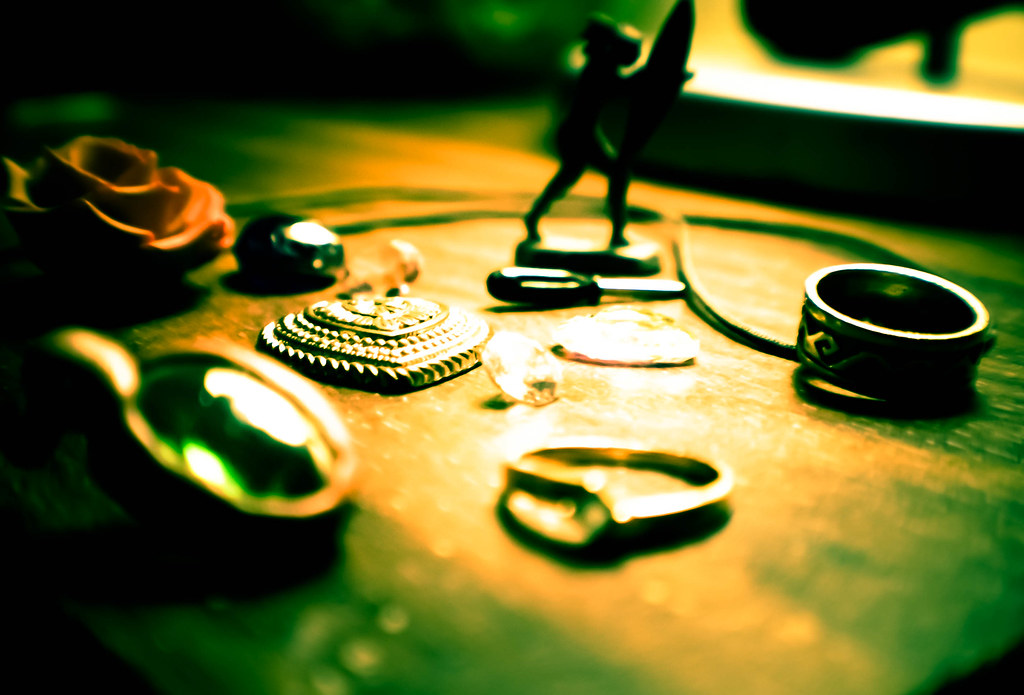
It can be really interesting to consider what items your characters treasure. Most of the time, these items hold more sentimental value than actual value—in A Gathering of Shadows, for example, Lila carries a shard of a statue from the first book as a sort of security blanket. In the same series, Kell's item is his magic coat—he doesn't go anywhere not wearing it, if he can help it.

Trinkets your characters carry can be a subtle way to deepen your characters, or hint at what they're feeling. A character might reach for their trinket when they're nervous, or upset, for some kind of reassurance. They might wear their trinket for all to see or display it in a prominent place—or they might hide it, as something too personal to share with others.

I like using trinkets to help ground my characters—after all, many of us can relate to reaching for something familiar in our uncertain moments. Of course the danger, for me, is I sometimes forget the characters have them, then have to add them back in during revisions (whoops!), but I do think they can be a useful (and easy) way to add another dimension to your characters.

So now I'm curious: do you use character trinkets?

Twitter-sized bite:
What items do your characters treasure? @Ava_Jae talks using trinkets to deepen your characters. (Click to tweet)
Related Posts Plugin for WordPress, Blogger...