Book Review: IGNITE ME by Tahereh Mafi

Photo credit: Goodreads
I have so many things I want to say about this book, but unfortunately many of them are slightly spoilery, so this review is actually kind of tough to write.

First let’s start off with the Goodreads summary:
“Juliette now knows she may be the only one who can stop the Reestablishment. But to take them down, she'll need the help of the one person she never thought she could trust: Warner. And as they work together, Juliette will discover that everything she thought she knew-about Warner, her abilities, and even Adam-was wrong.”
So, that’s actually a pretty vague summary, but anyway. Ignite Me is the third and final book of the Shatter Me series. I already reviewed the previous two books Shatter Me and Unravel Me, if you’re interested.

Now for Ignite Me. I have to say, throughout the first two books, Juliette was not my favorite protagonist ever. I didn’t hate her by any means, but while I loved her voice (because Tahereh Mafi has the most gorgeous prose I’ve basically ever read), I didn’t particularly love all of Juliette’s decisions or her outlook.

That being said, Juliette’s development from first book to last is incredible. This series easily has some of the most nuanced, dramatic and yet believable character development you’ll find out there (so, for YA writers, this is a fabulous example of how to do character development right. Seriously).

What I also loved about the conclusion to this trilogy is that it didn’t end anything like I expected it to. I don’t want to spoil anything, so I’ll just refer back to the character development note, but that’s really what resonated with me so strongly.

The only gripe I have is that I felt climax came and went a tad bit too quickly, but honestly, I loved the book far too much to really care.

So that about covers it! If you like fast-paced YA with fabulous character development and a truly unique and beautiful voice, I highly recommend this series. I loved every book and look forward to more of Mafi’s work.

Have you read the SHATTER ME series? 

Twitter-sized bite: 
Writer @Ava_Jae gives IGNITE ME by Tahereh Mafi 5/5 stars. Have you read this book? (Click to tweet)

Editing & Revision: Really Actually Not Optional

Photo credit: Nick Harris1 on Flickr
So I’ve kind of written bits and pieces of this post before, but after coming across a painfully erroneous comment on a blog post earlier this week (not my own), I felt the need to say this again, in more detail. So here we go. 

If your goal is to be a successful published writer, whether self or traditionally published, then you need to take editing and revisions seriously. They’re not optional. Period. No exceptions. Done.

This means a few things.

First, it means you need critique partners and beta readers. There are loads of places to find them, particularly online, and I broke down some great CP-finding resources here, so I’m not going to go over that again. But before you even think about submitting your work somewhere or hiring an editor, please take the time to find some critique partners. I recommend at least two (three is even better, in case you need a tie-breaker), but if you can handle swapping with more, go for it.

After you’ve swapped with betas and CPs, you need to look at their notes and make changes accordingly. This is the part where you decide what you want to change and what you don’t. Remember, it’s your story, but take the time to consider every comment carefully. Sometimes I find it helps to read through it, then let it sit for a day before you dive into edits, but it’s up to you.

However many times you repeat the process is also up to you, but the point is that you get it looked at by several people and take time to make the changes you need.

The changes you’ll be making in this stage are a good thing. Your CPs will see weaknesses that you didn’t, because you’re too close to your words. They’ll point out areas that are confusing, or slow, or difficult to understand, or whatever the case may be. This serves two purposes—not only does it help your book, but it helps you learn what areas you need to work on.

As far as hiring an editor goes, I personally only think this is necessary if you’re self-publishing. But if you are self-publishing, then it’s not an option. Traditionally published books don’t hit the shelves without passing under the careful gaze of an editor for a reason—editors help you get to the core of your story and really make it shine.

Can you hire an editor before submitting to agents or a small press? Sure, if you want to. But I wouldn’t recommend it if you haven’t passed it through a couple critique partners, first.

In the end, the point is this: editing and revision are vital parts of the writing process. Even if you manage to write beautiful, gleaming first drafts, a first draft is never ready for straight publication or submissions. Some manuscripts naturally need more editing than others, but regardless, this is a step that you can’t skip. Not if you’re taking your work seriously.

What do you think? Do you agree or disagree that editing and revision are not optional? 

Twitter-sized bites: 
"If your goal is to be a successful published writer...you need to take editing & revisions seriously." (Click to tweet
Writer @Ava_Jae says editing and revisions are never optional. Do you agree or disagree? (Click to tweet)

5 Publishing Myths That Need to Stop

Photo credit: Abee5 on Flickr
Every once in a while, I’ll hear someone make a blanket statement about writing or the publishing industry. Sometimes it’s a disillusioned writer, sometimes it’s someone trying to sound in the know to their unknowing friends, but one way or another there are some publishing myths floating around that I’d like to stuff into a plastic vat and dissolve in acid. At least, here.

So without further ado, here are five publishing myths that I personally think need to be destroyed:

  1. You can only get published if you have connections. If you believe this even for a second, I highly recommend you get a Twitter account and start following some agents ASAP. Agents find new authors through cold querying all the time—that is, writers they’ve never interacted with who submitted to their slush pile. Do connections sometimes help? Sure, I suppose, if you have any. But by and large, most writers starting out don’t have any, and it is absolutely not a requirement to finding success as a writer. 

  2. Self or traditional publishing is the only way to fame and riches. Repeat after me: there isn’t ONE correct answer for everyone. Self-publishing is not the right choice for everyone. Traditional publishing is not the right choice for everyone. Some people just want to see their book on the shelf when they walk into Barnes & Noble—and they’re not stupid for going the traditional route to meet that dream. Some people want to have much more control over the process and higher royalties—and they’re not stupid for going the self-publishing route to meet that dream.

    Honestly, there are so many methods and options out there for writers, and we should be celebrating those opportunities, regardless of whether or not you intend to use them.

    Also, if you’re looking for fame and riches, you’re in the wrong profession. Write because you love to write and because you want to create stories regardless of how much money you may or may not make. But don’t expect to get rich doing it, because while it does very occasionally happen, it’s certainly not the norm. 

  3. Anyone can write a book about a popular topic and become insta-rich. No.

    Whenever I hear someone say something along these lines, it’s an automatic sign to me that they know absolutely nothing about the publishing industry. Those so-called overnight success, hugely successful authors we hear so much about are about as rare as lottery winners—and they certainly didn’t find their success by jumping on a bandwagon (or overnight, for that matter).

    The thing that non-publishing people often don’t realize is that it takes years for a book to go from first draft to traditionally published. Even after a contract is signed and a book is officially going to be published, it often takes two (or even more) years before the book hits the shelf. So to imply that writers can look at what’s uber-popular, crank out a book like nothing and make millions is pretty erroneous on several counts. And that’s not even considering how difficult it is to write a polished book. So there’s that. 

  4. YA novels are inferior to Adult novels. This one will never cease to make me angry. Ever.

    I’m not saying that if you don’t like YA that something’s wrong with you, but what I am saying is that judging an entire category based off preconceptions or a single book that you heard about once (or hell, even a single book that you read and hated once) is wrong. YA authors have brought some of the most powerful, emotional, beautiful, exciting books I’ve ever read. And just because they’re written with teens in mind doesn’t mean that adults can’t enjoy them or that they’re somehow not worth as much as a book written for an adult audience. 

  5. Authors make so much money, it doesn’t matter if I illegally download their book for free. This is probably one of the few things that’ll make me rage more than the previous point. I wrote a whole post about why this is so beyond not true here, but the short version is this: most writers don’t make a lot of money to begin with, and pirating is the equivalent of taking money out of their paychecks. Money that they need for bills and food and everything else. So stop, ok? 

What do you think? Do you have any publishing myths you’d add to the list? 

Twitter-sized bites: 
Writer @Ava_Jae shares 5 publishing myths she believes need to stop. Do you agree? (Click to tweet)  
"You can only get published if you have connections" and four other publishing myths that need to stop. (Click to tweet

Don’t Stop Learning

Photo credit: paloetic on Flickr
Occasionally, when I’m feeling nostalgic or mining for blog post ideas, I’ll browse through some old blog posts. And sometimes, I’ll come across something past-Ava said like “I don’t normally read sci-fi…” and “[the] alternating first person POV, which was a little difficult to adjust to…” and I just laugh and pat sweet, naïve past-Ava on the back. 

I have learned so ridiculously much since starting this blog back in 2011.

2011 Ava had barely touched the surface of this thing called YA. She found books with multiple POVs jarring, didn’t know what QueryTracker was, was a total Twitter n00b, had never participated in NaNoWriMo and all of her books fit on one bookshelf.

Since writing the review I quoted from above, I’ve written two Sci-Fi manuscripts and three dual-POV books. I no longer find multi-POV novels jarring, in fact, I kind of love them. A lot.

So I do have a point to this post, and it’s this: the biggest lesson I’ve learned thus far, is that we’re never done learning and growing as writers. 2011 Ava never would have imagined that she’d one day write and absolutely adore a dual-POV Sci-Fi novel with aliens, of all things. I mean, 2011 Ava barely liked alien movies, for crying out loud.

One of the many things I love about writing is there’s always more to learn and discover—both about yourself and the craft. You can always improve a certain skill or discover that you love something you didn’t think you would, or learn a better writing/plotting/whatever technique.

And if you ask me? That’ll never get old.

Now it’s your turn—what's the biggest lesson you've learned since you first started writing? 

Twitter-sized bites: 
"One of the many things I love about writing is there's always more to learn and discover..." (Click to tweet)  
What's the biggest lesson you've learned since you first started writing? Join the discussion at @Ava_Jae's blog. (Click to tweet)

Discussion: Do Your Characters Surprise You?

Photo credit: junxdelux on Flickr
Here’s something that never ever gets old, at least not to me—I absolutely adore it when my characters surprise me.

Whether it’s a side character who out-muscles another for the role of love interest, a minor character who makes himself a major player, or a character who does something so completely shocking and unplanned that I have to pay attention to him…I love it. And those were all real examples.

To me, when my characters start taking control and doing things I hadn’t planned, it’s a sign that the story is taking a life of it’s own. It’s exciting, because it’s then that I know I’ve made the leap from writing to connect the dots (because I’m an outliner), to actually falling into the story.

And while I don’t like to make definitive statements, I suspect it’ll never get it old.

Now I want to hear from you: do your characters surprise you? 

Twitter-sized bite: 
Writers, do your characters surprise you? Join the discussion at @Ava_Jae's blog. (Click to tweet)

Fictional Parents: An Obstacle or a Missed Opportunity?

Photo credit: alvarezperea on Flickr
So I thought today I’d write a post rounding up some of my favorite parents from various books I’ve read, but when the time came to start listing them…it occurred to me that I couldn’t really think of all that many.

I’ve already written about the parenticide trend, so I guess I shouldn’t have been all that surprised, but I hadn’t really thought about just how much it permeates kid lit in well over a year (when I wrote that last post).

That being said, with some help from lovely Twitter friends, I managed to think of a grand total of three awesome parental figures. Which…isn’t much, but it’s a start.

In no particular order!
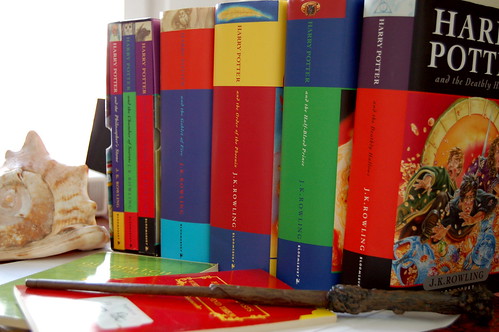
  1. Harry Potter (J.K. Rowling): Arthur and Molly Weasley

    Where to begin with the Weasleys? On top of being overall wonderful parents to their extraordinarily large family, they also pseudo-adopted Harry, have the best combination of quirks, and are badass wizards when they need to be. They were the loving parents Harry didn’t have in his childhood, and they even had time to knit embarrassing Christmas sweaters for all of them every year.

  2. The Mortal Instruments (Cassandra Clare): Lucian (“Luke”) Graymark and Jocelyn Fray

    Technically, Luke is Clary’s kinda-not-really-step-dad because Clary’s biological dad is decidedly not awesome (at least, not at parenting). But Luke has really grown on me throughout the series (note: I’ve only read the first three books so far). Without spoiling the extent of his badassness to those who haven’t read the books or watched the movie yet, all I’ll say is he’s the perfect blend of caring step-dad and awesome character.

    Jocelyn, on the other hand, is a little MIA for a while, but the more you learn about her, the more you realize the full extent of what a wonderful (and pretty darn cool) mother she is.

  3. Artemis Fowl (Eoin Colfer): Butler

    So, ok, Butler isn’t Artemis’s father—and his parents are actually in the series, but, well, they’re not exactly my favorite. But Butler! If you ask me, he’s more of a father figure to Artemis than his actual father is, and he’s certainly sacrificed a hell of a lot more for Artemis than the Senior Fowl. So in my book, Butler wins the Awesome Parent of the Year award. 
With these examples aside, the fact that it took so much digging for me to even come up with three examples got me thinking. Naturally, I understand the reasons parenticide works so well in kid lit, but the huge majority of dead, negligent, or just terrible parents in literature in contrast to the awesome parents mentioned in this post has made me wonder if maybe we’re missing out on an opportunity when we kill off parents in books. Every situation is different, of course, but I think I’d like to see more involved parents, and badass parents, and parents who are just plain awesome.

What do you think? Are fictional parents an obstacle or a missed opportunity?

Twitter-sized bites: 
Writer @Ava_Jae muses on parenticide and some of kid lit's best parents. Do you agree? (Click to tweet)  
Are fictional parents an obstacle or a missed opportunity? Join the discussion at @Ava_Jae's blog. (Click to tweet)

NEWS: How I Got My Agent!

Oh you guys. I’ve been dreaming about writing this post since I first started blogging, and now it’s here. It’s here!


I have the privilege of sharing my How I Got My Agent story! And I know it's long, so if you want to skip to the end, I'm fine with that. I won't know the difference. ;)

I started writing my tenth manuscript, an NA Sci-Fi novel, on May 22, 2013 and I finished the first draft on June 14th. It was the fastest I’d ever completed a first draft at the time, and I was floating. The book was totally different from anything I’d written in a long while—up until then I’d only written YA (albeit, my characters tended to border 17/18) and I’d written a lot of paranormal. But I learned the hard way YA Paranormal is insanely hard to break into right now, so I decided to try something new.

After several months of editing and trading with critique partners, I sent out my first batch of shiny queries on September 6th. The next couple weeks filled my inbox with loads of form rejection letters and one particularly nice personalized rejection—but rejections nonetheless. I started thinking maybe trying something different didn’t matter and the result would be the same as the last four manuscripts I’d queried.

I kept submitting and distracted myself with reading and brainstorming.

On October 7th, I submitted to Miss Authoress’s Secret Agent Contest. Unlike many other writing contests, the entries are chosen by a random lottery generator, so your odds of making it in are 100% random. Those who are chosen get an e-mail before the entries are posted to let them know they’ve made it into the lottery. I’d entered a Secret Agent contest with a different manuscript earlier in the year, so I knew how it worked and what to expect.

Except I didn’t get an e-mail. My entry wasn’t chosen for the contest.

I was disappointed, but I distracted myself with NaNoWriMo plans and continued to send out queries. I reminded myself there were loads more contests coming up like Agent Treat and Baker’s Dozen and Pitch Wars, so I always had another chance in the future.

Then, on October 14th, the Secret Agent was revealed—except it was a surprise of two secret agents, Emily Keyes and Louise Fury, and thus there would be twice the winners, which were posted shortly thereafter. To this day, I’m not sure why I clicked to see who the winners are—I don’t usually, especially if I’m still kinda disappointed, which I was. But I clicked and read the names of the winners.

And I nearly had a heart attack. Because listed under “Runners up” was “#41 Slave and Sira.”

I stared at the winner entry. It couldn’t be a coincidence, could it? Had someone else named their novel Slave and Sira? That seemed really unlikely, considering “Sira” is a word in a language I made up for the novel.

I raced over to entry #41 and read, with shaking fingers, my entry. The first 250 words of my novel. The entry that I was sure hadn’t made it into the contest was posted, and had comments, and the secret agents said it was a strong opening. What. What?!

I ran back to the winner post and checked again to make sure I wasn’t dreaming, but it was there! Louise Fury wanted to see my query and the first three chapters of my manuscript. After receiving instructions from Miss Authoress, I sent off the partial that very same day. And I danced. Around Twitter, anyway.


I worked hard to distract myself and finished my outline for the NaNo novel. Then on Halloween, I received a request from Team Fury for the first fifty pages. I danced for joy and sent the pages, announcing to myself that I’d received the best Halloween treat ever.

Then I prepared myself for the long haul. Ms. Fury’s stated response time was 4-6 weeks on partials and 6-8 weeks on fulls. I focused on NaNoWriMo and didn’t think about my partial…until I received a request for the full a couple days later on November 3rd. I was beyond excited. I ran around the house and jumped up and down and sent out the full and squeed with joy. Literally. I was brimming with happy energy.

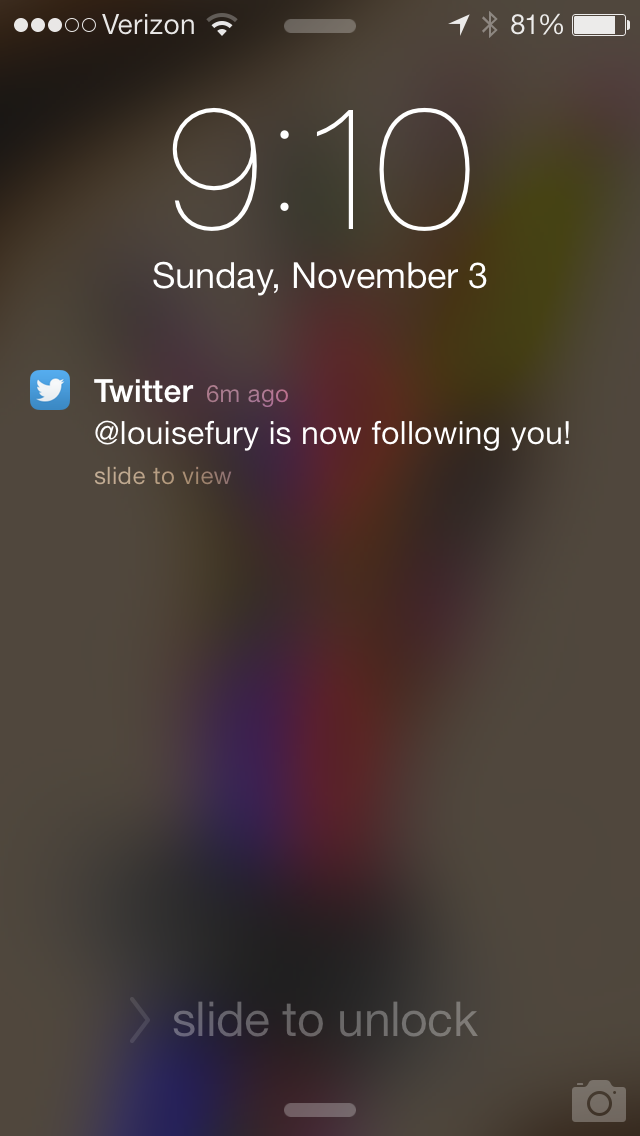
Then a couple hours after I sent the full, this happened:


Ironically, I was in mid-text conversation with someone, telling them the good news about an agent having my manuscript when I got the notification. I may have flipped out in mid-conversation and been all OMG THE AGENT IS FOLLOWING ME ON TWITTER. I REPEAT, THE AGENT IS FOLLOWING ME ON TWITTER and my poor non-writer non-Twitter friend was confused, but I regret nothing.

I’m not gonna lie, the next couple weeks were filled with me checking to see if I’d been unfollowed because she decided she didn’t like my manuscript after all and I might have checked just to make sure I wasn’t dreaming. But I wasn’t dreaming. And she didn’t unfollow. And I focused on NaNoWriMo and tried really hard not to think about my manuscript being read by the amazing Louise Fury. For the record, I totally failed—I was thinking about it constantly.

Then Pitch Wars came along and a few members of Team Fury were mentors and I wasn’t sure what the protocol was for mentors who may or may not have already looked at your full, so I asked. And after the most nerve-wracking twenty minutes of my life, a fabulous Team Fury mentor told me the team already had a meeting and I might not have to submit to Pitch Wars and I should be hearing from Ms. Fury soon.

QUEUE FREAK OUT.


I’m not gonna lie, you guys—I started crying. Happy tears. I kept telling myself it might be an R&R request but I didn’t even care—I’d be totally happy with an R&R.

Then started the longest two weeks of my life. Because I didn’t hear anything and I was glued to my e-mail and I kept fighting off stupid neurotic thoughts like what if she changed her mind or what if they confused you with someone else and my anxiety levels slowly crept up. And I tried to keep cool and calm and collected.

But then the Pitch Wars entry date came. After major agonizing over a decision about whether or not to enter with a CP, I submitted thinking if I heard anything, I’d withdraw right away.

Then on December 6th, just twenty minutes before I’d been planning to go to bed, I got the e-mail I’d been dreaming of for years: Louise Fury had read my manuscript more than once, spoken with her team members, and they wanted to talk to me. Was I available this weekend?

HELL YES I WAS AVAILABLE.

I was immediately overloaded with excitement and anxiety. Anxiety up the wazoo. We scheduled the call for the next day and I barely slept that night. I collected my list of questions and reviewed my research and when the call came, my hands were cold and shaking.

The call itself is a blur. Team Fury shared my vision for the book, and I agreed with the edit suggestions, and Louise was totally supportive of my wanting to write in multiple categories and genres, and when I hung up the phone, I was having a major David After Dentist episode.


I had seven queries out at the time, so I sent out three notices and five withdrawals, including the withdrawal from Pitch Wars. Out of the three notices, I received two requests for the full and one non-response. Both agents who requested graciously bowed out, and I was actually relieved, because it saved me from the agony of having to choose.

Which is great, because my choice? She’s pretty darn awesome. And it may have taken ten manuscripts and eight years, but I am so incredibly honored to say I’m now represented by Louise Fury of The Bent Agency! And I could not be happier to be joining Team Fury. :D


Query Stats (for this manuscript):
Total Queries Sent: 25
Rejections: 21
Partial Requests: 1
Full Requests: 4
Offers of Rep: 1
Twitter-sized bite: 
How writer @Ava_Jae landed her agent Louise Fury with her tenth manuscript. (Click to tweet)
Related Posts Plugin for WordPress, Blogger...