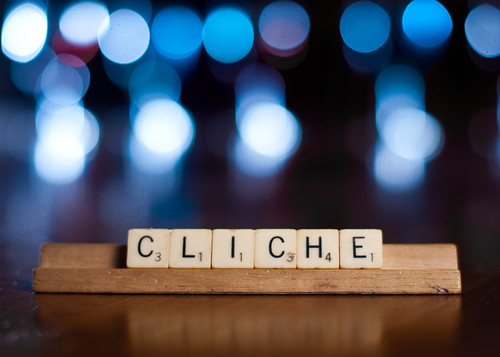
On Clichés and Writing

Photo credit: Tom Newby Photography
Oh, clichés. We writers hear about them all the time—how to avoid them and how to recognize them and exorcise them from our work to avoid the dreaded words of this is a cliché.

But lately I’ve been thinking about plot-related clichés and how, while we’re advised to avoid them whenever possible, they sometimes work.

The Hunger Games, The Coldest Girl in Coldtown and Every Day all start with their protagonists waking up. And each of them make it interesting and necessary and twist the cliché in a way that works.

Divergent the opens with a cliché writers are often told to avoid: characters describing themselves while looking in a mirror. And yet Roth did it and got away with it why? Because she made it work.

Now does that mean as writers that we shouldn’t bother trying to avoid clichés? Not so much. As many of Amy Trueblood’s first five pages interviews with agents have shown, clichés in openings in particular are often an instant turn-off for agents who see them way overused. But on the other hand, I don’t think the use of a cliché means the immediate death of your manuscript either…as long as it’s handled well.

Let’s take a look at the opening clichés in the published books I mentioned above.

The Hunger Games (Suzanne Collins) starts like this:
“When I wake up, the other side of the bed is cold. My fingers stretch out, seeking Prim`s warmth but finding only the rough canvas cover of the mattress. She must have had bad dreams and climbed in with our mother. Of course, she did. This is the day of the Reaping.”
Why does this work? Because this isn’t a typical character waking up and brushing their teeth like every other day morning. This opening is laced with foreshadowing and a sense of foreboding, and right off the bat readers are left with questions.

Now The Coldest Girl in Coldtown (Holly Black):
“Tana woke lying in a bathtub. Her legs were drawn up, her cheek pressed against the cold metal of the faucet. A slow drip had soaked the fabric on her shoulder and wetted locks of her hair. The rest of her, including her clothes, was still completely dry, which was kind of a relief. Her neck felt stiff; her shoulders ached…”
Why does this work? Because Tana woke in a bathtub for crying out loud. We know (or at least, sincerely hope) this isn’t normal and as she begins to take in her surrounds, we get the sense more and more that something is off.

Now Every Day (David Levithan):
“I wake up. 
Immediately I have to figure out who I am. It’s not just the body—opening my eyes and discovering whether the skin on my arm is light or dark, whether my hair is long or short, whether I’m fat or thin, boy or girl, scarred or smooth.The body is the easiest thing to adjust to, if you’re used to waking up in a new one each morning…” 
I think it’s pretty obvious why this works so well, namely, our protagonist immediately tells us he wakes up on a new body every day. That this is normal for him, which to me, is insanely intriguing.

Finally, Divergent (Veronica Roth):
“There is one mirror in my house. It is behind a sliding panel in the hallway upstairs. Our faction allows me to stand in front of it on the second day of every third month, the day my mother cuts my hair.” 
Why does this work? Because when she looks at her reflection, she has to sneak a look, because it’s not allowed. Tris has rarely ever seen her reflection up to that point, and is only permitted to sit in front of a (hidden) mirror once every three months.

These are just a couple examples, but the point is this: while clichés are generally best to be avoided, if you’re creative with them and make them unique to your manuscript in one way or another, they can still work.

What do you think? Have you ever tried to make a cliché work in a manuscript of yours? 

Twitter-sized bites: 
Are clichés a death sentence to your MS? Here's why writer @Ava_Jae says not necessarily. (Click to tweet
"While clichés are generally best to be avoided...they can still work." (Click to tweet)

Discussion: Do You Finish Every Book You Read?

Photo credit: Jim Belford on Flickr
Often on Goodreads, I’ll see people who have shelves of books they didn’t finish reading, something I find interesting, because as a rule, I nearly always read books from start to finish.

I’ve been thinking lately about what that is, and while I suppose I could say it has something to do with being taught early on to finish what I start, considering the only books in recent memory that I didn’t finish were books that I won in giveaways, I suspect it may also have to do with the fact that I buy just about every book I read. (Though if I ever aim to read 100 or more books in a year, this will probably change because money).

At any rate, I think by buying a book, I’m making a commitment of sorts to actually read it. And many times (though I’ll admit, not always), I’ve found that books I wasn’t enjoying quite as much had a great ending that still allowed me to enjoy it overall.

I’ve heard some say that they don’t have time to waste on books they aren’t enjoying, which I definitely understand. It’s why I always sample books before I buy, unless I’ve read the author’s work before and trust them to write a book I’ll enjoy. But if I’ve read more than an initial sample and decided to add it to my library, then I’ll read it cover to cover, even if I don’t love it as much as I hoped I would.

But I know not everyone works that way, and there’s nothing wrong with that. So I’m curious—do you finish every book you start reading? 

Twitter-sized bite: 
Do you finish every book you start reading? Join the discussion at @Ava_Jae's blog. (Click to tweet)

Should You Enter That Pitch Contest?

Photo credit: amortize on Flickr
So I’ve already written about why you should consider entering pitch contests, but I’d like to talk about the other side of the coin—that is, reasons you might not want to enter, or may want to pause before entering a contest.

Because the truth is, yes, contests are exciting and yes, they are absolutely wonderful opportunities that have lead to many writers landing agents or publishing contracts. But there are a couple questions you’ll want to ask yourself before entering a pitch contest:
  1. Is my manuscript polished? No really, be honest with yourself. These contests are for writers who are ready to query, or already are querying. If you’re not ready, then you won’t be doing yourself any favors by submitting early. Remember, you only get one first impression—don’t you want yours to be the very best it can be?

    Side note: if you see a contest coming up and you’re tempted to rush through your edits so that it’s ready on time—don’t. Take all the time you need to make your manuscript as good as you can possibly make it. There will always be another contest, but as I said above, you only get one first impression. 

  2. What can I get from this contest? Different writing/pitch contests have different prizes and goals. Some put your pitch in front of agents and/or editors, some provide winners with critiques and some do both. Make sure you understand what the aim of the contest is, and be sure you actually want the prize. If, for example, the winners have their pitches posted in front of agents or editors you aren’t interested in working with, then don’t waste the judges (and the publishing professionals) time by entering.  
If you’ve answered these questions favorably, then great! Get your pitch and whatever other entry requirements ready, follow the submission guidelines and good luck! But if not, then you may want to think long and hard before hitting that “submit” button.

For fun, here are some pitch contests that (I think) happen every year, with estimated dates:


NOTE: This is not a comprehensive list of contests, nor is their listing a guarantee that they'll be running again this year. This list is speculation based off previous years. Also, if you know of some contests I'm missing, feel free to let me know!

Have you entered any pitch contests? What was your experience like? 

Twitter-sized bites: 
Thinking you might enter that pitch contest? Make sure you ask yourselves these questions first. (Click to tweet
"You only get one first impression—don't you want yours to be the very best it can be?" #pubtip (Click to tweet)

Review: The Coldest Girl in Coldtown by Holly Black

Photo credit: Goodreads
So last week I shared my five favorite books of 2013, but shortly after writing it, I finished a book that definitely deserved to be on the list, namely, The Coldest Girl in Coldtown by Holly Black. Rather than trying to squeeze it in last minute, I decided to give it it’s own post. And here it is.

As I like to do with reviews, I’ll start with the Goodreads summary:
“Tana lives in a world where walled cities called Coldtowns exist. In them, quarantined monsters and humans mingle in a decadently bloody mix of predator and prey. The only problem is, once you pass through Coldtown’s gates, you can never leave. 
One morning, after a perfectly ordinary party, Tana wakes up surrounded by corpses. The only other survivors of this massacre are her exasperatingly endearing ex-boyfriend, infected and on the edge, and a mysterious boy burdened with a terrible secret. Shaken and determined, Tana enters a race against the clock to save the three of them the only way she knows how: by going straight to the wicked, opulent heart of Coldtown itself. 
The Coldest Girl in Coldtown is a wholly original story of rage and revenge, of guilt and horror, and of love and loathing from bestselling and acclaimed author Holly Black.”
For those of you wondering, yes this is a vampire book. But it is by no means just a vampire book.

As I tend to do with books that I wholly adore, I blew through all 400+ pages in 48 hours. Right off the bat, I knew I was reading a fantastic book—I was gripped from the first page to the last and I loved every moment of it.

Granted, I’m not anti-paranormal or sick of vampires, but even if I was, I suspect I would have loved this book just as much. This isn’t a girl-meets-super-sexy-vampire book, this is a book about survival and making difficult decisions to protect the people you love. This is a book with truly memorable and complicated characters and incredible twists. And as a bonus to some, it’s a standalone novel.

I’m going to continue to recommend this book to anyone who will listen, because I loved it that much. It immediately jumped onto my favorite books list and I hope to see more vampire books that are just as compelling and ultimately, perfect.

Have you read this book? What was your favorite book of 2013? 

Twitter-sized bite: 
Here's a five star review for THE COLDEST GIRL IN COLDTOWN by @hollyblack. Have you read this book? (Click to tweet)

Discussion: Do You Print Your MS for Editing?

Photo credit: mpclemens on Flickr
So with revisions coming up for me, I’ve been naturally thinking about editing. A lot. And as I’ve seen people on Twitter mention printing out their manuscripts and getting the red pens ready, it occurred to me that it’s been a while since I’ve actually printed out a manuscript. Like, well over a year. Maybe even two.

Now, that’s not to say I haven’t done any revisions—on the contrary, I’ve done loads of revising over the last couple years. But after having printing issues a while back, it occurred to me that there are other ways to change formats so that I can look at the manuscript with fresh eyes.

  • E-bookify! Exporting my draft as an e-book (using Scrivener) and reading it on an e-reader has been my favorite new method for a first read-through, specifically using iBooks on my iPad, which I’ve already blogged about.

  • Font fun. I’ve also heard of people changing the font and font size between drafts, and while I haven’t tried that myself (yet), it sounds like an easy way to change the way you look at your WIP.

  • Read it aloud. For purposes of revising for flow, reading your book aloud to your dog, a family member or an empty room works wonders.

So those are just a couple quick options, but now I want to hear from you: do you print your manuscript for editing?

Twitter-sized bites:
Can't print your MS out to edit? Here are a few other options to see your WIP in a new light. (Click to tweet)  
Writers, do you print your MS for editing? Join the discussion at @Ava_Jae's blog. (Click to tweet)

What Would You Like to See More of in Books?

Photo credit: katerha on Flickr
With the new year well on it’s way and my new reading challenge all set up, I think now’s as good a time as ever to think about books, and more importantly, what I’d love to see more of in my future reading.

To clarify, I’m not saying that any of the elements I mention below aren’t being done—all I’m saying is I’d like to see more. And maybe you would too.

So without further ado, here are five elements I’d like to see more of in my future reading:

  • Diverse characters. I’ve seen a big push for this, especially this year, and I love it. I want to see more characters from different cultures, characters who are disabled, characters who are struggling with mental or chronic illnesses, characters who aren’t defined just by their sexualities or just by their ethnicity or just by their health, but by everything put together. I want diversity within the minorities and I want characters who aren’t just one thing. 

  • Diverse settings. Don’t get me wrong, I love medieval-Europe based fantasies and US-based dystopias as much as anyone else, but what about the rest of the world? One thing I love about Leigh Bardugo's The Grisha trilogy is that it’s a steampunk-like fantasy based off of Russian culture (how cool is that?) and I adored Amanda Sun's Ink for it’s portrayal of (a glimpse, anyway) of modern-day Japanese society. I want more of that.  

  • Unreliable narrators. I can’t even explain to you how much I adore unreliable narrators. Whether they’re deliberately lying or not, I can’t get enough of protagonists who take me on a journey, only to reveal that the journey wasn’t quite like I’d been lead to believe. 

  • Awesome heroines. I want to see girls who embrace who they are, whoever they are. I want to see girls who save themselves, girls who admit they need help, girls whose lives don’t revolve around the next relationship, girls in healthy and loving relationships, girls who are smart, girls who are independent, girls who kick ass and girls who may not kick ass, but sure as hell aren’t waiting around for their prince to come and save them, either. I want to see girls who like to look pretty, girls who don’t care, girls who embrace femininity, girls who fit in with the guys and are comfortable in their own skin. I want to see girls of all shapes, sizes, colors, personalities and everything else, girls who are strong sometimes and broken others, girls who are emotional, girls who are not, and most of all, I don’t want to see them crucified for being themselves. 

  • An expansion in New Adult. Don't get me wrong, Contemporary Romance is great, but I think New Adult has the potential to be so much more than just one subgenre. I've seen some self-published writers push the boundaries in New Adult, and I want to see more—I'd love to see Paranormal and Sci-Fi and Fantasy and Thriller New Adult on the shelves. 

What do you think? Would you like to see more of these or other elements? 

Twitter-sized bites: 
Would you like to see more of something in your reading? Share your thoughts on @Ava_Jae's blog. (Click to tweet)  
What would you like to see more of in books? Join the discussion at @Ava_Jae's blog. (Click to tweet

Discussion: When Did You Know You Wanted to Be a Writer?

Photo credit: JohnONolan on Flickr
Fun fact: I didn’t always want to be a writer.

I’ve often read about authors who had never dreamt about anything else, who can’t remember ever wanting to be anything else. But that’s not me. Not quite.

In elementary school, I had all sorts of occupational dreams. I wanted to be a doctor until I realized I’m squeamish after all, I dreamt of being a movie star until I learned the meaning of stage fright, and I told my friends and family that I wanted to be a missionary until my interest drifted elsewhere.

I had several elementary school teachers tell me I should be a writer, but the idea didn’t really resonate with me until I was neck-deep in the first draft of my first book. But by then, it wasn’t really a question, it wasn’t hey, maybe I should be a writer, it was more of a realization that I loved what I was doing and I didn’t want to stop.

So I didn’t stop. And I won’t.

What about you? When did you know you wanted to be a writer?

Twitter-sized bites: 
Have you always wanted to be a writer? Join the discussion on @Ava_Jae's blog. (Click to tweet)  
When did you know you wanted to be a writer? Join the discussion on @Ava_Jae's blog. (Click to tweet)
Related Posts Plugin for WordPress, Blogger...