On Writing Characters Who are Nothing Like You

Photo credit: found_drama on Flickr
Fun fact: up until recently, I found it more difficult to write female POV characters than male POV characters. 

Now that’s not to say that I consistently wrote one with a greater degree of success than the other, but I often found the voice harder to nail with my female POV characters than I did with the guys. 

For the longest time I couldn’t really figure out why that was—as a heterosexual woman, it would make sense that I’d find it easiest to write from a female POV…right? 

Problem was, I often got bored with the voices of my female characters. They largely came out sounding the same, which I knew was a problem, and if I was being honest with myself, they really weren’t all that interesting. It wasn’t until I wrote a WIP with a female POV character who was absolutely nothing like me that I realized the problem—my previous female characters were too much like myself. 

Writing is an opportunity to take a journey through someone else’s eyes. It’s a chance to step out of yourself and experience someone else’s life. I love that about writing, and so it makes sense to me that I love to write characters that are very different from me. 

Granted, parts of myself do slip into my character’s personalities. Many of my MCs share my love for sarcasm and have analytical minds. Some of them have trouble with empathy, like me, and many of them are pretty strategically-minded.

I’ve often seen people online ask how to write characters different from themselves, and the biggest bit of advice I’ve seen is one that I couldn’t agree with more: think of them as people first. Beyond race, gender, religion or sexual orientation, our characters are people first. They have opinions, desires, fears and dreams like everyone else, they have tempers and motivations and pet peeves and loved ones. 

If you figure out who they are first, the rest falls into place. It’s just a matter of getting to know them well enough so that you can. 

Do you find it difficult or easy to write a character unlike yourself? Why? 

Twitter-sized bites: 
"Beyond race, gender, religion or sexual orientation, our characters are people first." (Click to tweet) 
Do you find it difficult or easy to write a character unlike yourself? Join the discussion at @Ava_Jae's blog. (Click to tweet) 

Discussion: Do You Write in Chronological Order?

Photo credit: Raoul Luoar on Flickr
I’m a fairly organized writer. I usually plot a basic outline with plot points to guide me along the way before I write a single word, and I always write in chronological order. I tried writing out of order once and it ended in disaster (and an uncompleted manuscript), so it’s unlikely I’ll be trying that again anytime soon (but never say never, right?).

However, I am more than well aware that not everyone works remotely close to the same way I do.

There are writers who pants completely with absolutely no idea where the MS is going to take them when they sit down to write, and there are writers who plot every last detail then write completely out of order.

There isn’t a right or wrong way to go about it, which is why I like writing about process so much—it’s fascinating to me to see all the different ways writers operate.

I’ve often seen writers encourage each other to write the scenes that excite them first—I tend to do the opposite: I write the scenes as they come, and when I have a scene ahead that I’m dying to write, I use that motivation to get me through the scenes I’m less excited about. If I start to get bored at any moment, I make something happen—both to entertain myself and future readers who will likely be bored if I’m getting bored.

Being that I’m a fairly logical person, chronological order to me makes sense—my scenes build off each other and unplanned ideas I get in earlier scene often weave their way into future scenes.

However! That doesn’t mean my way is better. It’s just what works for me.

But enough about me, I want to hear from you guys—do you write in chronological order or do you skip around? Why? 

Twitter-sized bites: 
Do you write in chronological order when first drafting? Join the discussion at @Ava_Jae's blog. (Click to tweet)  
Do you write the most exciting scenes first when drafting? Share your process at @Ava_Jae's blog. (Click to tweet) 

Write the Next Book

Photo credit: steam_rocket on Flickr
I’ll always remember sitting with my first manuscript and a pile of rejections, wondering where to go from here. I didn’t want to give up on the book, and starting anything new felt just like that—giving up. 

I eventually tried to write a sequel, but got less than halfway through before I began to realize if I never sold the first book, book two would be dead on arrival. I wasn’t ready to trunk the manuscript, so I continued querying, but I also started a short story that evolved into my second manuscript. 

Eventually, I did trunk that manuscript. It wasn’t easy to finally put it aside and focus on something new because it felt like admitting defeat. But by putting it away and writing something new, I learned a very important lesson: the top priority for any writer should be to write the next book. 

Don’t get me wrong, social media is important and when you publish, so is marketing. Branding, reaching out to other writers, getting involved in the community, reading as many books as you can get your hands on—all of those things are important. But whether you’re unpublished, self-published or traditionally published, the best thing we can do to further our careers and improve our skills is to write the next book. 

For unpublished writers, the next book is a fresh opportunity to attract an agent or editor. 

For self-published writers, the next book is a new chance for readers to fall in love with your words. 

For traditionally published writers, the next book is another opportunity to sell and bring in some new readers. 

The next book is what builds our careers. It adds to our repertoire of skills and teaches us new things about the craft of writing and our own ability. It reminds us that writing is always the most important focus and teaches us to push through and be consistent. 

So take some time to connect with people on social media and promote your books and keep up to date on the industry. But above all, keep your top priority in mind: the next book. 

What do you think? Is writing the next book more important than social media and marketing?

Twitter-sized bites: 
"The best thing we can do to further our careers and improve our skills is to write the next book." (Click to tweet) 
Is is writing the next book more important than social media and marketing? Join the discussion at @Ava_Jae's blog. (Click to tweet) 
How to Find Blog Photos Using Flickr

Photo credit: Andy Woo on Flickr
So I received another question! And it's one that I've been meaning to answer, anyway.

As many bloggers are aware, including blog photos is a great way to add a little extra engagement to the page and make the post look more interesting visually. But with copyright laws and the possibility of lawsuits if photos are used incorrectly, it can sometimes be a little scary to start using photos.

The key is to find photos under a Creative Commons license, and I find all of mine through Flickr.

Flickr is a free site that you can log into with a Google, Facebook or Yahoo! account where photographers (amateur and otherwise) around the world upload and share their photos. And my favorite part about it is that you can search through copyright-free photos for free use in posts.

The steps are pretty simple:
  1. The search. Once you've logged into Flickr, you go up to the search bar in the top right corner and type in whatever key word you want to use to filter through photos. I usually choose something related to the post, so for instance, for this post, I searched "photos" "pictures" and "photography." 

  2. The Creative Commons filter. After you get your results, click “Advanced Search" to bring up the advanced search menu. From there, choose “Only search within Creative Commons-licensed content” at the bottom and it “Search” again to filter your results with only pictures that are copyright-free. 

  3. Choose your photos. Generally, I open up any photo I find interesting in a new tab, then mark my favorites with the star-shaped favorite button. This allows me to save any photos I like for future use and to also remind myself a) not to reuse them and b) to go back later on and let the person know I've used their photo (which is optional, and I am majorly behind on). 

  4. Copy the URL. Once you've picked your photo and checked the Creative Commons settings to see the rules (which is done by clicking the hyperlinked “Some rights reserved”…usually it's to add attribution, which you should always do anyway, but it’s good practice to check), right click the photo and select the size you want. I usually choose “Medium 500.” It will then bring you to a new page with just the photo. Right click the picture again and choose “Copy Image URL." From there you can use that URL to upload the picture into your post.
So that’s it! Don’t forget to add attribution (I usually like to link back to the artist’s Flickr page) and you now have a photo for your blog post. Enjoy!

If you blog, where do you get your blog post photos? 

Twitter-sized bites: 
Not sure where to find blog post photos? Blogger @Ava_Jae shares four easy steps to finding copyright-free photos. (Click to tweet)  
Don't break copyright law for a blog post photo—here are four steps to finding copyright-free images. (Click to tweet) 

Critique Etiquette: Should You Resubmit Revisions?

Photo credit: cellar_door_films on Flickr
So you’ve won a critique of your query letter, or first page, or first paragraph, or first fifty pages, etc. Or maybe you’ve come across a writer whose giving away critiques for free, or an event in which a bunch of writers give away critiques, or whatever the case may be. Point is, you’ve won a critique and you’re excited—and you should be! Critiques are exciting. And a little nerve-wracking. But worth being excited over. 

You send your critique off and you wait. Maybe the writer sends it back in an hour, maybe in a week, maybe longer, but regardless of how long it is, it feels like forever. Then the critique arrives in your inbox and you open it and…

Wow. That’s a lot of red. 

But you’re a writer! So you take the notes and you use it to rework your submission, but you’re not totally sure that it’s better. Or that those changes you made really worked. What if you made it worse? Oh God, what if you ruined it? What if?

At this point, you’re probably feeling pretty tempted to send it back to the writer who left you those helpful edit notes to take a second look at it. Just to make sure you didn’t go overboard. Or you didn’t miss the point of the notes. Mostly you just want to make sure you didn’t destroy your work. 

But while it is so tempting to resubmit that revision to the writer in question, and trust me, my lovely writers, I know how tempting it is, should you do it? Should you resubmit that revision? 

There are two possible scenarios with two very different answers. 

  • Scenario 1: The editor invited you to resubmit a revision x-number of times. This happens! It does, and when it does, it’s wonderful and I hope you thank that person profusely if you decide to take them up on their offer, because they’re not obligated to offer, but they did, and that’s really awesome of them. If this is your scenario, then send away! And be happy because the editor will reassure you that you aren’t losing your mind. 

  • Scenario 2: The editor did not mention anything about resubmitting a revision. This also happens. If this is your scenario, then do not resubmit, at least, not without asking first.

    The thing is, winning a critique is not an automatic invitation to submit your revisions afterwards. Many editors or critiquing writers consider freebies a one-off, and rightfully so—you’re getting their services and their time for free, and the thing with revisions is they can go on pretty much forever if you let them. They take a lot of time, and not everyone is able to give away that much time for free.

    You see, it’s not that one revision is a big deal—the issue is that when you ask an editor (or whoever is looking at your work) to look at your revisions without an invitation, you’re asking them to do so for anyone who asks, however many times they ask. Because once you say yes to one person, it’s much more difficult to say no to someone else, or even no to the same person when they want to send a third or fourth revision.

    By asking someone to take a second look at your work, when they hadn’t agreed or opened the door for you to do so, you’re putting them in an uncomfortable situation. On one hand, saying no isn’t fun, but saying yes makes it even more difficult to say no later. 

It’s a simple enough mistake, and I totally understand why some writers don’t realize that this is something than can make for a very uncomfortable situation for the person editing your work. Just remember: when in doubt, ask. But definitely don’t assume the answer is yes. 

Note: Just to be clear, I’m not writing this post to reprimand anyone. As I follow many editors on Twitter, I’ve seen this issue mentioned more than a couple times, so being that it’s not often discussed, I figured I’d write about it. 

Also, in paid or swapping situations, this is usually established right from the beginning. But if not, the safest thing to assume is if they didn’t invite a resubmission, you shouldn’t resubmit. Though if you’re not sure, it doesn’t hurt to ask. 

What critique etiquette tips do you have?

Twitter-sized bites: 
Is it ok to resubmit revisions after a critique? Here's why you may want to pause before you do. (Click to tweet)  
"Winning a critique is not an automatic invitation to submit your revisions afterwards." (Click to tweet) 

Speed & Quality: Not Mutually Exclusive

Photo credit: Steve Rhodes on Flickr
When writing about fast-drafting, I’ve often said it’s ok to write badly. I’ve said first drafts are ugly about 95% of the time, and it’s totally fine to write something that you tear apart later, and it’s normal (and completely acceptable) if your first draft sucks.

All of that is true.

But the bit I didn’t cover is just because you finish a draft quickly—even insanely quickly—doesn’t mean it’s going to suck. Just because you speed through a first draft like it’s your job doesn’t mean that what you’ve written is guaranteed to be total word vomit.

I say this, because I’ve heard of writers online getting crucified for finishing 50k in a couple days. I’ve seen some truly amazing people write 100,000 words or more in a week, and then feel discouraged because other writers accuse them of cheating or say that what they write must be total garbage and other rather unpleasant (and untrue) accusations.

Look, the thing about fast-drafting, or first drafting in general, is that your first draft is likely to be ugly. It’s likely that you’ll read it back and cringe in certain spots and it’s likely that when you read it back, you’ll destroy it with a red pen.

But are first drafts guaranteed to be horrible? Not at all. Even first drafts written a couple days can be relatively clean (relatively, because all drafts need work).

The truth is this: every writer is different. Some writers slam out a pretty cleanish draft in a few days and the rest of us envy their ability, but the thing is, it’s not impossible, and it’s not cheating.

Some writers take years to write a first draft, and the draft comes out ok. Or it comes out terrible. Or it comes out wonderful. All of these writers are equally awesome.

Some writers take a couple months to write a first draft, and the draft comes out average. Or it comes out horrible. Or it comes out clean. All of these writers are equally awesome.

Some writers take a few days to write a first draft, and the draft comes out meh. Or it comes out ugly. Or it comes out sparkling. All of these writers are equally awesome.

No two writers work the same way—hell, many writers don’t even work the same way with different manuscripts.

Fun fact: the fastest I’ve ever written a full first draft was in roughly three weeks (though this may change with this NaNo WIP, but I digress). When I read it back a month later, I’d expected it to be pretty rough—after all, I’d never finished a full manuscript in three weeks before (my previous record had been somewhere around a month), so it made sense that this WIP would be a little uglier than usual.

Except it wasn’t. To this day, that draft is the cleanest first draft I’ve ever written.

This NaNo draft, meanwhile? I’ll be the first to admit it’s going to get torn apart in edits and revisions. And that’s ok. Every MS is different.

My point is this: just because something is written quickly doesn’t mean it’s not written well. That’s not to say it’ll be perfect—nothing is perfect in the first draft stage—but writing quickly doesn’t automatically mean writing badly.

Speed and quality are not mutually exclusive. Every writer is different and it doesn’t matter whether it takes you two days or two years to finish a first draft, or if you need three rounds of revision to make it shine, or twenty before it’s presentable. Your process is yours and yours alone.

Own it. Keep writing. Ignore the haters. And know that you, writer, are amazing.

What is your first draft process like? 

Twitter-sized bites: 
"Just because something is written quickly doesn't mean it's not written well." (Click to tweet)  
Are all first drafts guaranteed to be horrible? Here's why one writer doesn't think so. (Click to tweet)  

How I Won NaNoWriMo in 9 Days

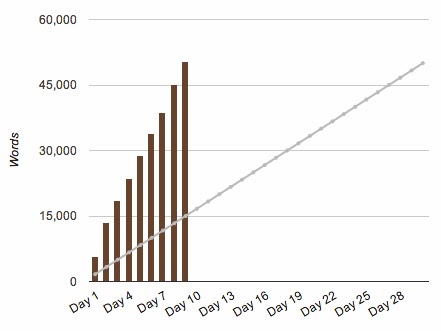
So this is my NaNoWriMo word count progress chart:


Or at least, that’s what it was on Saturday after I hit 50k.

So statistics! We like statistics. Here’s how my nine day breakdown went:
Day 1: 5,731 words written, 5,731 total.
Day 2: 7,724 words written, 13,455 total.
Day 3: 5,150 words written, 18,605 total.
Day 4: 5,145 words written, 23,620 total.
Day 5: 5,130 words written, 28,750 total.
Day 6: 5,056 words written, 33,806 total.
Day 7: 5,002 words written, 38,808 total.
Day 8: 6,251 words written, 45,059 total.
Day 9: 5,237 words written, 50,296 total. 
Daily average: 5,588 words.
Now, I wasn’t originally planning on writing 5k a day. My goal on November first when I started NaNoing was 2k a day, which is my normal writing goal when I first draft in any other month. I know from experience that I can maintain 2k a day pretty consistently, and it would bring me to 60k at the end of the month, which was fine by me.

But on day one I blew way past 2k and hit 5k with relative ease. I was hyped on NaNo and excitement and everyone was sprinting and I thought, why the hell not? and I kept writing way past my goal.

Day two I still said my goal was 2k. Then I started writing and got really excited again and Emmy Neal challenged me to be ambitious after I was tired and I thought, fine fine I’ll do it and I wrote until my brain collapsed at close to 8k.

Day three I hit 5k again and it occurred to me that I could probably keep doing this 5k a day thing and finish even faster than I thought. And my NaNo graph was telling me that at this pace I’d finish on November 9th or 10th and the competitive part of me didn’t want to see my daily average output drop so…I didn’t let it drop.

By day five I was no longer in denial. I knew my new goal was 5k a day, and more than that, I wanted to finish the entire book before the end of the month—or even better, before Thanksgiving because Black Friday is Get Assassin’s Creed 4 day and all bets are off after that. So.

That’s my current goal, and with 50k in the pot, I’m more than halfway there.

Being that this is the fastest I’ve ever sped through 50,000 words, there are a couple things I did (and didn’t do) to move the process along:

  • I turned my MS into mad libs. Well, not really—I just used a lot of placeholders. I’ve never used them before, but I’ve had some of you wonderful readers recommend them to me, and boy am I glad because they saved me a lot of getting stuck in mid-sentence upon realizing I don’t know a minor character’s name. Or the name of a town. Or an object. Or just about any world building or character-oriented detail that I’ve yet to work out. Instead of pausing to figure it out, I inserted a big fat (NAME) or (TOWN) or whatever other placeholder fit the particular situation. I have a lot of blanks. A lot. But it’s ok, because those are the sort of details I can work out in future drafts. 

  • I committed writing sins. I told instead of showed. And used filter phrases like nobody’s business. And summarized in places that would probably be better served without summary. And named emotions. And probably broke plenty of other writing rules I’m not thinking of at the moment. And as I continue writing the 30-some-odd-k left of this WIP, I’ll continue to do so.

    Why? Because this is a first draft, and the point of the first draft isn’t to get it perfect, it’s to get it done. 

  • I deviated from my outline. I tend to look at my outline as more of a guide than a strict rulebook. So far at least, everything’s gone mostly as planned, but characters have thrown major curveballs my way and scenes have turned out entirely different than the way I imagined them, which is totally a-ok with me. They usually turn out better than I expected, anyway. 

  • I made notes as I went along. Lots of them. Mostly to correct things, sometimes to remind me to fix something while I revise in the future, sometimes to brainstorm future potential possibilities. Most of these notes won’t really be looked at until I start my second draft in the future, but they’ll serve as good reminders for elements that need adjusting or expanding later on. 

  • I wrote in spurts. This doesn’t work for everyone, of course, but I’ve found that I write best in thirty-minute spurts. With Write or Die, I can usually pound out 1,000 words in that timeframe (and oftentimes if I hit the end of the timer and haven’t reached 1k, I’ll keep going until I do). Then I’ll take a break and browse Twitter, or eat, or stretch, and come back for another round. Rinse and repeat. 

  • If I still had the energy, I wrote beyond my goal. It helps to be ahead for those days in the future when the writing isn’t being so nice. Or you’ve had a long day and you’re tired. Or you can’t find the time. Or you just really want a day off.

    If you have the time and the energy to keep going beyond your goal, go for it. You’ll be glad you did later. 

  • I slacked off on my reading. At the end of the day, after writing 5,000 words and staring at the screen for hours, I didn’t often feel like looking at more words. I’ve already met my reading challenge of the year, and once I finish writing I’ll be right back to my normal pace, but my reading output definitely slowed down, because I often needed a break from letter combinations.

And that is, in a nutshell, how I managed it. Now to get back to writing.

Note: If you want to read a really impressive story, check out Taryn Albright who hit 50k in three days. Yeah. You read that correctly. I bow to her wordage mastery.

Are you doing NaNo? How are you progressing? And if not, are you writing/editing/otherwise? 

Twitter-sized bites:
One writer shares her process for completing #NaNoWriMo in 9 days with tips for fast-drafting. (Click to tweet) 
Why committing writing sins and deviating from your outline are a-ok while fast-drafting. (Click to tweet)
Related Posts Plugin for WordPress, Blogger...