 |
| Photo credit: joo0ey on Flickr |
This post isn’t about that, exactly, but while I was tweeting about it, @Holly1994 brought up a point that really resonated with me, in that she compared claiming vampirism/lycanthropy is a chronic illness is similar to all those blind characters out there who have superpowers that totally negate their blindness.
Which…got me thinking about how so very common it is for disabled characters to have superpowers that totally erase their disability.
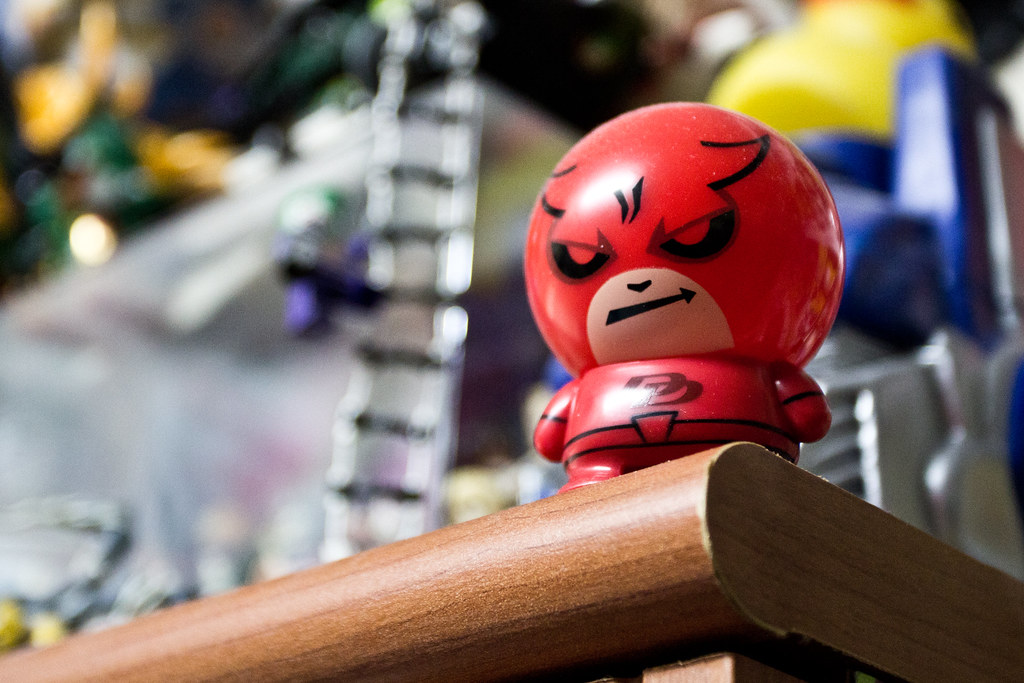
The biggest and easiest example here, of course, is Daredevil—a character who is blind, but whose superpowered senses are so enhanced that he can see through sound, sort of, so he’s blind but…not really. He can still navigate with little difficulty and fight crime and be a total badass due to his ability to sense things around him in precise detail.
I looked up some other examples and found quite a few (by the way, some of the source links have super ableist language, JSYK):
- Dr. Mid-Nite: blinded by an explosion, but can see in pitch blackness for some reason, so he wears special super-dark goggles so he can see during the day—and fight crime at night.
- Captain Marvel, Jr: character who has some kind of physical disability that makes mobility difficult, but can transform into an able-bodied superhero to fight crime before transforming back into his non-superhero, disabled self.
- Thor: Apparently in the 1962 comics, Thor also had the transform thing: his “human” self needed a mobility aid to get around (a cane) because Odin wanted to teach him a lesson in humility (which is majorly problematic for entirely different reasons, but I digress), but he could transform into Thor, who is able-bodied, to be a hero.
- Iron Man: in the comics, Tony Stark is injured and becomes paraplegic—but he can still move his legs and fly around as Iron Man in his suit, and apparently the comic writers got tired of writing him as disabled and cured him with a biochip implant.
- Komodo: A bilateral amputee graduate student who stole The Lizard’s (from Spider-Man) serum to regrow her legs and became a trainee Avenger.
- Doctor Strange: apparently a car accident resulted in nerve damage that caused the loss of use of his hands—until he found magic and became a sorcerer. (EDIT: I've been told that possibly Doctor Strange doesn't need use of his hands to perform magic because...it requires less dexterity or something? I'm not familiar with the story, so not sure, but possibly this might be okay.)
I’m sure there are other examples, but you get the idea.
The problem here is exactly what I mentioned above: their superpowers directly negate their disabilities. Physically disabled characters are suddenly able-bodied again, because, apparently, they couldn’t be superheroes otherwise.
Of course, there are examples of superheroes who’s abilities don’t negate their disability–Professor X, for example, who is paraplegic and telepathic—but his telepathy doesn’t make him able to walk again. And Hawkeye who (eventually, at least) is deaf and learns sign language to better communicate—but his supernaturally good aim doesn’t negate the fact that he can’t hear.
Right now at least, I don’t personally have a problem with disabled superheroes whose powers don’t erase their disability. I think it’s cool that many disabled kids may be able to see a character like them who is superpowered and badass but still has to deal with the same difficulties they do with their disability.
However, the narrative of superpower-erasing-disability is so very common, and that is a problem. Because the implication is the only way to make this disabled character awesome is to make him able-bodied. Because people then point to those characters and say there’s your disability representation—you have enough representation already. Because they are, in essence, saying what makes those characters cool is the way they can erase their disability with superpowers.
And that’s not fair. Because it totally erases difficulties disabled people have to wrestle with while still claiming to be representative.
We need more disabled characters—and I want to see them save the world, and hunt down killers, and go to magical schools, and lead revolutions. I want to see them be totally awesome, and get the hot love interest, and be heroes.
But I also want to see them struggle with their disability. I want to see them get frustrated, and deal with ableism, and have bad days and good days. I want to see them take medication, and if their condition is degenerative I want to see them get worse, and be uncertain about the future, and not have a good answer for what life will be like in five, ten years. I want them to deal with their disability in real, tangible ways. I want it to affect their everyday lives, I want their disability to be visible and invisible, and I want it to matter.
But I also want to see them live. I want to see them get by just fine, and be the hero, and I want them to be an inspiration because they do incredible things—not because they’re disabled—and I want their disability to be normalized.
Everyone deserves to see themselves represented, and for the disabled, that means in a way that doesn’t totally erase everything that makes them disabled to begin with. Everyone deserves to see themselves as heroes without being told the only way to do so is to erase their reality.
Twitter-sized bites:
Of course, there are examples of superheroes who’s abilities don’t negate their disability–Professor X, for example, who is paraplegic and telepathic—but his telepathy doesn’t make him able to walk again. And Hawkeye who (eventually, at least) is deaf and learns sign language to better communicate—but his supernaturally good aim doesn’t negate the fact that he can’t hear.
Right now at least, I don’t personally have a problem with disabled superheroes whose powers don’t erase their disability. I think it’s cool that many disabled kids may be able to see a character like them who is superpowered and badass but still has to deal with the same difficulties they do with their disability.
However, the narrative of superpower-erasing-disability is so very common, and that is a problem. Because the implication is the only way to make this disabled character awesome is to make him able-bodied. Because people then point to those characters and say there’s your disability representation—you have enough representation already. Because they are, in essence, saying what makes those characters cool is the way they can erase their disability with superpowers.
And that’s not fair. Because it totally erases difficulties disabled people have to wrestle with while still claiming to be representative.
We need more disabled characters—and I want to see them save the world, and hunt down killers, and go to magical schools, and lead revolutions. I want to see them be totally awesome, and get the hot love interest, and be heroes.
But I also want to see them struggle with their disability. I want to see them get frustrated, and deal with ableism, and have bad days and good days. I want to see them take medication, and if their condition is degenerative I want to see them get worse, and be uncertain about the future, and not have a good answer for what life will be like in five, ten years. I want them to deal with their disability in real, tangible ways. I want it to affect their everyday lives, I want their disability to be visible and invisible, and I want it to matter.
But I also want to see them live. I want to see them get by just fine, and be the hero, and I want them to be an inspiration because they do incredible things—not because they’re disabled—and I want their disability to be normalized.
Everyone deserves to see themselves represented, and for the disabled, that means in a way that doesn’t totally erase everything that makes them disabled to begin with. Everyone deserves to see themselves as heroes without being told the only way to do so is to erase their reality.
Twitter-sized bites:
What's the problem with superpowers erasing disabilities? @Ava_Jae breaks it down. (Click to tweet)
"Everyone deserves to see themselves as heroes without...eras[ing] their reality." (Click to tweet)