Showing posts with label Janice Hardy. Show all posts

What’s Driving Your Plot? by Janice Hardy

Hello, friends! Today I've got a special guest for you guise, Janice Hardy, author of The Healing Wars trilogy and several writing books, most recently Understanding Conflict (And What It Really Means). Hope you enjoy!

Conflict encompasses a wide scope of problems and situations, and can be as varied and interesting as you want to make it. But no matter what type of conflict a character faces, it presents a challenge in how to resolve the conflict. That challenge leads to a choice on the best course of action, and that choice forces the character to act. And that’s good, since those challenges, choices, and actions create and drive the plot (the combination of internal and external conflicts). Without conflicts, the protagonist would have no problems at all, and there'd be no story.

On one side, we have the external conflicts. These are challenges the protagonist has to physically overcome to resolve the core conflict problem (and all the smaller problems along the way). They’re the actions she takes to fix the problems preventing her from getting her goal. They’re what make up most of the action in the plot, since this is what the protagonist does from scene to scene.

For example:

  • Protagonist wants to find her missing sister, but someone has stolen the security tapes covering the parking lot she was last seen in.
  • Protagonist wants to impress her date on their trail ride, but she has no idea how to ride a horse.
  • Protagonist wants to surprise his girlfriend with breakfast in bed, but he has to get her kids out of the house first.

External conflicts are based on how the protagonist uses her intelligence, skills, and resources (or lack thereof) to overcome an external challenge. The key thing to remember with external conflicts is that resolving them takes action—the protagonist does something. While she might take a moment (or longer) to come up with a plan to overcome the challenge, it’s what she does that resolves it.

Generally speaking, the scene will unfold like this: The protagonist will be trying to achieve a goal when she’s presented with a challenge (she’s trying to do something in a scene and something stops her—the conflict). She’ll either react on instinct and try to overcome that challenge, or take time to decide what to do (how much time is up to the writer). The difficulty of the challenge, the level and type of conflict, and the competence of the protagonist determine how that challenge is resolved. What happens at the end of the challenge leads to the next goal of the plot and the next challenge.

This is essentially plotting in conceptual form. Pursue a goal, face a challenge, outsmart or overpower it, proceed to the next challenge with a new goal.

Of course, just watching someone complete a series of tasks can get boring after a while. Most external challenges just require skill, strength, or intelligence to overcome, others will be much harder to resolve due to personal issues. To counter potential task boredom, another layer of conflict is often added to keep the story interesting. This is where the internal conflicts kick in.

Internal conflicts are the emotional, ethical, or mental struggles a character faces while trying to decide what to do about an external problem. The challenge isn’t a physical thing in the way, but a struggle within the protagonist to make the right choice. It’s the mental and emotional debate the protagonist needs to have in order to resolve an external problem.

For example:

  • Protagonist wants to save her missing sister, but doing so will reveal a secret she can’t afford to have known.
  • Protagonist wants to be loved, but her refusal to compromise keeps her alone.
  • Protagonist wants to romance his girlfriend, but he doesn’t want to risk making her kids mad and their not liking him.

An external task that’s easy to complete can be made difficult by adding an emotional roadblock. What needs to be done is clear, but the protagonist doesn’t want to resolve it that way for personal reasons. Either the right choice has consequences she doesn’t want to suffer, or there is no good choice—whatever she does has serious ramifications.

Internal conflicts are based on who the protagonist is and what has happened to her in her life, and this past makes it harder for her to make decisions and resolve her external challenges. They typically come from the morals and ethics of the character, and more often than not, choosing one side negates the other and the protagonist can’t have it both ways.

Internal conflicts are great opportunities to put the protagonist in the hot seat and force her to decide who she is and what she stands for. How far is she willing to go to help a friend? What will she risk? What does she value? Her struggles while making a decision shows readers who she really is as a person.

Mixing the two create a plot- and story-driving engine that keeps readers invested in what problems might be faced and where the emotional challenges will come from. It not only piques readers’ interest about what could happen, but it makes them wonder why, and anticipate how the protagonist will overcome the conflict.

So, what’s driving your plot?


Looking for more tips on creating conflict? Check out my latest book Understanding Conflict (And What It Really Means), an in-depth guide to how to use conflict in your fiction.

Janice Hardy is the award-winning author of the fantasy trilogy, The Healing Wars, and multiple books on writing, including Understanding Show, Don't Tell (And Really Getting It), Planning Your Novel: Ideas and Structure and Revising Your Novel: First Draft to Finished Draft. She's also the founder of the writing site, Fiction University. For more advice and helpful writing tips, visit her at www.fiction-university.com or @Janice_Hardy.

Why I Use Adverbs as Placeholder Words by Janice Hardy

Hey guys! I've got another special guest post today from award-winning author of The Healing Wars trilogy, Janice Hardy! Today she's talking about adverbs and placeholder words, so hope you guys enjoy!

P.S.: Janice is hunkering down during the hurricane, so she may not immediately be able to answer comments, but will as soon as she can!


You’ve no doubt heard it over and over: Never use adverbs in your writing. Sound advice, but if you follow it to the extreme, you could miss out on their very useful properties.

As bad a reputation as adverbs have, they’re handy during a first draft. They allow you to jot down how a character feels or how they say something without losing your momentum. You can keep writing, and go back and revise later.

They’re also wonderfully helpful red flags that point out opportunities to revise and flesh out what your character is doing. They’re like your brain telling you about the emotional state of your character, and pointing out a place you might want to examine further.

For example:

  • I walked cautiously across the room to the back door.

Here, “cautiously” is doing the explaining, telling that this person is nervous in some way. You could find another word for “walked cautiously” like tiptoed, sneaked, or slipped, but that only solves the adverb problem. It doesn’t do anything to capitalize on what your subconscious might be telling you. Instead, try looking deeper and showing someone being cautious in a way that helps characterize and further show the scene.

  • I scanned the room, checking for tripwires, pressure plates, anything that looked like it might be a trap. Clear. I darted for the door.

This is interesting and tells you a lot more about what’s going on, which probably saves you words somewhere else. Especially since there’s a decent chance the description in that scene might be a little flat. If you had a better sense of the character’s emotional state and what that character was doing, you probably wouldn’t have used the adverb in the first place.

Adverb tells are used most often in dialogue. They’re dropped in to show emotion or description without conveying what that emotion or description is:

  • "I hate you,” she said angrily.

In this instance, “angrily” doesn’t say how the character speaks. Does she shout? Snarl? Spit? The adverb is vague and adds nothing to the sentence that readers didn’t already assume by reading the dialogue. It’s a pretty good guess saying, “I hate you” means she’s angry.

Dramatizing the anger would show and thus make the scene more interesting. This character might bang her fist on a table, mutter snide comments under her breath, spit in someone’s face, or even pull out a Sig Sauer nine mil and blow some guy’s brains out. All of those would be more exciting than “angrily,” which can mean something different to everyone who reads it.

By using an ambiguous adverb, not only are you falling into lazy writing, you’re missing a great opportunity for characterization. The gal who would mutter snide comments is not the same gal who’d break out that Sig.

Now, let’s look at a line like:

  • "I hate you,” she said softly.

Many people would swap out “softly” for whisper in this instance, but whisper isn’t the same as speaking softly. You can speak softly and not whisper. “Softly” is an adverb that conveys something specific depending on the context in which it’s used. It denotes tone as well as volume, attitude as much as forcefulness. What we pair with this adverb changes how we read it.

  • She clenched her fists so tight her knuckles went white. “I hate you,” she said softly. (Implies controlled anger.)

  • She giggled, covering her mouth when the teacher turned their way and glared. “I hate you,” she said softly. (Implies playfulness.)

  • She kept the table between them, moving as he did around the edge. “I hate you,” she said softly. (Implies fear or apprehension.)

All three sentences use the same adverb, but notice how each has a different feel to it based on what came before it. Anger. Playfulness. Fear. Can you replace the adverb with something else? Sure. You could even drop the tag entirely. Do you have to just because it contains an adverb? No. It all depends on what you want that line to convey to readers.

Adverbs work when showing the action would take more words than using the adverb, and that would gunk up the story. It could even shift focus to the wrong detail and confuse readers.

For example:

  • She muttered incoherently.

This is clear and says what it needs to say. You could eliminate “incoherently” and dramatize it, but that might put too much focus on something that doesn’t need that much focus.

  • She muttered half-words that didn’t make any sense.

Every writer will have their own preference here, but “incoherently” feels clearer to me in this instance than “half-words that didn’t make any sense.” I may not want readers trying to figure out what she’s trying to say; I just want them to know she’s not saying anything that makes sense. Making a point of what she’s saying instead of how she’s saying it could lead readers down the wrong path.

The reader/writer disconnect can happen at any time. Look at where you use adverbs and identify what you’re trying to do with them. If what’s in your head isn’t making it to the page, you could wind up with a disconnect.

  • "Oh, that’s just wrong,” Bob said angrily.

Here, the adverb is used to denote anger, but it makes readers decide what Bob’s anger looks like and how he acts when he’s angry. You might know Bob cracks jokes so he doesn’t blow up, so you read his dialogue in a sarcastic tone, but readers might think Bob screams and yells, or maybe he gets quiet and dangerous. They could read that same line in different ways according to what “angrily” means to them.

Adverbs are effective placeholder words that let your subconscious know where you can craft stronger scenes and sentences. It’s not always about replacing them with stronger words. Sometimes those adverbs are pinpointing an important aspect that would make the scene sing if you fleshed it out.

Adverbs, generic nouns, boring adjectives, even clichés—are valuable first-draft gems to quickly insert a basic emotional note into a scene without having to stop the drafting to find the perfect word or description.

How do you feel about adverbs? Do you find them useful or do you avoid using them?


Check out my new book, Understanding Show, Don't Tell (And Really Getting it), and learn what show, don't tell means, how to spot told prose in your writing, and why common advice on how to fix it doesn't always work.


Janice Hardy is the award-winning author of The Healing Wars trilogy and the Foundations of Fiction series, including Planning Your Novel: Ideas and Structure, a self-guided workshop for planning or revising a novel, the companion Planning Your Novel Workbook, and Revising Your Novel: First Draft to Finished Draft. She's also the founder of the writing site, Fiction University. For more advice and helpful writing tips, visit her at www.fiction-university.com or @Janice_Hardy.


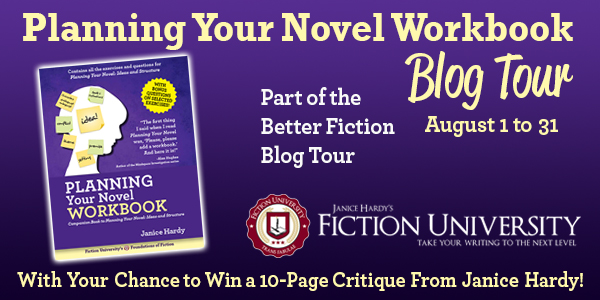
Win a 10-Page Critique From Janice Hardy

Three Books. Three Months. Three Chances to Win.

To celebrate the release of my newest writing books, I'm going on a three-month blog tour--and each month, one lucky winner will receive a 10-page critique from me.

It's easy to enter. Simply visit leave a comment and enter the drawing via Rafflecopter. At the end of each month, I'll randomly choose a winner.


a Rafflecopter giveaway


*Excerpted from Understanding Show, Don't Tell (And Really Getting It)


Twitter-sized bite:
Author @Janice_Hardy talks adverbs & placeholder words on @Ava_Jae's blog + a giveaway! (Click to tweet)

The Benefits of Story Structure by Janice Hardy

Hey guys! I've got a very special guest post today from award-winning author of The Healing Wars trilogy, Janice Hardy! Today she's talking about story structure, so hope you guys enjoy!


I've never been a "wing it" kind of gal, so story structure has always appealed to me. I find it comforting, and it lets me worry about the story itself and not whether or not I'm missing anything important. Even better, I can quickly drape any idea I have over my favorite structure to see if there's actually enough there to write an entire book.

If there is, then understanding basic story structure makes both the plotting and the writing of that book a lot easier. Story structure offers plot turning points to aim for and provide a framework for the plot. Even if you're a pantser, structure can help during revisions when you have a first draft done and want to make sure all your plot points are working.

Some writers worry that structure will create a formulaic novel. If you follow them exactly and take them literally, then yes, that could happen, but the strength of story structure is to let it guide you and remind you of the important plot elements of a novel. The turning points are more conceptual and suggest types of situations to aim for. And even when a novel does follow them exactly, if done well, readers don't even notice. The novel feels tightly plotted, not predictable.


How Story Structures Work

Structure is like the line drawings in a coloring book. How you create your story (color in the line drawings) is up to you, but the structure provides guides and boundaries to help keep you focused. Turning points such as, "leave the ordinary world" are just a way of saying, "the protagonist does something new that starts the plot." This can be a literal "enter a magic wardrobe and discover Narnia," or "decide to wear a dress to school for the first time ever to catch the eye of the boy you like."

Each turning point represents a major shift in what the protagonist is experiencing, and the choices she has to make to move forward.


Why You Want to Use a Story Structure

What makes any structure so valuable as a tool is that the details of each turning point can be anything you want them to be. The structure is just a frame to hang the story on, and having solid, proven turning points can help you decide what events need to happen to get the most out of your own plot.

They also help you find holes in your plot and places where the stakes might need to be raised. If you notice the protagonist never fails, that's a red flag that you might not have enough at stake or enough conflict driving the plot. Or you might not have a solid character arc that allows your protagonist to grow. Structure is a guide, and the scenes and problems encountered are all up to you.


My Favorite Choice: The Three Act Structure

Although there are many common structure, my favorite is the Three-Act Structure. Not only is it the most common story structure out there, it's an easy to use structure for both beginning and experienced writers.

People have broken the Three-Act Structure down in a myriad of ways, but it unfolds basically like this:


Act One: The Beginning (The Setup and Discovery of the Problem)

Act one is roughly the first 25% of the novel and focuses on the protagonist living in her world and being introduced to the problems she needs to resolve. Something about her life is making her unhappy, but she’s not yet ready to do anything about it. She might not even be aware of the problem, but feels unsatisfied in some way. She's presented with an opportunity to change her life, and she either accepts the challenge or tries to avoid it and gets dragged into it anyway. By the end of the first act, she's on the plot path that leads to the climax of the novel.

Act one is all about showing the protagonist's world (her life, dreams, issues, etc, as well as the literal setting) and letting readers see the problems and flaws she'll need to overcome to get what she ultimately wants. In essence, it's where you say "See how messed up this gal's life is? This is what she has to fix before she can win."


Act Two: The Middle (Figuring Things Out)

Middles make up roughly 50% of a novel. The protagonist leaves what’s familiar to her and undergoes a series of challenges that will allow her to get what she wants and solve the Act One problem. She struggles and fails repeatedly, learning the valuable lessons she’ll need in Act Three to defeat the antagonist.

Good middles show this struggle and growth, and braids together the plot and subplots, crashing the conflicts against each other. Each clue, discovery, and action brings the protagonist closer to the Act Two disaster that sends her hurtling toward the climax and resolution of the novel. She’ll start off with some level of confidence, sure of her plans, but as things spiral out of control she’ll become more and more uncertain and filled with self-doubt until she’s forced to consider giving up entirely.

Act Three: The End (Facing the Antagonist and Resolving the Problem)

The ending is the last 25% of the novel. The protagonist decides to take the problem to the antagonist. She’ll use all the things she’s learned over the course of the novel to outwit and defeat that antagonist. They battle it out, and she’ll win (usually), then the plot wraps up and readers see the new world the protagonist lives in, and the new person she’s become after undergoing these experiences.

The final battle with the antagonist doesn’t have to be an actual battle, just two conflicted sides trying to win. The protagonist gathers herself and any allies and challenges the antagonist. There is often a journey involved, either metaphorical or literal, as a final test.

Having a general sense of how these three acts unfold in your novel can be enough information for you to write it. Structure doesn't have to be a detailed outline of every scene and what happens. It's just a frame in the shape of the story you want to tell.

Do you use a story structure? If so, which one?


Win a 10-Page Critique From Janice Hardy

Three Books. Three Months. Three Chances to Win.

To celebrate the release of my newest writing books, I'm going on a three-month blog tour—and each month, one lucky winner will receive a 10-page critique from me.

It's easy to enter. Simply visit leave a comment and enter the drawing via Rafflecopter. One entry per blog, but you can enter on every stop on the tour. At the end of each month, I'll randomly choose a winner.

a Rafflecopter giveaway

Looking for tips on writing your novel? Check out my book Planning Your Novel: Ideas and Structure, a series of self-guided workshops that help you turn your idea into a novel, and the just-released companion guide, the Planning Your Novel Workbook.


Janice Hardy is the award-winning author of The Healing Wars trilogy and the Foundations of Fiction series, including Planning Your Novel: Ideas and Structure, a self-guided workshop for planning or revising a novel, and the companion Planning Your Novel Workbook. She's also the founder of the writing site, Fiction University. For more advice and helpful writing tips, visit her at www.fiction-university.com or @Janice_Hardy.

Website | Facebook | Twitter | Goodreads | Amazon | Barnes & Noble | iTunes | Indie Bound


Twitter-sized bite:
Author @Janice_Hardy talks the benefits of story structure on @Ava_Jae's blog + a giveaway! (Click to tweet)
Related Posts Plugin for WordPress, Blogger...