Fixing the First Page Giveaway #32!

Photo credit: smcgee on Flickr
It's that time again! We're nearly halfway through the month, so it's time for the thirty-second Fixing the First Page feature.

For those who’ve missed before, the Fixing the First Page features is a public first 250 word critique. Using the lovely rafflecopter widget, anyone interested in winning a public (as in, featured in a post on this blog) first page critique can enter.

For an example of what this critique will look like, here's the last Fixing the First Page post.

Rules!

  • ONLY the first 250 words will be critiqued (up to finishing the sentence). If you win and send me more, I will crop it myself. No exceptions.

  • ONLY the first page. I don’t want 250 random words from your manuscript, or from chapter 3. If you win the critique and send me anything other than the first 250 words of your manuscript, I will choose someone else.

  • I will actually critique it. Here. On the blog. I will say things as nicely as I can, but I do tend to be a little blunt. If you’re not sure you can handle a public critique, then you may want to take some time to think about it before you enter.

  • Genre restrictions. I'm most experienced with YA & NA, but I will still accept MG and Adult. HOWEVER. If your first page has any erotic content on it, I ask that you don’t enter. I want to be able to post the critique and the first 250 in its entirety without making anyone uncomfortable, and if you win and you enter a page with erotic content, I will choose someone else.

  • You must have your first page ready. Should you win, you need to be able to submit your first page within 48 hours of my contacting you to let you know you won. If 48 hours pass and I haven’t heard from you, again, I will choose someone else.

  • You’ll get the most out of this if it isn’t a first draft. Obviously, I have no way of knowing if you’re handing me a first draft (though I will probably suspect because it’s usually not that difficult to tell). I won’t refuse your page if it’s a first draft, but you should know that this critique will likely be of more use if you’ve already had your betas/CPs look over it. Why? Because if you don’t, the critique I give you will probably contain a lot of notes that your betas & CPs could have/would have told you.

  • There will not be a round 2 (unless you win again in a future contest). I hate to have to say this, but if you win a critique, it’s NOT an invitation to send me a bunch of your revisions. I wish I had the time available to be able to look at revisions, but sadly, I don’t. If you try to break this rule, I will nicely say no, and also remember to choose someone else should you win a second contest. Which would make me sad. :(

So that’s it! If you’re okay with all of the above and would like to enter to be the thirty-first public critique on Writability, do the thing with the rafflecopter widget below. You have until Saturday, February 18th at 11:59 PM EST to enter!


a Rafflecopter giveaway

Bookish Update!

So fun news this week! We are now officially eight months away from Beyond the Red's paperback release and nine months away from Into the Black's launch, both of which I'm really psyched about. This means, of course, that pre-order links are going live—hooray!

If you'd like to get Beyond the Red's paperback, releasing in October, you can pre-order it on Amazon and the page is there on B&N but the pre-order feature hasn't quite gone live yet—but when it does it'll be on that page.

And! If you'd like to pre-order Into the Black, Beyond the Red's sequel, you can pre-order it on Amazon and hopefully the page will appear on B&N soon—I'll update this when it does.

But I'm really, really proud of Into the Black. I've just recently turned it in to my editor and I think I like it even more than Beyond the Red, which is weird for me to type but true. I'm super excited to share it with you guise in the Fall—I think you'll really like it.

So that's the bookish news! I'm super psyched to see the ball rolling and look forward to many more updates in the future. :)

Twitter-sized bite:
Want to pre-order BEYOND THE RED's paperback or sequel, INTO THE BLACK? @Ava_Jae shares some happy news. (Click to tweet)

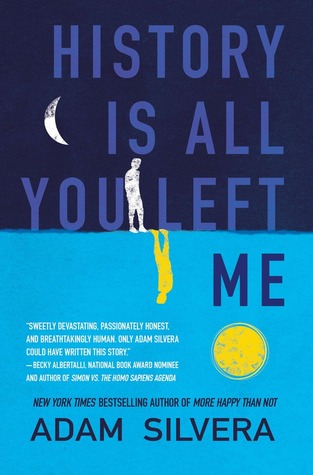
Book Review: HISTORY IS ALL YOU LEFT ME by Adam Silvera

Photo credit: Goodreads
So I knew going in History is All You Left Me was going to be another heartbreaking Silvera read—I mean, the premise is clearly an emotional one—but wow, I did not anticipate just how powerful and important this book would be.

Before I unabashedly sing History's praises, however, here's the Goodreads summary:

"When Griffin’s first love and ex-boyfriend, Theo, dies in a drowning accident, his universe implodes. Even though Theo had moved to California for college and started seeing Jackson, Griffin never doubted Theo would come back to him when the time was right. But now, the future he’s been imagining for himself has gone far off course. 
To make things worse, the only person who truly understands his heartache is Jackson. But no matter how much they open up to each other, Griffin’s downward spiral continues. He’s losing himself in his obsessive compulsions and destructive choices, and the secrets he’s been keeping are tearing him apart. 
If Griffin is ever to rebuild his future, he must first confront his history, every last heartbreaking piece in the puzzle of his life."

Right, so. I saw people in the GayYA conversation about the book say History starts at heartbreaking and moves toward hope, which is really a perfect way to describe it. A lot of the book is Griffin talking directly to Theo as he processes his grief and moves through a life where Theo is no longer alive. The narrative goes back and forth between the present day and the past, so we get to know Theo and Griffin's history with him, all while knowing how it's ultimately going to end. 

I sometimes have trouble with Contemporary novels keeping my attention, but this definitely wasn't a problem for History. The whole book is so beautifully written—it's raw, and emotional, and real—and had me feeling approximately all of the things a chapter or two in. 

Then there's the OCD rep. This was really interesting to me to read because the things that trigger Griffin and his compulsions are entirely different from the things that bothered me (and sometimes still do) at the height of my worst, uncontrolled probably-OCD anxiety. But that's the thing about mental illnesses—they are so varied in the way they affect people, even though representation tends to focus on one or two ways it manifests. So I was really, really happy to see not-frequently-covered ways OCD can affect someone on the page, because lack of awareness causes so much damage and this fights against it. 

All in all, I really loved this book and I know it'll stick with me for a long time. If you can handle something raw, emotional, and yes, heartbreaking, but also hopeful, then I can't recommend this incredible book more.

Diversity note: All of the main characters are queer—Griffin and Jackson are gay, Theo is bi, and there's another queer boy who says he doesn't like labels. Also, Griffin deals with OCD and (possibly, according to Griffin and his psychiatrist at the end—minor spoiler) a delusional disorder. Both the queer and OCD rep are #ownvoices.

Have you read, or do you plan to read, History?

Twitter-sized bites:

.@Ava_Jae gives 5⭐️s to HISTORY IS ALL YOU LEFT ME by Adam Silvera. Is this beautiful & powerful YA on your TBR? (Click to tweet)

Looking for a raw YA about grief, hope, and mental illness? Try HISTORY IS ALL YOU LEFT ME. (Click to tweet)

Vlog: On Writing Distinctive POVs

You asked, I answered: today I'm talking how to write distinctive POVs, especially when working on multi-POV novels.


RELATED LINKS: 


Do you find it challenging to differentiate your POVs?

Twitter-sized bite: 
Author @Ava_Jae vlogs on writing distinctive POVs, especially when writing multi-POV novels. (Click to tweet)

About Those Online Relationships

Photo credit: benowhere 3.0 on Flickr
So this April, I'll have been on Twitter for six years. It's kind of amazing to think about how much has changed in those years, both in myself as a person, and in my career stuff, and in, well, the world.

Given I've been online for so long, it kind of goes without saying I've made a lot of online friends along the way. And when I think about relationships in my life, it's not really surprising that I consider many people who I've met on Twitter friends.

Though the stigma about online relationships seems to be slowly fading out as meeting people online becomes the norm, there's still a pretty big crowd of skeptics out there who roll their eyes at the mention of online friends. I've heard every argument against the validity of online relationships—the claim that people are fake online, that you can't really have a relationship if you haven't met them (?), that it's not real, dangerous, not the same, etc.

Almost six years into this, though, I'm more sure than ever that online relationships can be as real and rewarding as in-person relationships. The many people who I met online and have since met in person have been equally wonderful in person, and there was something kind of comforting of knowing you've already skipped the awkward "getting to know you" stage by the time you've met. For an introvert, online spaces where you can make friends—and better, where you can make them based off mutual pre-established interests—are gold. They cut out the social anxiety that keeps many of us silent in person and smothers conversations before they have a chance to bloom.

It's online where I've been able to talk about things people in my real life surroundings wouldn't understand. It's online where I've been able to connect to a community of like-minded individuals I haven't found in my everyday life. It's online where I've made some truly wonderful friends who I'll always be grateful for.

While online relationships certainly shouldn't replace your real life friends and interactions, they're certainly wonderful to have, especially if you don't have a wide community of like-minded people in your everyday life. I love my online friends, and I'm very grateful to have them. :)

What do you think? 

Twitter-sized bite:
Are online friendships valid? @Ava_Jae shares her thoughts on why they're so important. (Click to tweet)

How to Write a Synopsis

Photo credit: Rsms on Flickr
So this blog is turning six years old this year, and I've realized all this time I've managed to avoid writing a post on how to write a synopsis. Sure, I wrote a joke post about writing a synopsis, which was really more like agonizing over writing a synopsis, and I wrote about a new thing I've been doing that's saved me a lot of pain, namely, writing the synopsis before writing the first draft, but there are still times when you and I will have to write synopses for manuscripts we've already written, and, well. It's not easy.

I'd be remiss if I talked about synopsis writing without pointing you to Susan Dennard's excellent post on writing a one-page synopsis, which I reference when writing my own post-manuscript synopses. I'm not going to reiterate everything she says, and there are a lot of important points in there, so take the time to look it over.

But let's say you know the basics about putting down the main plot points and making sure you cover all the important events from beginning to end (yes, that means giving away the end) and you're still struggling. Because condensing your book into a synopsis? Is really hard.

The way I usually go about it when I have to write a synopsis after writing the full manuscript, is to not worry about the length at first. I go through and explain the major plot points, trying to keep each point no more than a sentence or two. If you're a plotter like I am, it helps to have your outline out next to you while you do this—both because chances are likely you already condensed the main plot points into a sentence or two for your outline, and because it's easier to decide what's vital to mention and what isn't when you have the whole outline in front of you.

Then I write. I cover the main conflict and plot, the important plot twists, briefly mention any romantic entanglements when relevant (although, if it's not a huge part of the plot, then I gloss over that), and make sure the core of the story is explained.

When I reach the end of this initial synopsis, it's usually way too long—like, eight to fifteen pages when it should really be no more than three or so. But that's okay; for me, at least, it's much easier to cut than it is to add, which brings me to my next step: condensing.

This is also a good time to make sure you've formatted your synopsis correctly. A synopsis should be single-spaced, Times New Roman point 12, regular margins, etc. I mention this now because in the past I've accidentally had the wrong font, done a bunch of work condensing, thought I was done—then realized the font was wrong and when I changed it still had half a page left to cut. So to save you that agony, make sure you've formatted correctly from the beginning.

Back to condensing! So this is where you need to ask yourself what is vital to cover and what isn't. Oftentimes, when you think about it, you'll find you've mentioned scenes you could breeze over with half a sentence or cut altogether, so that's the first area you'll want to cut. Once you've gone through and made sure every scene you mention is absolutely vital to understanding the plot, you'll then want to take a look at your word choice.

Ask yourself if that scene you described in three sentences could be described in one, or if you could mash those two scenes together into the same sentence. Then when you're done with that, it'll be time to condense your language. For a list of words and phrases to look out for, check out my two line editing posts, How to Condense Without Losing Anything Useful and How to Make Cuts Without Losing Anything Useful.

In the end, how long should your synopsis be? I aim for one to three pages, generally, but guidelines vary situation to situation and agent to agent. If you're querying, it's a good idea to have a one page synopsis and a two-or-three page synopsis ready, because a lot of it comes down to preference. There are situations where longer synopses are okay, too (especially if your manuscript is super long), but in general, shorter is better.

With all those steps in mind, the synopsis is yours to master. Here's hoping you won't have to do another one for a while. ;)

How do you tackle writing a synopsis? 

Twitter-sized bite:
Struggling to condense your manuscript into a synopsis? @Ava_Jae shares some tips for this dreaded step. (Click to tweet)

You're Doing Just Fine

Photo credit: that.alastair on Flickr
I've seen a lot of lamenting in my writerly social media circles about how difficult creative-types have been finding it to get back to their creative work since the election. From writers saying they haven't been able to write a word since, or talking about how difficult it's been to revise, or how slow the words have come, or even how much people's reading habits have taken a hit—it's been hard for a lot of us.

I've also seen some people come down pretty hard on themselves about it, so here's a post for you: you're doing just fine.

Look, everything is hellish right now. The last week and a half of our Bully in Chief has been worse than many of us imagined. Between protests, and phone calls, and keeping informed when every hour there's something new, our political climate is really emotionally draining right now. It's not remotely surprising so many of us have been struggling to make progress.

I've written a post already about self-care in these times, so I'm not going to reiterate that, but I will say this: things are hard, and if you're lagging behind your usual output, know you're not alone.

Some things that I've found helpful in terms of boosting my productivity as of late include:

  • Not checking Twitter until after I've gotten out of bed and brushed my teeth, etc. 
  • Closing Twitter and turning my phone face-down on my desk when I need to focus. 
  • Setting concrete tasks I need to accomplish every day and checking them off when I do them. 
  • Building in extra time into my expected completion dates/self-determined deadlines. 
  • Putting on headphones and listening to lyric-less music (like soundtracks) when working.

But the main point I want to make is this: whether your progress has been stalled, a trickle, or a slog, you're not alone, and you're doing just fine. We're all trying to figure this out together one day at a time. 

Finally, for some encouragement, check out the #WriteYourResistance tag on Twitter. It's beautiful, inspiring, and encouraging—which I think we could all use. 

How have you been handling your creative output since November? 

Twitter-sized bite:
Struggling to get back to your creative work since the election? You're not alone. (Click to tweet)
Related Posts Plugin for WordPress, Blogger...