About Traditionally Publishing New Adult

Photo credit: ALBOWIEB on Flickr
So back in 2014 there was a lot of talk about New Adult. The Not YA but Not Adult genre was fresh and new and gaining popularity, and while it had started in the Contemporary Romance sector, a lot of people hoped it would expand into other genres, as it had the potential to do so. It was an exciting time with a lot of speculation as people waited for the book that would be the big break for non-Contemporary Romance New Adult.

Except, unfortunately, that book never arrived. More New Adult books were published, and the traditional market shaped New Adult into the niche it is today: a romantic subgenre.

There's nothing wrong with that, of course—there are some great NA romance reads out there, like my favorite In Focus series. But as I've continued to see writers who want to traditionally publish ask about non-romance NA and pitch their Sci-Fi and Fantasy books as New Adult, I think it's important to talk about the realities of New Adult books in the traditional marketplace.

The truth is, if you want to traditionally publish a non-Contemporary Romance manuscript with New Adult aged characters and themes, you'll have to do one of two things:

  1. Age the manuscript down to Young Adult. 
  2. Age the manuscript up to Adult.

Both are perfectly fine options, and in the latter case you may not have to change too much, because twenty-something or (late) teen characters in Adult books are totally okay (just look at the Shades of Magic trilogy by V.E. Schwab).  Unless, of course, the voice and themes, pacing, etc. doesn't fit Adult, in which case with some adjustments you can make the switch down to YA, or revise so that it does fit Adult.

The simple truth is you're not doing yourself any favors by calling your non-Contemporary Romance manuscript New Adult—the market has shown those other genres don't sell as well as they needed to to survive, which means nowadays those other genres often don't get picked up to begin with. So if you find yourself in this position where you have a non-Contemporary Romance manuscript that would be New Adult if New Adult sold non-romantic genres, then you may want to start considering whether aging your manuscript up or down would better fit the manuscript and your career goals if you have your heart set on publishing traditionally. 

What do you think? 

Twitter-sized bite:
Have a non-Contemporary Romance MS you want to traditionally publish? @Ava_Jae says you may want to do this first. (Click to tweet)

Vlog: 4 Places to Find Critique Partners

Ready to work with critique partners but don't know where to find them? Today I'm talking four places where you can find critique partners.


RELATED LINKS:


Where did you find your critique partners?

Twitter-sized bite: 
Ready to work with CPs but don't know where to find some? @Ava_Jae vlogs about 4 places to find CPs. (Click to tweet)

Tip Round Up for New Writers

Photo credit: penmanila
Deciding you want to be a published author can be pretty overwhelming at first. There's so much information out there—tips on virtually every part of writing and storytelling, information about querying and submission, traditional publishing versus self-publishing, contests, conferences, agents, editors, etc. etc. etc.

So when someone asked if I could write "where to start" type post for new writers, I thought it was a great idea. So here we go.

First of all, you may want to look at the first fifteen steps you'll be facing as a writer about to write a novel. Once you've figured out what you'd like to write about, it's time to decide if you're a plotter, pantser, or hybrid. Assuming you're the first or last, you'll want to think about your plot essentials and start turning your idea into a plot (and even if you aren't, you may want to try plotting without plotting). From there, you may want to try something similar to how I plot, or try combining two plotting methods.

Then it's time to first draft! Before you dive in, know it's fine if your first draft sucks, because first drafts are usually awful and that's okay. Some days you'll find you'll struggle to find the words (which is normal and okay), so remember ultimately first drafts are for you, and no, you don't have to know everything while first drafting. Also, while you're working, don't forget to take self-care days.

Once you've written your manuscript, worked with critique partners, and revised it several times, your manuscript is now query-ready. If you want to traditionally published it's now time to look for an agent. So where do you start?

Firstly, here are five things you should know before you get an agent.  With that in mind, you'll want to research (for real, don't skip this step—do your research before you start querying) and pay attention to these red flags. Once you've researched, it's time to actually write the query letter.

To start with, here's a quick how to covering the basics, but don't forget to include manuscript-specific details and makes the stakes in your pitch personal. Remember you don't need these five things in your query, and as a bonus, here are some tips for choosing book comps. And for an example of a query that worked, here's the query I used that lead to my signing with an agent, and also my top ten querying tips.

Then time will come to do your best to survive the query wars. You'll inevitably have to deal with rejection, so remember hope is a great emotional remedy. And for some encouraging statistics along the way, remember it's okay if you don't debut with your first manuscript, because most writers don't. Eventually, however, you may get The Call, which is every level of exciting.

Once you get an agent you'll soon be on submission and hopefully, if things go well, you'll have to start thinking about launching your book. But even if you don't reach those stages for many more years, don't worry, because when you're a writer, time is on your side.

What other tips would you recommend for new writers? 

Twitter-sized bite:
Want to write a book & get pub'd but not sure how to start? Author @Ava_Jae rounds up tips from idea to querying. (Click to tweet)

How to Launch a Book (Part II)

Photo credit: gabia party on Flickr
So on Monday I started my two-part How to Launch a Book series, and today finishes off with the final three months. Hope you guys enjoy!


3 MONTHS BEFORE LAUNCH:


  • Start seriously thinking about launch parties (if you want one). So I mentioned in the last post that you don't necessarily have to have a physical launch party (or any launch party at all). But if you do decide you want one, now is when you'll want to start getting the details in order. Where do you want to have it? What will it be like? Who will you invite? Start talking to your local bookstores (or whatever other venue) to get the details handled.

  • Giveaways! About now is when you want to really start cranking up the promo machine, and giveaways are a great way to generate buzz. ARCs, pre-orders, swag, something else—make sure you get the word out there and send out some free stuff to excited readers. Twitter and Goodreads giveaways are both pretty effective around this time and can help get the word out.

  • Make sure that blog tour is booked! Similar to launch parties, you don't necessarily need to have a blog tour, but if you decide you want one, you'll definitely want to have this in the works already. Talk to bloggers who have done blog tours in the past and find out what you'll need to get yours booked.

1 MONTH BEFORE LAUNCH:


  • (It's okay if you) freak out. The month before your book releases is notoriously known amongst writers as a...shall we say, tremulous time? It's an emotional period for writers and often full of a lot of nerves, so make sure you take care of yourself this month.

  • Cry over final author copies. Or don't cry, but this is a common happy tears moment and it can be a fun thing. I recommend recording you opening up your first author copy, because it can be really fun promo to share and also just nice to have for yourself.

  • Answer so many interview questions/write all the blog posts. Assuming you're doing a blog tour (or at least working with bloggers) you'll probably have SO MANY interviews to fill out this month. Hopefully you've planned ahead. Either way good luck and try to have fun!

  • Make sure your launch party plans are finalized. Get those details set in stone! Your party is a month away and it'll be here before you know it.

  • More giveaways! If you have any ARCs left, now's a good time to give them away!


1 WEEK BEFORE LAUNCH:


  • Know some people will probably get your book early (and it's okay). For all the build up there is to launch day, it's not something that's actually set in stone. Amazon often ships pre-orders early (Beyond the Red started shipping out over a week early!), and Barnes & Noble and other stores often put the books out a few days early or something even more. While it's not a bad idea to ask readers to hold off buying your book until your launch day (because sales that happen pre-launch day, for whatever reason, don't count toward bestseller list sales), it's not something you need to stress about. Just enjoy the pictures as they come in and know your book is heading out into the world.

  • Self-care. For real, this is an intense week. Make sure you pay attention to yourself, give yourself a reward, and focus on self-care.

LAUNCH DAY:


  • Know you probably aren't going to get much work done. Launch day is a really exciting and fun day. Social media is often totally excited for you, you get to see your book in stores (probably), and you know today is the day. But also know all the excitement is very distracting so you likely won't get much done today.

  • Prepare for your launch party (if you have one). If you're having a launch party, physical or virtual, it is now imminent! Get yourself prepared and get ready to have fun!

Twitter-sized bite:

Curious about what goes into launching a trad pub'd book? @Ava_Jae finishes her 2-part How to Launch a Book series. (Click to tweet)

The Benefits of Story Structure by Janice Hardy

Hey guys! I've got a very special guest post today from award-winning author of The Healing Wars trilogy, Janice Hardy! Today she's talking about story structure, so hope you guys enjoy!


I've never been a "wing it" kind of gal, so story structure has always appealed to me. I find it comforting, and it lets me worry about the story itself and not whether or not I'm missing anything important. Even better, I can quickly drape any idea I have over my favorite structure to see if there's actually enough there to write an entire book.

If there is, then understanding basic story structure makes both the plotting and the writing of that book a lot easier. Story structure offers plot turning points to aim for and provide a framework for the plot. Even if you're a pantser, structure can help during revisions when you have a first draft done and want to make sure all your plot points are working.

Some writers worry that structure will create a formulaic novel. If you follow them exactly and take them literally, then yes, that could happen, but the strength of story structure is to let it guide you and remind you of the important plot elements of a novel. The turning points are more conceptual and suggest types of situations to aim for. And even when a novel does follow them exactly, if done well, readers don't even notice. The novel feels tightly plotted, not predictable.


How Story Structures Work

Structure is like the line drawings in a coloring book. How you create your story (color in the line drawings) is up to you, but the structure provides guides and boundaries to help keep you focused. Turning points such as, "leave the ordinary world" are just a way of saying, "the protagonist does something new that starts the plot." This can be a literal "enter a magic wardrobe and discover Narnia," or "decide to wear a dress to school for the first time ever to catch the eye of the boy you like."

Each turning point represents a major shift in what the protagonist is experiencing, and the choices she has to make to move forward.


Why You Want to Use a Story Structure

What makes any structure so valuable as a tool is that the details of each turning point can be anything you want them to be. The structure is just a frame to hang the story on, and having solid, proven turning points can help you decide what events need to happen to get the most out of your own plot.

They also help you find holes in your plot and places where the stakes might need to be raised. If you notice the protagonist never fails, that's a red flag that you might not have enough at stake or enough conflict driving the plot. Or you might not have a solid character arc that allows your protagonist to grow. Structure is a guide, and the scenes and problems encountered are all up to you.


My Favorite Choice: The Three Act Structure

Although there are many common structure, my favorite is the Three-Act Structure. Not only is it the most common story structure out there, it's an easy to use structure for both beginning and experienced writers.

People have broken the Three-Act Structure down in a myriad of ways, but it unfolds basically like this:


Act One: The Beginning (The Setup and Discovery of the Problem)

Act one is roughly the first 25% of the novel and focuses on the protagonist living in her world and being introduced to the problems she needs to resolve. Something about her life is making her unhappy, but she’s not yet ready to do anything about it. She might not even be aware of the problem, but feels unsatisfied in some way. She's presented with an opportunity to change her life, and she either accepts the challenge or tries to avoid it and gets dragged into it anyway. By the end of the first act, she's on the plot path that leads to the climax of the novel.

Act one is all about showing the protagonist's world (her life, dreams, issues, etc, as well as the literal setting) and letting readers see the problems and flaws she'll need to overcome to get what she ultimately wants. In essence, it's where you say "See how messed up this gal's life is? This is what she has to fix before she can win."


Act Two: The Middle (Figuring Things Out)

Middles make up roughly 50% of a novel. The protagonist leaves what’s familiar to her and undergoes a series of challenges that will allow her to get what she wants and solve the Act One problem. She struggles and fails repeatedly, learning the valuable lessons she’ll need in Act Three to defeat the antagonist.

Good middles show this struggle and growth, and braids together the plot and subplots, crashing the conflicts against each other. Each clue, discovery, and action brings the protagonist closer to the Act Two disaster that sends her hurtling toward the climax and resolution of the novel. She’ll start off with some level of confidence, sure of her plans, but as things spiral out of control she’ll become more and more uncertain and filled with self-doubt until she’s forced to consider giving up entirely.

Act Three: The End (Facing the Antagonist and Resolving the Problem)

The ending is the last 25% of the novel. The protagonist decides to take the problem to the antagonist. She’ll use all the things she’s learned over the course of the novel to outwit and defeat that antagonist. They battle it out, and she’ll win (usually), then the plot wraps up and readers see the new world the protagonist lives in, and the new person she’s become after undergoing these experiences.

The final battle with the antagonist doesn’t have to be an actual battle, just two conflicted sides trying to win. The protagonist gathers herself and any allies and challenges the antagonist. There is often a journey involved, either metaphorical or literal, as a final test.

Having a general sense of how these three acts unfold in your novel can be enough information for you to write it. Structure doesn't have to be a detailed outline of every scene and what happens. It's just a frame in the shape of the story you want to tell.

Do you use a story structure? If so, which one?


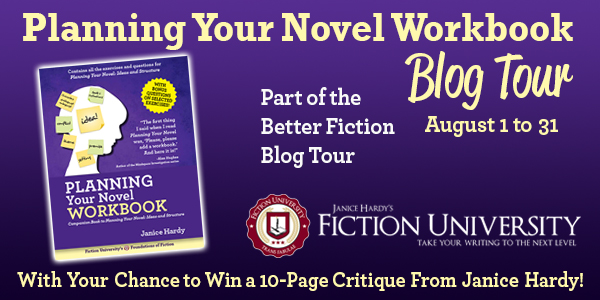
Win a 10-Page Critique From Janice Hardy

Three Books. Three Months. Three Chances to Win.

To celebrate the release of my newest writing books, I'm going on a three-month blog tour—and each month, one lucky winner will receive a 10-page critique from me.

It's easy to enter. Simply visit leave a comment and enter the drawing via Rafflecopter. One entry per blog, but you can enter on every stop on the tour. At the end of each month, I'll randomly choose a winner.

a Rafflecopter giveaway

Looking for tips on writing your novel? Check out my book Planning Your Novel: Ideas and Structure, a series of self-guided workshops that help you turn your idea into a novel, and the just-released companion guide, the Planning Your Novel Workbook.


Janice Hardy is the award-winning author of The Healing Wars trilogy and the Foundations of Fiction series, including Planning Your Novel: Ideas and Structure, a self-guided workshop for planning or revising a novel, and the companion Planning Your Novel Workbook. She's also the founder of the writing site, Fiction University. For more advice and helpful writing tips, visit her at www.fiction-university.com or @Janice_Hardy.


Website | Facebook | Twitter | Goodreads | Amazon | Barnes & Noble | iTunes | Indie Bound


Twitter-sized bite:
Author @Janice_Hardy talks the benefits of story structure on @Ava_Jae's blog + a giveaway! (Click to tweet)

Vlog: On Character Motivations and Goals

On the importance of character goals and motivations for all of your major characters.


RELATED LINKS: 


How and when do you figure out your character goals and motivations? 

Twitter-sized bite: 
Author @Ava_Jae vlogs about the importance of character goals & motivations for all of your major characters. (Click to tweet)

How to Launch a Book (Part I)

Photo credit: gabia party on Flickr
So, on Saturday when I asked Twitter for some blog post ideas, someone asked if I could do a post on what's involved in launching a book. While I can only talk about my personal experience along with some educated guesses/generalizations based off my friends' experiences, it's something I haven't yet talked about. As I wrote the post, however, I realized this was going to be insanely long, so I've split it into two parts. So here we go.

How to launch a book, part one.

8 MONTHS BEFORE LAUNCH:

  • Cover reveal. So timings actually vary, but my cover reveal was roughly eight months before publication, and that seems to be a relatively common-ish reveal time. But do note timing will vary publisher to publisher.

    That said, one of the first parts of launching a book is indeed the cover reveal. This is when excitement for a book will really start, because you'll be (hopefully) sharing your reveal with an audience who doesn't already know about your book. Most sites that do cover reveals have guidelines to follow, and they generally make it pretty easy for authors to contact them and inquire about a cover reveal (and yes, the job of finding a site to host your cover reveal often (but not always) falls on the author).

  • Buy swag. Technically, you should have started this as soon as *you*, the author, have your finalized cover, but once the cover is out in the world, you'll definitely want to invest in some swag. I went with postcards and bookmarks, personally—I found the bookmarks were much more popular than the post cards, but post cards are good for mailing, so it's a trade off. (Here's a great post on self-promo and marketing materials that work by Erin Bowman.) Book plates also tend to be popular, something I need to look into getting...

    But anyway, swag is super useful both for giveaways and for leaving behind at events and local bookstores and libraries, if they take them. (And in my experience, they often do.)


6 MONTHS BEFORE LAUNCH:

  • Talk about your book a ton. I mean, you probably were doing this already, but if you haven't started, make sure you talk your book up! Pre-order links also start to go up somewhere around this time, so once those have gone live, make sure you pin them to your Twitter and put them on a prominent place on your website.

  • Think about launch parties. Do you want a launch party? If so, where? This is a good time to start asking yourself what you want to do in terms of the day. I personally decided a launch party was going to stress me out more than it'd be worth it, as I had just recently moved to the area and didn't really know enough people to even merit a party. I ended up doing an online launch party instead, which was fantastic, and lots of fun, and generated way more buzz than a local party would have for me.

    That said! You may very well want a physical launch party, so this is around the time you'll want to start brainstorming the logistics.

  • Look into future local events. Or not local events, if you can afford them. Conferences, book fairs, library events—take a look at what's going on in the upcoming year and decide what you'd like to attend so you can promote yourself and your book.

  • ARC tour/giveaways. Somewhere around this time you will probably get your ARCs if you haven't already! This is a super exciting time, and also when you can prepare to send your ARC out to readers through giveaways and tours. I did two different ARC tours—one for an upcoming blog tour and one for the Sweet Sixteens debut group I was a part of, which helped generate some early reviews. Yay!

  • Look into blog tours. These are optional, of course—some authors do them, some don't. I did two blog tours, and I found them both helpful in terms of getting early reviews and generating a little buzz. So this is something you may want to start looking into at this point.

What do you do to get excited about a book before launch? 

Twitter-sized bite:
Curious about what goes into launching a trad pub'd book? @Ava_Jae kicks off a 2-part How to Launch a Book series. (Click to tweet)
Related Posts Plugin for WordPress, Blogger...