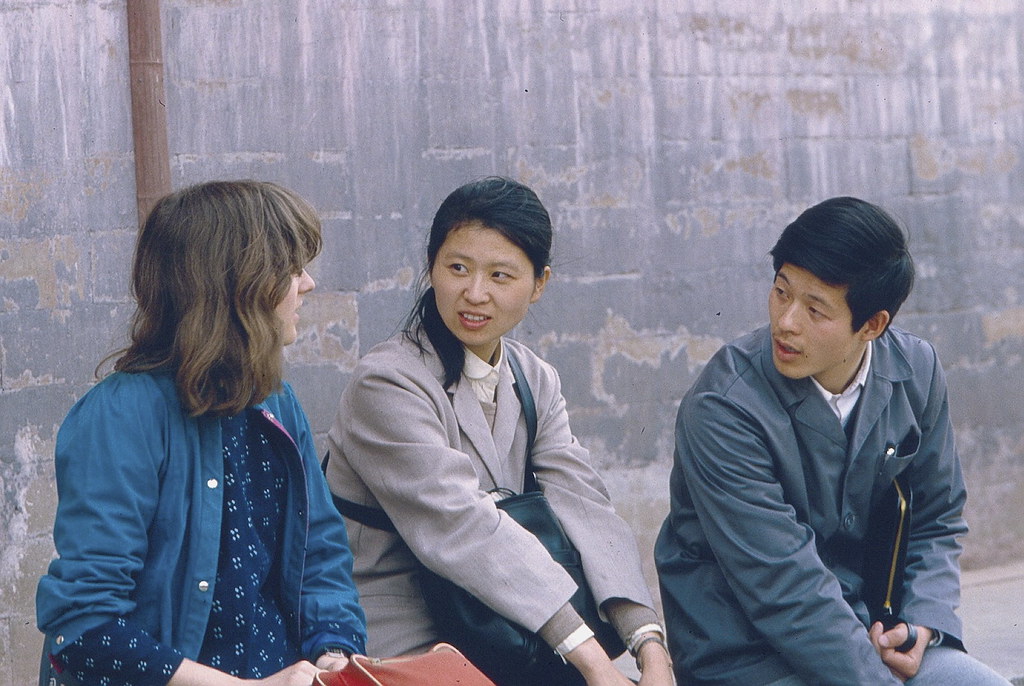
On Writing Realistic Dialogue

Photo credit: kattebelletje on Flickr
Dialogue is a tricky thing to master. Trying to write speech in a way that mimics the way we speak isn't something that comes naturally—like just about everything writing-related, it takes a lot of practice and a lot of reading to get a good feel for it.

I've written some do's and don't's for writing realistic dialogue in the past, so I won't reiterate all of that, exactly, but I think there's still more to be said for writing dialogue that doesn't fall flat, so here are five more points to think about:

  1. Language is always evolving. I recently took a Linguistics class (such a good decision, writing-wise), and the number one lesson repeated throughout the semester was this: language is always changing. This is really important to consider, especially if you write YA, because teens are huge drivers of language change and it changes *so* quickly. Slang that was popular just five years ago is already falling out of favor: teens don't say really "(epic) fail" or "pwned" anymore, for example. It's your responsibility, as a writer, to keep up to date with the way language is changing, especially if you write for teens.

  2. Think carefully about each of your characters. How much education do they have? What regional dialect are they a part of (remember: everyone has an accent)? Do they swear a lot (or at all)? Are they likely to speak formally or informally? Do they tend towards long or short sentences? All of these factors and more will play into how they speak, and it's up to you to make sure each character has their own distinctive speech style.

    When writing Beyond the Red, this was something I had to think about a lot, given that my two main characters come from very different backgrounds and levels of education. It wouldn't make sense for Sepharon (alien) royalty to speak the same way a guy who was raised by human nomads did. Culture, education, and even personality should all be considered when differentiating the way your characters speak.

  3. Not all conversations are straightforward. Real-life conversations can be very complicated and nuanced. People frequently don't say exactly what's on their minds—we speak through subtext, we use tone and body language to add meaning to our words, we answer questions with questions or silence, and we change topics or end conversations when we don't want to talk about something. Consider:

    "I told him we'd go to the afterparty," Leah said.
    Bree laughed. "Of course you did."
    OR

    "I told him we'd go to the afterparty," Leah said.
    Bree rolled her eyes. "Of course you did."


    Same exact words in both of these conversations, but I don't need to explain how Bree's body language completely changes what she's saying.

  4. Don't omit contractions needlessly. 9/10 times when I read dialogue that feels stilted, this is part of the problem. People speak with contractions all the time—without them, we sound like robots at best, and laughable at worst. Even if you're writing historical or a formal character, you do not want to omit every single contraction: your characters will only sound stiff and unnatural.

  5. Many teens swear. While not all teens swear, writing teen characters who deliberately don't swear (oh, fiddlesticks!) can often sound contrived. If your teen character doesn't swear, it's okay...but make sure you aren't censoring just because—and definitely make sure your teen isn't surrounded by other teens who magically don't swear either. It's honestly just not very realistic—and teens will notice.

These are just a couple points on writing realistic dialogue, but now I want to hear from you. What tips do you have for writing speech that doesn't sound stilted? 

Twitter-sized bites: 
How do you write realistic dialogue? @Ava_Jae shares five tips to consider. (Click to tweet
Struggling to write realistic dialogue? @Ava_Jae shares five tips you may want to implement. #writetip (Click to tweet)

Vlog: On Writing Sequels

Should you write sequels before selling the first book of a series? Today I'm sharing my take on a publishing question with no one right answer.


RELATED LINKS: 


Twitter-sized bite: 
Is writing sequels before you're agented/published worth it? @Ava_Jae shares her thoughts in today's vlog. #pubtip (Click to tweet)

BEYOND THE RED Pre-Order Giveaway!

So, incredibly, Beyond the Red will be released in three weeks (eep!). I'm really excited to get it out there so you guys can read and there's a lot going on in March (like a conference! And events in Maryland!) and *EXCITEMENT.*

To further add to the excitement, last week I was able to announce a thing I've been trying to put together for a while: signed pre-orders are now a thing you can get! All pre-orders ordered through my local indie, Nicola's Books, by February 22 will be signed by yours truly. They take international orders, but through a separate channel, so if you're an international reader, please let me know through my contact page that you're interested and I'll get you the info you need. :)

However! I know that many of you have already pre-ordered—which is amazing!—and I want to be able to do something special for everyone who has pre-ordered, and everyone who will pre-order.

So to thank you guys, I'm running a giveaway now until release day, March 1st. All you need to enter is proof of a pre-order—which I'll only ask for if you win. And speaking of winning...


This is my first name in Sephari—the language spoken by the natives on Sepharon, where Beyond the Red takes place. If you've seen a peek at the chapter openers in Beyond the Red, it might look a little familiar to you:


So what does this have to do with the giveaway, you ask? Welllll...

FIFTEEN winners will get prize packs that include:

  • Their first name in Sephari
  • A personalized postcard
  • A signed bookmark

All you guys need to do is pre-order if you haven't already by February 29th and enter the rafflecopter below. I'm going on the honor system here, so it's easy to hit the button below but please have proof of pre-order ready in case you win. 

So that's what I've got! Thanks again to all of you who have supported, regardless of whether or not you've ordered. I appreciate every single one of you guys. :)


a Rafflecopter giveaway


Twitter-sized bite:

Have you pre-ordered BEYOND THE RED by @Ava_Jae? Enter by 2/29/16 for a chance to win 1 of 15 prize packs! (Click to tweet)

Book Review: CAM GIRL by Elliot Finley Wake (w/a Leah Reader)

Photo credit: Goodreads
So while anything Elliot Wake (Raeder) writes is pretty much on my insta-buy list (and has been since both Unteachable and Black Iris blew me away), when I heard Cam Girl features a nonbinary major character, needless to say I knew I had to buy it ASAP.

So I did. And I'm so glad I did because this book felt really important to me. 

Before I go on, here's the Goodreads summary, as per usual: 

"Vada Bergen is broke, the black sheep of her family, and moving a thousand miles away from home for grad school, but she’s got the two things she loves most: her art and her best friend—and sometimes more—Ellis Carraway. Ellis and Vada have a friendship so consuming it’s hard to tell where one girl ends and the other begins. It’s intense. It’s a little codependent. And nothing can tear them apart. 
Until an accident on an icy winter road changes everything. 
Vada is left deeply scarred, both emotionally and physically. Her once-promising art career is cut short. And Ellis pulls away, unwilling to talk about that night. Everything Vada loved is gone. 
She’s got nothing left to lose. 
So when she meets some smooth-talking entrepreneurs who offer to set her up as a cam girl, she can’t say no. All Vada has to do is spend a couple hours each night stripping on webcam, and the “tips” come pouring in. 
It’s just a kinky escape from reality until a client gets serious. “Blue” is mysterious, alluring, and more interested in Vada’s life than her body. Online, they chat intimately. Blue helps her heal. And he pays well, but he wants her all to himself. No more cam shows. It’s an easy decision: she’s starting to fall for him. But the steamier it gets, the more she craves the real man behind the keyboard. So Vada pops the question: 
Can we meet IRL? 
Blue agrees, on one condition. A condition that brings back a ghost from her past. Now Vada must confront the devastating secrets she's been running from—those of others, and those she's been keeping from herself..."

There are three things you can pretty much expect whenever you pick up one of Raeder's books:
  1. Incredibly gorgeous writing.
  2. Very sexy scenes throughout. 
  3. TWISTS LIKE WHOA.
Cam Girl indisputably delivered on all three points. 

While I found some of the pre-Blue cam girling stuff a bit much for me at the beginning (not a flaw of the book, just a personal taste thing), I'm so glad I kept reading because the story and characters more than made up for it. 

Vada, an artist, deals with chronic pain specifically in her hand and arm from the accident at the beginning of the book. I've read a few books now with characters who struggle with chronic pain, but this depiction resonated the most with me—and the further connection of not being able to do art because of the pain, something I deal with IRL, is something that echoed unexpectedly deeply with me. 

Then there's Vada's relationship with her best friend, Ellis, which I absolutely loved reading. Vada and Ellis have a blurry best friends/more than best friends relationship, but though Vada has accepted that she's bisexual, the thought of having a serious long-term relationship with a girl freaks her out, which is an experience with bisexuality that I haven't seen deeply explored in a book before. It worked really well here in terms of tension and adding a complicated dynamic to Vada and Ellis's relationship, and it felt like a real experience that was important to tackle. 

All of these character elements and more weave incredibly well into the plot, which is messy and complicated and finished off with an ending I totally didn't see coming. I loved the frank discussions about gender and sexuality, and seeing a major nonbinary character figure themselves out and explore their identity is something I really appreciated. 

I loved reading this, will probably re-read in the future, and now I'm even more excited for Raeder's next book, Bad Boy, which features a trans guy major character. If you haven't picked up Raeder's books before and you like (very) steamy, complicated, and dark New Adult books, I honestly can't recommend his writing more.

Diversity note: Vada, the protagonist, is Latina, bisexual, and deals with chronic pain, and another major character is nonbinary (genderfluid). The author is openly bisexual and nonbinary, so it's #ownvoices, too.

Twitter-sized bites:
.@Ava_Jae gives 5 stars to CAM GIRL by Elliot Wake (w/a Leah Raeder). Is this twisty, diverse NA on your TBR? (Click to tweet)

Looking for a NA w/ major nonbinary, disabled, & bi characters? Check out CAM GIRL by Elliot Wake (w/a Leah Raeder). (Click to tweet)

Discussion: What Do You Want to See More of in YA?

Photo credit: studieforbund_vofo on Flickr
I've been thinking lately about what I'd like to see more of in YA, which is a thing I tend to do whenever I'm in the figuring out what to write next stage, because oftentimes, asking this question helps me story ideas I really want to write. But more than that, I like discussing this in general, because it often brings up book recommendations for books I'm really looking for.

So! Here we go. Some elements I'd really love to see more of in YA include...

  • More nonbinary major characters. So far, I've read three novels with nonbinary major characters—two of which weren't YA (*waves to Cam Girl and George*), and one of which was released yesterday *waves to Symptoms of Being Human.* I've got some others on my list that I definitely want to read, including some new releases this year, but this is something I'd really love to see more of in general. 

  • Chronic illness representation. I wrote an entire post on the lack of chronic illness representation in YA, so I won't go into super detail about this, but things haven't gotten any better since I wrote it, so this is still I think I really want to see. Specifically, new releases and double bonus if the representation isn't epilepsy or diabetes, as that seems to be, like, 70% of the representation out there.

  • More LBTQIAP major characters. There are a lot of great books out there that cover the G, and I will still very happily read more, but I'd very much love to see more of the other letters in the spectrum covered. This is something I have seen a bit of an improvement with recently, but there's definitely room for more. Bring on the LBTQIAP major characters! 

  • Marginalized characters in stories not *about* their marginalization. Contemporary books are awesome, and issue books are absolutely 100% important, so I don't want to ignore that. But up until recently, the majority of books featuring marginalized characters were about the marginalization, and while this is also a thing that is slowly changing, I'd definitely love to see more books with marginalized characters having adventures totally unrelated to their marginalization. Like Six of Crows, and The Girl from Everywhere, and The Abyss Surrounds Us. More, please!

  • More disabled characters kicking ass. This is related to the last point, but I specifically want to hone in on disabled characters because this is something that is still extra rare to find. Six of Crows and Far From You did a really fantastic job with this, and I absolutely want to see more of it. 

So those are five things I'd really love to see more of in YA—now I want to hear from you. What do you want to see more of in YA?

Twitter-sized bite:
What do you want to see more of in YA? Join the discussion on @Ava_Jae's blog. (Click to tweet)

Vlog: On Writing & Income

There are a ton of misconceptions regarding a writer's income, and not a whole lot of information to help manage expectations. So today I'm covering general (realistic) income expectations for writers who want to be traditionally published.


RELATED LINKS: 


Twitter-sized bites:
Curious about how authors get paid? @Ava_Jae vlogs about income expectations w/ traditional publishing. (Click to tweet
Not sure how a writer's income works? @Ava_Jae breaks it down in today's vlog. (Click to tweet)

On Bending (and Breaking) Writing Rules

Photo credit: Hernán Piñera on Flickr
So given that I've been running this writing blog for close to five years now (whoa), I've written rather frequently about various writing rules. Where to start a story, for example, or things you should/shouldn't do while first drafting, or when and how to tackle revisions. I try to remember to mention from time to time that writing strategies and tips only work when they work for you, and that writing rules aren't completely set in stone, and that writing is subjective, etc., etc., etc.

So when I saw this tweet from Pantomime author Laura Lam, recently, it occurred to me I hadn't really talked about rule breaking in regards to writing, recently.
So fun fact, Beyond the Red also starts with one of my MCs waking up. Granted, he wakes with a knife to his throat and a phaser pressed to his head, so it's not a typical this is my morning routine wake up, but it starts with waking up nevertheless. I didn't make that decision because I didn't know about the rule of not starting a book with a protagonist waking up—I knew about it and went ahead with this opening anyway because that is, legitimately, where the story starts, and it's just before the inciting incident.

In fact, I don't think I would've been able to pull off that opening if I hadn't known the don't start with waking up rule and why it was a rule to begin with. Because if I hadn't understood why it was in place, I wouldn't have known how to work around it.

And that, right there, is the key. Bending or breaking writing rules successfully depends entirely on understanding the rule and why it's there to begin with.

This is why, even if you plan to break or bend the writing rules, it's still important to learn about them. This is why throwing the rules out entirely without understanding them first rarely works.

All writing rules are in place for a reason and your job, as a writer, is to learn and think about them seriously before deciding whether or not you'll apply them to your own work.

Have you ever (purposefully) bent or broken any writing rules?

Twitter-sized bites: 
"Breaking writing rules successfully depends entirely on understanding the rule and why it's there." (Click to tweet)  
Is it okay to bend or break writing rules? @Ava_Jae weighs in with her thoughts. #writetip (Click to tweet)
Related Posts Plugin for WordPress, Blogger...