So You Wrote a Book

Photo credit: Vainsang on Flickr
So since I’ve started doing this thing where I actually tell people I’m a writer when they ask, it’s come up a couple times that I’ve written “a” book. I put “a” in quotations, because I don’t usually go into the “I’ve actually written thirteen books but only one is getting published so far” thing unless it comes up, which it rarely does.

But last week, when I was having one of these conversations with a well-intentioned non-book person, I casually mentioned “my book” and not thirty seconds later came something along the lines of: “Oh wow, you wrote a book? Where is it published?”
Sigh.

I hesitated when I answered, because now I can say that my book is going to be published, which is awesome. And I did say that. But I couldn’t help but think that if I’d had this conversation seven months ago, that question would’ve really stung. Again.

But this post is not about the well-intentioned nice non-book person. It’s about societal assumptions and how we, as writers, handle them.

Part of the so-called overnight success phenomenon is the idea outside the publishing word that writers always publish the first book they write and basically start calling editors the day after they finished their first draft (because that’s how writers get published, right? Riiiiight?)

If you are here reading this blog there is a 99% chance you know that’s not how it works. Not even close. (And for the 1%—that’s not how it works. Not even close.) But when all we ever hear about are writers debuting on the NYT Bestseller’s list and becoming mega-superstars, the true backstory gets overlooked. No one wants to hear how they spent years and years writing, and getting rejected, and putting away books, and trying again and again. It’s not exciting to talk about the books they wrote and put away because they couldn’t get them published.

So, instead, there’s this image of writers publishing their first book ever and getting rich off it. And while, rarely, it can happen, it is such an outlier. Most writers, even writers who write full-time, did not start off that way.

So you wrote a book, and you mention to someone that you wrote a book, and now you’re staring that question in the face. And it sucks, it really sucks to have to say, “It’s not published yet” and watch the other person smile politely and immediately lose interest. It sucks to watch them go from excited (wow! you’re a real live author!) to condescending (so what’s your backup job?) in the space of a few words.

Unfortunately, it’s just the reality of being a writer, particularly during those long years before you get a publishing contract. And if you self-publish, unfortunately it doesn’t really go away ever, unless you hit it really really big (which, again, outlier).

The thing is, you can’t change the way other people think. And you often can’t avoid that ugly conversation if you’re open about being a writer. This is, unfortunately, part of the writer life. But while non-book people often don’t understand—and probably won’t understand unless someone talks to them about what it’s really like—other writers do.

So when you encounter conversations like this, acknowledge that it sucks. Acknowledge that it hurts and it’s not fair. But know that there are others like you who completely understand, and know that you are not a failure or a disappointment in any way, shape, or form.

This is just another reality of being a writer. And it’s okay.

Has this conversation happened to you?

Twitter-sized bite:

On the "overnight success" story and societal assumptions about writers. (Click to tweet

Vlog: Genre vs. Category

Today I'm clarifying two frequently used pub/book world terms: genre and category. They're not the same!


RELATED LINKS: 


What other differences between genre vs. category would you add to the list? 

Twitter-sized bites: 
Not sure what the difference is between genre and category? Writer @Ava_Jae breaks it down in her vlog. #pubtip (Click to tweet)  
In today's vlog, @Ava_Jae says genre and category are not the same. What do you think? (Click to tweet)

Guest Post: On the Writing Community

Note: Hey all! Today I've got a guest post from Kira Budge, the Associate Online Administrator for Chapter One Young Writer's Conference, which is a conference I'll be speaking at this summer! *confetti* I hope you enjoy (and enter the super awesome giveaway)! :) 


Hi guys! My name’s Kira Budge and I’m the Associate Online Administrator for the Chapter One Young Writer’s Conference (Ch1Con), a writing conference by young writers, for young writers. Today, as part of the Ch1Con 2015 Blog Tour, I’m doing a guest post on the importance of the writing community. There will be a giveaway too, so read to the end for that!

As an arts community, the writing world has a particularly vibrant sense of human connection. Both in real life and online, writers, readers, and industry professionals communicate about the stories they love and the ideas they’d like to see more of. Through these conversations, we all can have an immense effect on both individuals and on the world as a whole. I think this is one of the greatest rewards we get from our art.

As a widespread community and especially through the Internet, our industry has the chance to enact social change, such as in the We Need Diverse Books campaign. Through the expansion of our art to include more and more voices, we give readers the world over a chance to understand different perspectives. Discussions on important topics like these abound throughout our community and help us all to make a greater difference.

On a more personal level, the writing community helps people through the partnerships that writers establish with each other. With the assistance of other writers of all different experience levels, each of us can learn more about the industry, have guidance through the tough times that inevitably come, and gain useful critiques. One of the greatest tangible benefits for me in participating in the writing community has been the critique partners and beta readers I’ve been able to gain. With their help, I’ve improved the quality of my writing bit by little bit.

Our internet community has a way of connecting over funny topics as well as the more serious. Twitter is one of my favorite locales for this. The recent influx of parody accounts, which present real issues in the industry and common cliches in a way that everyone can enjoy, is one example. Another is the hashtags that pop up regularly in regards to the industry, like the #VeryRealisticYA tag created by Ch1Con partner John Hansen at Ava Jae’s serendipitous encouragement. Because we have similar interests, writers on the Internet enjoy a common understanding of what’s being expressed without even having to meet!

When you do meet, however, incredible things can happen. Almost eight years ago, as a young little munchkin with lots of big dreams (not much has changed there), I joined my first writing community, the Scholastic Write It! Boards online. There I met the girls who would eventually become some of my best friends, offering the critique, guidance, and, most especially, support that I’ve needed to make it as far as I have with both writing and regular life struggles. Five years later, after meeting each other on other social media platforms, the incredibly innovative and go-getting Julia Byers decided it was prime time that we all met in person. This experiment of a private writing conference blossomed into the Chapter One Young Writers Conference that I am proud to be a part of today!


Meeting these girls, and all of the other people who have attended and supported our conference thus far, has been one of the best experiences of my life. Something magical happens when you get together with people who have the same interests, shared dreams, and a similar life experience. Last year, while discussing the ins and outs of the industry, talking about high school and college life during lunch, and analyzing Harry Potter and the Hunger Games on the Chicago L, I loved being me so deeply and sincerely I can hardly express it. Through our conference, I’ve made many new friends, learned a hundred new skills, and found a thousand new ways to explore the wonders of storytelling. I wouldn’t give that up for anything.

This year, Ch1Con will take place on Saturday, August 8th in the suburbs of Chicago, IL, Arlington Heights. 2015 registration is currently open on the Ch1Con website for writers from a middle school to undergraduate level and at an early bird discount price of $39.99. Three speakers have been confirmed so far: headliner Kat Zhang, the bestselling author of the Hybrid Chronicles, Taryn Albright, better known as the Girl with the Green Pen, and our very own wonderful Ava Jae! As a special bonus, Ava Jae’s agent, Louise Fury, will open to queries only from conference attendees for up to thirty days after the event. Awesome, right? I am psyched.

Annnnnd I’d love to meet you there! With how great the writing community is, I’m always looking out for more writer friends like those on the Ch1Con team. So if you fall into our age range, take the chance to register ASAP! The early bird discount ends May 31st and there are only thirty slots open. You can sign up this link with adult registration for those 18+ and youth registration (with parental/guardian consent) for under 18s.

Even if you can’t attend in person, we’d love to meet you through the online platforms where our team originally met! Don’t ever let anyone tell you that online friends aren’t as good as real-life friends, because we’re proof of the opposite. We have Twitter chats and other events available for you guys! For more information, check out our website and social media platforms:


In the end, whatever way works best for you to participate in the writing community, with us, with others, online, in person, I promise you’ll find great benefits to the process and, even more importantly, develop friendships that can run soul-deep. I know because I’ve got some of my own.

Now for the promised giveaway! Here on Ava’s blog, we’re giving away a Trish Doller prize pack, which includes hardcovers of Something Like Normal and Where the Stars Still Shine as well as an ARC of The Devil You Know. Enter using the Rafflecopter below! Thanks, guys.

a Rafflecopter giveaway

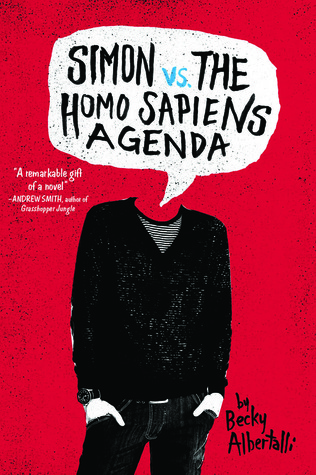
Book Review: SIMON VS. THE HOMO SAPIENS AGENDA by Becky Albertalli

Photo credit: Goodreads
So as is my MO, before I begin gushing about Becky Albertalli’s adorable Simon vs. The Homo Sapiens Agenda, here is the Goodreads summary
“Sixteen-year-old and not-so-openly gay Simon Spier prefers to save his drama for the school musical. But when an email falls into the wrong hands, his secret is at risk of being thrust into the spotlight. Now Simon is actually being blackmailed: if he doesn’t play wingman for class clown Martin, his sexual identity will become everyone’s business. Worse, the privacy of Blue, the pen name of the boy he’s been emailing, will be compromised. 
With some messy dynamics emerging in his once tight-knit group of friends, and his email correspondence with Blue growing more flirtatious every day, Simon’s junior year has suddenly gotten all kinds of complicated. Now, change-averse Simon has to find a way to step out of his comfort zone before he’s pushed out—without alienating his friends, compromising himself, or fumbling a shot at happiness with the most confusing, adorable guy he’s never met.”
So first and foremost, if you’re a YA author looking for an example of really spot-on boy POV, I can’t recommend Simon Vs. more. I was really really impressed with just how real Simon sounded, both in his head and in the dialogue—and the dialogue from the other characters was written just as perfectly. But don’t take my word for it. Both Adam Silvera and John Hansen said basically the same thing, and they have way more experience being a teen boy than I do. 

So awesome voice aside, Simon Vs. was just a really freaking adorable book. I connected to Simon immediately, it starts in the absolute perfect spot in the plot (another note to YA writer: this is how you start a book), and there were moments that were just so darn cute I was actually giggling and “aww”ing out loud. 

I don’t often pre-order books from authors I haven’t read before, but I made an exception with Simon Vs. and I’m so glad I did. I whipped through the pages quickly because I needed to know if I was right about who Blue was and I was dying to see Simon and Blue’s happily-ever-after, and I loved that all of the characters, including the minor ones, were complex, layered and realistic. I really don’t have any complaints about this book except, I suppose, that it’s a shame I won’t be able to read it for the first time again. 

If you’re looking for a happy, fun m/m YA romance, I couldn’t recommend Simon Vs. more. 5/5 stars to this one for sure, and I can’t wait to see what Albertalli comes up with next. 

Have you read any diverse YA recently? I’m always looking for recs! 

Twitter-sized bites: 
.@Ava_Jae gives 5/5 stars to SIMON VS. THE HOMO SAPIENS AGENDA by @BeckyAlbertalli. Have you read this cute m/m YA? (Click to tweet)     
Looking for an adorable m/m read w/ a great boy POV? Check out SIMON VS. THE HOMO SAPIENS AGENDA by Becky Albertalli. (Click to tweet)

Discussion: How Do You Decide Where to End a Chapter?

Photo credit: guzzphoto on Flickr
Ending a chapter in the right (or wrong) spot can be the difference between unputdownable and “I guess I’ll get back to this tomorrow.” Every chapter ending turns the tables on the readers who now have to decide whether to read one more chapter or take a break. 

These chapter endings are opportunities, but they can easily become lost opportunities if you don’t make the most of them.

While you’re first drafting, however, deciding where to end a chapter can sometimes be tricky. And when someone on Twitter recently asked me how I decide, it occurred to me I hadn’t really written about it. 

I’d kind of glazed over this part largely because the answer is hard to explain—because while I’m first drafting at least, where to end a chapter, for me, is part instinctual and part planning. But even that has changed as my writing process has changed. 

When I first drafting in Word, where to end a chapter, for me, was 100% instinctual. When I wrote a line that sounded like it’d be a good hook, I’d hit enter a couple times and start a new chapter. Sometimes this was in the middle of a scene, sometimes at the end—it was a case-by-case basis but what they had in common was that they ended on lines that I hoped would be intriguing enough that readers would want to read on. 

When I switched to first drafting to Scrivener, however, my process changed slightly. Before I start drafting at all, I plan out just about every scene and write a quick sentence or two or three summary of what will happen for each scene. While first drafting, I think less about where the chapter will end and more about ending the scene in a way that is interesting and will make readers want to read on. Granted, with the way I have Scrivener set up, the “chapters” are automatically split up by scene, and I further split them up while revising, but it’s often less present in my mind than it was when I wrote in Word. 

However. 

Sometimes, I’ll write a line near the end of a scene and stop earlier than I expected because I hit a point that would make a perfect chapter ending. Or I’ll break mid-scene while writing because I've reached a great hook. And that stuff is still very much instinctual. 

That said, after drafting in Scrivener I’ve done a lot more chapter splitting while revising than I did before—which, actually, I don’t mind because it really forces me to pay attention to my chapter endings and decide where would be the best place to break. 

Deciding on chapter endings while first drafting, however, can be a really fluid process, so I’m curious: how do you decide where to end a chapter? 

Twitter-sized bite: 
How do you decide where to end a chapter? Join the discussion on @Ava_Jae's blog. (Click to tweet)

Vlog: Is Your Manuscript Query-Ready?

So you've worked with critique partners and revised your manuscript several times, but how do you know if your WIP is ready to query?


RELATED LINKS: 

What signs do you look for when deciding if your MS is query-ready? 

Twitter-sized bite: 
How do you know if your WIP is query-ready? Writer @Ava_Jae discusses her process in today's vlog. (Click to tweet)

There Isn't One Way to Be a Girl

So I came across this tumblr post yesterday, and after chatting with one of my CPs about it, it got me thinking.

http://bethrevis.tumblr.com/post/116119181047/this-is-what-frustrates-me-people-dont-like

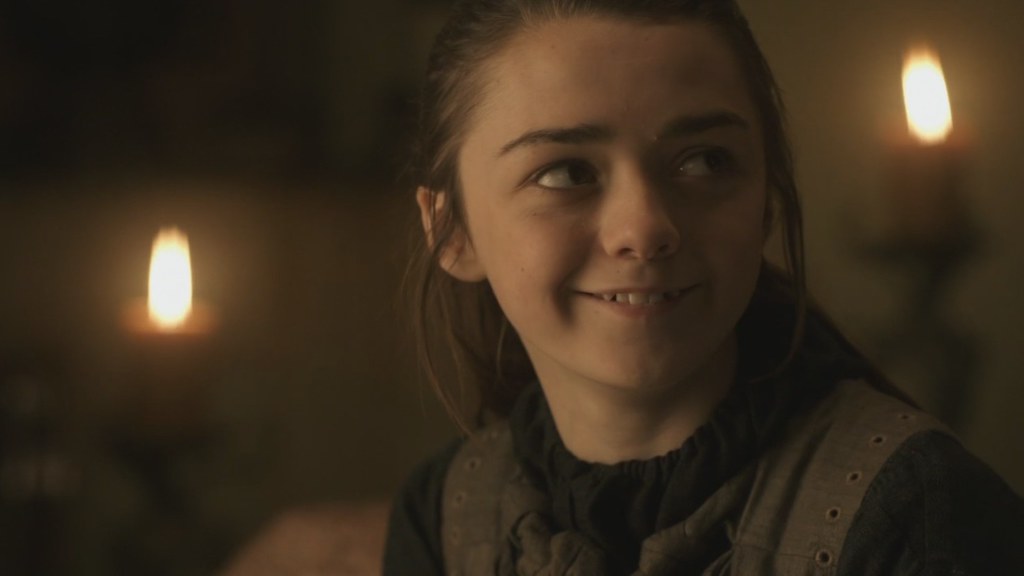
On one hand, I agree with the quote and the article it came from. I think oftentimes, in books and TV shows and movies, the women who are praised for being strong often do tend to be more masculine than the traditional “norm.” From Katniss to Arya, Mulan to Daenerys, Tris to Black Widow, the image of strong female characters almost always feature girls who (literally) kick ass, and hide their emotions, and rebel against gender conformity. Girls who, conversely, are more feminine tend to come under fire for being too passive, too “girly,” too emotional, too implicitly weak. 

But being feminine and being strong are not mutually exclusive, and I definitely agree with everything said about Sansa in that post. 

On the other hand, I don’t want to come down on gender nonconforming girls either, because they stand as a societal reminder that there’s no one way to be a girl. And that’s something that even now in my twenty-somethings, I’m still re-teaching myself.

Photo credit: Jemimus on Flickr
As a not-traditionally-feminine girl who grew up in a household with a very feminine mother and two very feminine sisters, it was, and still is, refreshing to me to see girls embracing themselves, even when that person doesn't necessarily conform to gender norms. I didn't until just recently ask myself why, for example, Mulan was hands-down my favorite Disney princess and the only one I ever identified with and I suspect it was because she was a strong princess who didn’t look or act like what you'd expect from a princess. She hated dresses (as a kid, so did I!), and rolled her eyes at her mother’s attempts to make her appear more girly (*cough*), and she did everything the guys did and no one could stop her (it will be a surprise to no one, I think, that my favorite sport has always been martial arts). 

It wasn’t until recently that I really began to embrace myself, even when that person wasn’t as girly as years of dresses, skirts, and frilly blouses insinuated I should be. It wasn’t until a year or so ago that I realized I could like makeup, and nail polish, and earrings and yes, even dresses, but also like (very) short hair, and hoodies, and jeans, and blazers, and graphic tees, and beanies. For years I had this idea in my head that being a girl meant liking all the girly, frilly things and because the clothes I often wanted to wear were decidedly less feminine, there must be something wrong with my taste and style. 

There isn’t one way to be a girl, and there isn’t a wrong way to be a girl, either. Girls can be feminine and masculine simultaneously. Girls can be emotional black belts, stoic fashionistas and make-up wearing sword-wielders. Girls can show strength in different ways—whether it’s through Sansa’s controlled political-savviness or Arya’s daring courage. Feminine, masculine and strong can all be used to describe girls—or even the same girl, and I want to see representation of them all. 

There are limitless varieties of girls, and every single one of us deserve to see ourselves as a heroine. We are complicated, and layered, and contradictory, and we are raw, and real, and here. 

What do you think? 

Twitter-sized bites:
"There are limitless varieties of girls, and every single one of us deserve to see ourselves as a heroine." (Click to tweet)  
.@Ava_Jae says there isn't one way to be a girl, or one way to be strong. What do you think? (Click to tweet)
Related Posts Plugin for WordPress, Blogger...