Manuscript Wish List (MSWL): A Hugely Valuable Resource for Writers

Photo credit: Julie Edgley on Flickr
So just recently, the amazing Jessica Sinsheimer (Sarah Jane Freymann Literary Agency) and K.K. Hendin (author extraordinaire whose book I’ve raved about in the past) announced the launch of their new Manuscript Wish List site. 

For those who haven’t already seen it’s incredible hashtag version #MSWL on Twitter on tumblr,  MSWL is a site where agents and editors share what projects they wish they had in their inbox. That’s right—it’s a peek directly into what agents and editors are hoping to find right now.

For more information about how this supremely awesome idea came to be and what it’s all about, check out MSWL’s About page.

So while I’m no longer in query mode, I did find the MSWL Twitter event extremely helpful (and exciting!) while I was querying, and I know without a doubt that had this site existed a year ago, I would’ve been living on it.

You see, the tough thing about the MSWL Twitter event is it’s much harder to filter (not impossible, mind you, just takes some Twitter savviness and anyway, digression). There also tend to be a lot of tweets and it’s so very easy to miss something in the fray and well, this website? It’s basically genius.

The extra bonus fantabulousness of the MSWL site is you can filter the results by genre (Fantasy, LGBTQ, YA, NA, whatever) or tag (Crossover, Literary Style, Boarding School, Dual POV,  TV/Book/Movie comp, time periods, etc.). From there, you can see the entries, which vary from a couple sentences to a full paragraph all about what that particular agent or editor would love to see.

I mean, c’mon you guys, HOW AMAZING IS THAT? (Rhetorical question: it’s obviously the bomb).

Querying is tough, and doing your query research can be excruciatingly difficult at times, but I suspect this will really help a lot of writers in their search for an agent or editor who will love their work. So if you’re a querying writer, make sure you take some time to browse this amazing site, and don’t forget to thank Jessica Sinsheimer and K.K. Hendin for their awesomeness!

Will you be using this incredible resource? 

Twitter-sized bites: 
Like #MSWL? Don't miss out on @jsinsheimer & @kkhendin's new MSWL website for your query research! (Click to tweet)  
Getting ready to query? Make sure you check out the new MSWL site for agent and editor wish lists. (Click to tweet

Vlog: Why Writers Must Read

Are you a writer who doesn't have time to read? Here's why you may want to seriously consider making it a priority: 


Also, here's the blog post version from several years ago. 

What do you think? Is reading really a top priority for writers?

Twitter-sized bites: 
Writer @Ava_Jae vlogs about reading and why it's not optional for writers. #writetip (Click to tweet)  
Is reading really a top priority for writers? @Ava_Jae weighs in her thoughts. (Click to tweet)  
"Just about everything you need to know to write your book is available in other people's books." (Click to tweet)

Discussion: Are You a Re-Reader?

Photo credit: jamelah on Flickr
I’ve been thinking about re-reading, lately.

Largely because of my never-ending TBR list (and not-so-infinite allotted time), I don’t re-read quite as much as I used to. And yet, I’ve recently met some people who frequently re-read novels five or six times (sometimes in a row!) and it got me thinking about why we re-read and re-watch and re-consume our favorite media.

I mean, from an outsider perspective, one might think it’d be a little boring to re-read something—after all, don’t you already know what’s going to happen? But as anyone who’s ever re-read a favorite book can tell you, you come out of every reading with something a little different. You notice things on the second and third and fourth readings that you hadn’t picked up on the first time. The nuances become more clear, the foreshadowing obvious, the character development easier to understand.

That, and re-living a favorite book, quite frankly, can be a lot of fun.

Nowadays, the main reason I re-read books is to remember what happened before I dive into the sequel, so I can pick up on the nuances and references from the previous book without pausing to try to wrack my brain to remember what happened. This, of course, really only applies to when there’s been a decent amount of time between the reading of book one and book two, but I find that it really does help me fully understand the sequel.

That being said, I don’t re-read every book before picking up the sequel, especially if it’s a particularly long book (City of Lost Souls, for example? Probably not going to get a re-read before I pick up City of Heavenly Fire, even if I did enjoy it. Which I did). Mostly because of the aforementioned time constraints and mountainous TBR list.

But I’m curious. Do you re-read books? Often? Sometimes? Three or five times? 

Twitter-sized bite: 
Do you re-read books? Often? At all? Several times over?  Join the discussion on @Ava_Jae's blog. (Click to tweet)

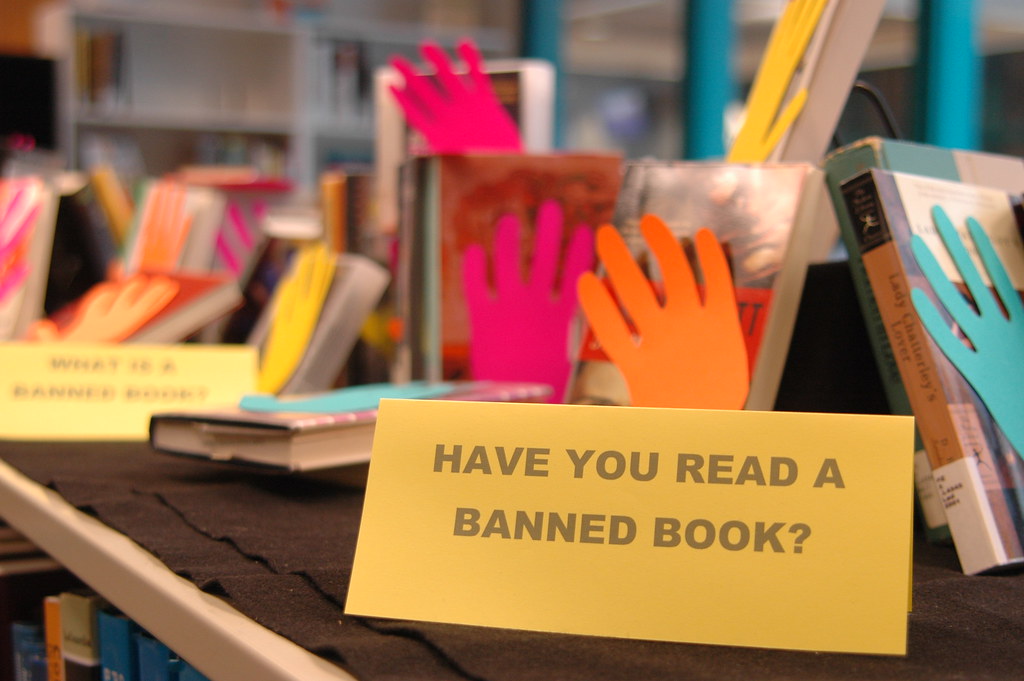
On Censoring and YA

Photo credit: CCAC North Library on Flickr
I was a pretty sheltered kid growing up. 

Though I moved around a bit, I always lived in safe, upper-middle/middle class areas. I had a religious (Christian) upbringing and went to church almost every Sunday. It’s something I am, actually, very much grateful for, even if my worldview has shifted quite a bit since Sunday school times.

That being said, it’s something I’ve been thinking a lot about lately.

Largely because of that upbringing, I didn’t really read many books with cursing or sex as a young teen. (I did have a healthy dose of violence in my books, largely thanks to my Ted Dekker obsession, but that’s another matter entirely). The first book I read with an f-bomb in it was The Catcher in the Rye my sophomore year of high school. I remember rather vividly coming across the first f***—it was followed by a nervous smile as I glanced around and thought, we’re allowed to read this in school? 

Oh little, sheltered Ava. You were so adorable.

Come to think of it, we read Brave New World that year, too. Also shocking to my sheltered mind, though for entirely different reasons. Sophomore year was an interesting school-reading year. Anyway.

Despite my relatively sheltered upbringing, I did not, shockingly, learn vulgarity from Holden Caulfield. I’d heard cussing in movies, in music, from my peers, from my peers, oh and did I mention from my peers? I mean, I had a bilingual best friend in middle school who tricked me into saying curse words in Swedish—after all, the forbidden is interesting and fun to kids (and adults, really). You can’t go to a public high school (or middle school, for that matter) without hearing all about sex, drugs and students expanding their vocabulary to a couple choice four-letter words.

My point? Sex, drugs, cursing, and yes, even violence, are all part of a teenager’s life. Exposure is inevitable. And trying to imply that those things aren’t a part of the average teen’s life by pushing for a censoring of YA, quite frankly, is disingenuous.

Literature isn’t about escaping reality, not really—it’s about diving into reality in a whole new way. Maybe that reality isn’t necessarily the same as yours, but that’s also part of the point. It’s about exposure to different world views, different lives, different experiences that you yourself haven’t (or can’t) experience. It’s about a deep, human connection; it’s about reality reflected back at us in a way we’d never considered before.

It’s not about hiding.

It’s not about pretending the world is something it isn’t.

It’s definitely not about sheltering.

Here’s the thing, I think it’s important to represent all aspects of teen life—and yes, that includes the swearing, the sex, the drugs and the violence. Because whether we like it or not, teens are swearing, are having sex, are using drugs, are dealing with violence on one level or another—whether it’s a heated argument or something much more dangerous. And no, not all teens do all of the above (or even one of the above). But the point is there are teens that do—a hell of a lot of them—and don’t they deserve to see their experiences, their struggles and their realities reflected in fiction as well? Don’t they deserve to know they’re not alone? That their struggles aren’t impossible to overcome? That they can each have happy endings, that regardless of what they are or aren’t involved in, they’re people who deserve to be loved and respected? That they aren’t somehow lesser for their decisions or circumstances?

I don’t know, you guys, but it just seems insanely important to me.

I understand wanting to protect your kid from the world, I do. And one day, when I’m a parent, I’ll probably understand it even better, but for now, I sympathize.

But here’s the thing: censoring literature, whether it’s by banning books or trying to keep your kids from reading certain novels? It’s not going to do much of anything, except maybe limit their ability to empathize with people unlike them.

Barring bubble-boy over-the-top-type sheltering (which I really don’t think is going to do anyone any favors), teens are going to be exposed one way or the other. Maybe it’ll be through their peers, maybe it’ll be from a book, or movie, or TV show, or video game they watch or read or play under the radar. But one way or the other, your sheltered kid is going to face reality, and you know? They’ll probably be okay.

What do you think? 

Twitter-sized bites: 
"Literature isn’t about escaping reality, not really—it’s about diving into reality in a whole new way." (Click to tweet)  
.@Ava_Jae shares why she thinks NOT censoring YA is so important. What do you think? (Click to tweet

Discussion: How Do You Know When Your MS is Query-Ready?

Photo credit: Mullenkedheim on Flickr
Entering the query wars, is, by and large, somewhat terrifying. It’s when you release the book you’ve been slaving over for several months (or even years!) to be reviewed by publishing pros. It’s when your first rejections will inevitably come in and you’ll hop onto the emotional roller coaster that’s the life of a writer trying to get published.

I’ve often talked about being careful not to submit your manuscript too soon—something that can lead to rejections that could’ve been otherwise avoided. But trying to determine whether or not your manuscript is ready for submitting can be tough—after all, it’s extremely difficult (maybe impossible?) to be completely objective about our work.

So how do you know when your manuscript is query-ready?

  1. It’s been through several drafts. When I say “draft” I don’t mean you’ve gone through it and fixed spelling errors. When you revise your work, you need to really revise—that means making plot, scene, character, world building, pacing, and voice changes. That means writing new scenes and deleting unnecessary ones and rewriting and rewriting and rewriting until you get it right. How many drafts that’ll take depends on you and your manuscript, but it will MOST LIKELY be more than one. 

  2. Your critique partners think it’s good to go. I encourage writers to have several rounds of critiques with their critique partners and beta readers, with edits in between. That way, you can see if the changes you’ve made based off previous feedback was effective, or if it needs more work, etc. If you do the multiple-round method with your partners, eventually you will likely start to get comments along the lines of “if you make x and x changes, you’ll probably be set!” and that’s when you know you’re THIS close. Make the changes. Then you might be ready. 

  3. The only changes you can (honestly) think of are sentence-level tweaks. At some point, you’ll be staring at your manuscript after many many edits and you’ll catch yourself moving commas around and changing that word back and forth and obsessing over tweaks that quite frankly? Aren’t going to be a deal breaker. When you hit this point, you either need more beta/CP feedback (if you haven’t had some already) or you’re likely ready to submit. 

All of that said, you might go through those steps then years later look back and say, “yeah, it wasn’t ready.” It happens to all of us (including me, several times over). But I do think if you pass those three stages, you’ll be much closer to being query-ready than you were before.

Also, here are four signs that your manuscript absolutely isn’t ready.

How do YOU know when your MS is query-ready?

Twitter-sized bites: 
Is your MS query-ready? Writer @Ava_Jae shares three signs to look for when deciding.  #writetip (Click to tweet)  
How do you know when your MS is query-ready? @Ava_Jae shares three signs to look out for. (Click to tweet

Getting Published in 15 Steps: From Querying to Book Deal

Photo credit: derivativeofcourse on Flickr
So a (long) while ago I wrote a post about 15 steps to writing a novel, from the initial idea, to starting the query process. However, as many of you know, starting the query wars is really just the beginning to the whole trying to get published thing.

So I figured I’d continue.

Do note that this really only applies to traditional publishing. If you’re self-publishing you don’t need an agent (though some self-publishers are very happy with their agents) and your steps will be very different.

  1. Query agents. Oh, the joys of the query trenches. This is where writers agonize over writing the perfect query letter (and hopefully don’t do this or this), critique the hell out of them, then press send and…well…

  2. Try not to check your e-mail every five minutes. And, if we’re being honest, probably fail to resist. 

  3. Receive rejections. Rejections are inevitable. I did this thingie with query statistics last year, but the short version is this: rejections are 100% normal and expected. And they suck. But you are absolutely not alone. 

  4. Distract yourself with another project/lots of reading/TV/ice cream. Working on another project while you’re querying can be a great motivation booster/emotional bandaid/ super productive distraction. I highly recommend it. It’s also a great time to catch up on your overflowing TBR pile, gorge on ice cream and (try to) relax a bit. 

  5. Get requests. YAY! Requests are exciting. And nerve-wracking, because after you send you have to wait again. But go you! Go requests! Make sure you celebrate and enjoy this happy, super-exciting step. 

  6. Receive rejections. Of course, rejections do sometimes (oftentimes) come in after requests, too. These suck even more than the query rejections, but they too are part of the process. But remember, you only need one yes.

    That being said, sometimes you’ll go through the query process and this is the step where it’ll end. You’ll receive rejections and more rejections and your list of possible agents will run low and you may have to ask yourself if it’s time to move on. And sometimes, the answer will be yes. But the thing to remember is it’s okay. I had to go through this five different times before I finally got my fantabulous agent. It happens, it’s normal, and it’s hard, but if you don’t give up and keep writing new projects and querying said projects, eventually…

  7. THE CALL. AN AGENT WANTS TO REPRESENT YOU OMG YES IS THIS REAL AHHHHHHH!

  8. Edit your book (again). This step actually depends on your agent—some agents are editorial and will go through several rounds of editing with their clients to make sure their manuscripts are as shiny as can be before going on submission, while others or not. There’s no right or wrong as far as this goes, it’s just preference, and if you know which you’d prefer, make sure you research ahead of time and query the right ones. 

  9. Go on submission. Oh, the joys of being on submission. It’s kind of like querying again, except this time your agent is in your corner, which is pretty awesome. You are, however, doing a lot of waiting…

  10. Try not to check your e-mail every five minutes. Boy, this sounds familiar. Oh, is that an e-mail? 

  11. Receive rejections. Sadly, you do not leave rejections behind when you finish querying. They’re still very much a part of the submission process, and will continue to be every time you go on submission again (did I mention you’ll be repeating this step with close to every book you write? YAY). 

  12. Distract yourself with another project/lots of reading/TV/ice cream. Not unlike query distractions, working on a new project is a golden way to focus your energy on something productive and hope-making. Reading and TV and ice cream are also winners. 

  13. Get requests. And dance with your agent! Because yay! ALL THE REQUESTS. 

  14. Receive rejections. And be sad with your agent because rejections still are un-fun. Sometimes, like querying, this will be the final step for that particular manuscript. The fact of the matter is, not all writers debut with the book that got them their agent—and that’s totally 100% okay. It’s hard, and not fun, and massively disappointing, but it does happen, and if it happens to you? You are absolutely not alone.

    Work on your next book. Edit it to awesomeness. Go out on submission again. Until…

  15. THE OTHER CALL. YOU’RE GOING TO BE PUBLISHED HOLY WOW IS THIS REAL LIFE ALL THE CONFETTI AHHHHHH! 

Twitter-sized bite: 
How to get published, from querying to the book deal, condensed into 15 steps. (Click to tweet
Related Posts Plugin for WordPress, Blogger...