My Favorite List: What Do You Want to Write About?

Photo credit: Chapendra on Flickr
When I’m ready to think about starting a new manuscript, the very first thing I do, before I even begin brainstorming, is revisit my favorite list of all time.

This is the list that reminds me why I love to write. It helps me to remember all of the potential for great stories out there, and most of all, it inspires me with all of the things I still want to write about. Because it forces me to ask just that:

What do I want to write about?

This is a list that I add to and rewrite and change all the time. It’s a springboard of ideas, both vague and specific.

I love working on this list, because it makes me excited, both for stories I haven’t written, and for books that I have that cross off items from the list. But most of all, it serves as guaranteed inspiration to launch me into brainstorming.

The list can include anything, from a specific manuscript idea to overcoming a struggle you have with writing. It can be an image, a character name, a trait, an idea, a world, a writing characteristic, or a goal.

I’ve rewritten my list several times (in part because I keep losing the hard copy, but never mind that). To give you an idea, here are a few items on my most recent list:

  • Diverse characters
  • Rich, interesting worlds
  • Combining Sci-Fi & Fantasy
  • Flawed characters 
  • Sympathetic antagonists 
  • Ninjas

I also have some characters names and more plot-specific items, but hopefully you get the idea.

This is the list I go to whenever I’m low on inspiration, or am struggling while trying to brainstorm, or even just want a refresher. It’s my favorite list, and one that I intend to continue to use over the years.

Do you have a what I want to write about list? What are some items that are (or would be) on it? 

Twitter-sized bites: 
Do you keep a list of what you want to write about? Here's why one writer swears by it. (Click to tweet)  
What do YOU want to write about? Writer @Ava_Jae shares her favorite inspiration list. (Click to tweet

How to Write Emotion Effectively

Photo credit: Robert Scoble on Flickr
I’ve mentioned my editing philosophy when it comes to emotions in the past, namely, if I see a told emotion (i.e.: he looked furious), I mark it with a note along the lines of stop telling and show us.

But showing emotion is sometimes a little easier said than done. Where do you even begin? If you’re having trouble, it may help to use these four steps:

  1. Identify the emotion you’re trying to show. For the purpose of the example, let’s go with fear. But of course this could be anything. 

  2. Write down some associated words/common traits of that emotion. There are two sources you can use to try to figure these out—your experience, and The Emotion Thesaurus (or, ideally, both). The idea is to develop a list of related words or descriptors of an emotion. You'll want to draw on your experience to determine how exactly that emotion will affect your character. For fear, that might mean feeling cold, increased heart rate, clammy palms, prickling, jumpiness, hyperventilating, etc. The nice thing about The Emotion Thesaurus is that the list is developed for you, so you can skip right on over to the next step...

  3. Choose a couple best suited for the situation and your character. Emotions affect everyone differently, and different levels of emotion (nervousness versus outright terror, for example) may affect the same person in different ways. Once you have your list prepared, you want to take a couple traits or reactions that you think best fit the scenario and your character, and use them together. For the sake of the example, I’m going to use feeling cold, an increased heart rate and shaking. 

  4. Rewrite using your new words. Taking the words you've chosen from step three, rewrite the emotion with more impact. 

So, for example, you may have started with…
I was terrified as I grabbed my phone.  
Using the steps above, you could end up with something like...
My heart rammed against my ribcage. Ice breathed down the back of my neck as I snatched my phone. My fingers were shaking so badly that I hit the wrong number and had to start over...
You get the idea. The goal, in the end, is to write emotion without explicitly stating it. With the right combination of characteristics, imagery, thoughts and actions, your readers should be able to infer the emotion through context.

What other tips do you have for showing emotion effectively?

Twitter-sized bites: 
Having trouble showing emotion in your writing? Here are four easy steps to get you on the right track. (Click to tweet)
Do you have trouble writing emotion? Writer @Ava_Jae shares four easy steps to showing emotion effectively. (Click to tweet)  

Pacing Tip: Contrast in Plot

So I’m sure most of you remember middle and high school (or equivalent) English class, where the teacher drew the arc of the average story on the board, which looked something like this:
Oversimplification, but you get the idea.

What your English teacher may or may not have told you is if you were to zoom into any point in that arc, it should look a little something like this:
...Yes. It should look like a porcupine back. Or something.

What your English teacher definitely didn’t tell you is that it should never look like this:
Hope someone has a defibrillator handy.

Like a flatlining heartbeat, a plateauing plot is bad news.

Just like any decent roller coaster, your plot should include highs and lows both emotionally and pace-wise. Victories and setbacks, moments of quiet tenderness and heart-wrenching loss, chapters paced at breakneck speed followed by moments of rest and introspection.

The one constant amongst the highs and lows that you should strive to include is contrast.

The thing to remember about pacing and plot is too many high-action scenes next to each other is just as monotonous as too many consecutive quiet scenes. Think of it like a marathon: if you run at full-speed for too long, you’re going to burn out (or in this case, burn your readers out), whereas a burst of speed in the right places followed by a period of rest (as in slowing down, not stopping altogether) will suit you better. (Disclaimer: I’ve never run a marathon in my life, nor do I intend to. This may be bad marathoning advice, but it works in writing—promise).

Highs and lows keep things interesting—and even better, they make their respective ups and downs that much more powerful. A crushing loss after a euphoric high hurts twice as bad a slight disappointment after a moment of sorta-kinda-hopefulness.

So next time you start to feel your story plateauing, consider throwing in a major high or low to shake things up a bit. Your MS will thank you.

Do you include contrast in your plot? 

Twitter-sized bites: 
Do you have contrast in your plot? Writer @Ava_Jae shares the importance of highs and lows in your WIP. (Click to tweet)  
Does your plot need a defibrillator? Here are some pacing tips to inject life back into your plot. (Click to tweet

Mini Book Reviews: INK and SIEGE AND STORM

So it’s been a long time since I’ve reviewed (or should I say raved?) about some books I’ve read recently, and so I’d like to share with you two equally fantastic books that have jumped onto my favorites list.

Firstly, a book I just finished a couple days ago: Ink by Amanda Sun

The Goodreads summary:

Photo credit: Goodreads
“On the heels of a family tragedy, the last thing Katie Greene wants to do is move halfway across the world. Stuck with her aunt in Shizuoka, Japan, Katie feels lost. Alone. She doesn’t know the language, she can barely hold a pair of chopsticks, and she can’t seem to get the hang of taking her shoes off whenever she enters a building. 
Then there’s gorgeous but aloof Tomohiro, star of the school’s kendo team. How did he really get the scar on his arm? Katie isn’t prepared for the answer. But when she sees the things he draws start moving, there’s no denying the truth: Tomo has a connection to the ancient gods of Japan, and being near Katie is causing his abilities to spiral out of control. If the wrong people notice, they'll both be targets. 
Katie never wanted to move to Japan—now she may not make it out of the country alive.”

So I’ve been interested in Japan and Japanese culture for some time, so when I heard about this YA Fantasy set in Shizuoka, I was immediately intrigued. The Japanese backdrop in Ink was so beautifully incorporated that I wanted to hop on a plane and visit immediately after finishing the book. Add in a unique mythology, hot Japanese boys, kendo, a pace that has you flipping pages quickly, and a complicated, realistic romance to boot, and I didn’t hesitate to give it five stars.

As a side note, I actually recommend picking up the print copy of this book. Not only is the cover (and texture of the cover) entirely perfect, but there are sketches throughout the book including little flip-the-page type animations in the corners of the pages that were really nice finishing touches that would not have been the same in an e-copy.

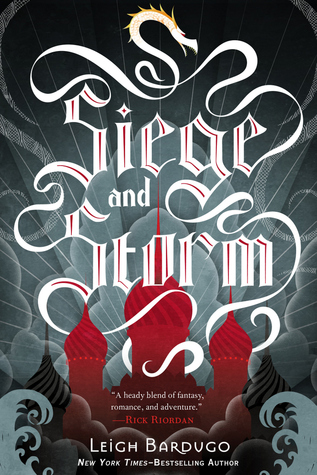
Now the wonderful Siege and Storm by Leigh Bardugo.

The Goodreads summary:

Photo credit: Goodreads
Darkness never dies. 
Hunted across the True Sea, haunted by the lives she took on the Fold, Alina must try to make a life with Mal in an unfamiliar land. She finds starting new is not easy while keeping her identity as the Sun Summoner a secret. She can’t outrun her past or her destiny for long. 
The Darkling has emerged from the Shadow Fold with a terrifying new power and a dangerous plan that will test the very boundaries of the natural world. With the help of a notorious privateer, Alina returns to the country she abandoned, determined to fight the forces gathering against Ravka. But as her power grows, Alina slips deeper into the Darkling’s game of forbidden magic, and farther away from Mal. Somehow, she will have to choose between her country, her power, and the love she always thought would guide her—or risk losing everything to the oncoming storm.”

First and foremost, if you like YA Fantasy and haven’t read Shadow and Boneyou need to go to your nearest bookstore or grab your e-reader and buy it immediately. The Grisha trilogy is one of my favorite YA trilogies of all time. The Russian-based fantasy backdrop combined with steampunk elements, an intensely epic magic system and an antagonist that you’ll love as much as you hate are just some of the reasons that I’ve fallen so deeply in love with this series.

I actually meant to review Siege and Storm ages ago, but at any rate, I loved this book. As you probably guessed from the above, it’s the sequel to Shadow and Bone and it certainly did not disappoint. I loved the new characters, the romance is complicated and sometimes ugly and always wonderful, and to say it’s an exciting read is an understatement.

Both of these books really helped to satisfy my fantasy fix, and I couldn’t recommend them more.

Have you read either of these books? Do you have any recommendations for me? Share your thoughts in the comments below! 

Twitter-sized bites: 
Looking for great YA Fantasy reads? Don't miss INK by Amanda Sun & SIEGE AND STORM by Leigh Bardugo! (Click to tweet
Looking for a great read in an exotic setting? Check out these fabulous YA Fantasies! (Click to tweet)  

How to Use Scrivener's Cork Board

If you’ve been reading this blog for a while, chances are likely that you know my love of flashcards. Or rather, my love of plotting with flashcards. For me, flashcards to plotting is the cheese to my macaroni (that is to say, yum). 

So now that I’ve officially written a full manuscript from first plot bullet to final polished word in Scrivener, I’d like to share with you my favorite feature of all time: the cork board.

The cork board is actually the feature that sold me as far as buying Scrivener goes, and what I love about it is that it allows me to combine my plotting with flashcards method that I’ve grown to adore over the years, with the simplicity and beautiful organization of the computer. (Plus the lack of cramping hands is a pretty nice bonus, too).

So when you open up the cork board view in Scrivener, it looks a little like this:


Or rather, it looks like that if you have some plot points and blurry Photoshop magic at your disposal. But you get the idea.

On the left, you have a list of all of the flashcards on the board. Every flashcard can be titled, with a little summary section that you can fill in while plotting. I use this to lay out my initial plot long before I’ve written a single word in the WIP.

As you write up flashcards, you can move them around, re-title them, delete them, or label them. The manuscript in the screenshot above is a dual-POV MS, so I repurposed the labels to mark the POVs of my two POV characters, which allowed me to keep an eye on the distribution of the POV while plotting and changing things around later on.

Once you’ve finished plotting and you’re ready to start writing, you can open up each flashcard to look like this:


The great thing about Scrivener is that it works in scenes, so every flashcard you open up and type in will be saved in that card. If you decide during revisions that you need to move a scene earlier or later, you can easily do so by going back to the cork board (or using the menu on the left) and dragging it to where it’s supposed to be. For anyone who’s had to cut and paste a scene from one section of an MS Word doc to another, I promise you this is a million and two times easier.

So that’s basically it. Scrivener’s cork board is simple, the organization is beautiful, and quite frankly, I hope to never have to plot without it again.

Have you played around with Scrivener’s cork board feature? If so, what did you think? 

Twitter-sized bites: 
Not sure how to use Scrivener's cork board? Writer @Ava_Jae shares her love for this great plotting tool. (Click to tweet)  
Do you use Scrivener's cork board feature? Share your experience at @Ava_Jae's blog. (Click to tweet

To NaNo or Not to NaNo?

Photo credit: Junnn on Flickr
After many years of sitting on the sidelines, I participated in NaNoWriMo for the first time in 2012. And despite having experienced a major false start and basically starting over half-way through November, I walked away with 50,000 shiny new words that eventually became a 90,000-some odd word WIP monster.

If you’ve already decided you’re going to participate in NaNoWriMo this year, then congratulations (and good luck)! I hope you’ve started preparing, or at least started thinking about preparing, because NaNoWriMo is no small commitment. 

But maybe you haven’t decided whether or not you want to participate, and that’s ok, too. This post is for you. 

Despite knowing about the event, I didn’t participate for years because November was typically a busy time for me. Being the competitive person that I am, I was scared of starting something that would be too stressful to finish. 

But then I participated last year and loved it. 

Here’s what’s great about NaNoWriMo:

  • It forces you to write consistently. As I’m sure you’ve heard if you’ve done any amount of research on NaNoWriMo, in order to meet the 50,000 word goal at the end of the month, you need to write 1,667 words a day. If you don’t write every day, then you’ll need to write a little more on the days that you do. But the point is, you need to write, and write often if you want to declare yourself a NaNoWriMo winner. And that’s not a bad habit to get into. 

  • It reminds you it’s ok to write badly. I happen to believe that 95% of first drafts suck. But the point of a first draft isn’t to write something beautiful, it’s just to get the story down so that you can polish it into something fantastic later.

    When fast-drafting for NaNoWriMo, you don’t usually have the time to edit as you go. You just need to slap those words down at the speed of light and write. 

  • The writing community is awesome. The writing and publishing community is full of some of the nicest, most understanding and encouraging people out there. During NaNoWriMo, all participates are in it together, which can be great for motivation. 

  • Pretty graphs. Call me crazy, but watching that word progress graph grow over time is pretty darn satisfying. 

  • A nice chunk of shiny new words at the end. Regardless of whether or not you reach 50,000 words, you’ll have new pages that didn’t exist at the beginning of the month. And that’s something that should be celebrated. 

NaNoWriMo isn’t easy, and there will be days when you’re exhausted and you’ll wish you didn’t sign up. But at the end of the month, when you have a chunk of a new book sitting on your hard drive, you’ll be glad you gave it your best. 

Are you participating in NaNoWriMo this year? Why or why not?

Twitter-sized bites: 
Undecided about whether or not to participate in #NaNoWriMo? Writer @Ava_Jae shares some reasons to consider it. (Click to tweet)  
Are you participating in #NaNoWriMo this year? Join the discussion at @Ava_Jae's blog. (Click to tweet

Writing Discussion: When Do You Research Your Novel?

Photo credit: Nomadic Lass on Flickr
I’ve been thinking about researching, specifically, researching for a WIP. 

Whether you’re writing a fantasy, sci-fi, contemporary, romance, thriller or something else entirely, some form of research usually comes into play, whether it’s looking up how long it takes a bone to heal, or what the weather is like in Arkansas. 

For me, my research tends to come in three stages:
  1. Brainstorming. This is the initial research done while developing the book idea. Researching in this stage tends to be more for purposes of inspiration (Pinterest comes in handy), and the amount of research depends pretty heavily on the idea. For me, it varies anywhere from 100% inspiration fun, to more detailed what is this country/time period/culture like?

  2. Quick search. This is the research I’ll do while writing the actual WIP. Usually, as the title indicates, it’s a quick Google search to answer a question or double-check a fact, and it most times it only takes a couple minutes.

  3. Filling in the gaps. This is more intensive research done while revising. In this stage, I’ll really get into fact-checking and I’ll gather as many details as I can to add some verisimilitude to the writing. Whatever question marks, blanks or uncertain elements I incorporated into the first draft will be ironed out in this stage. 
With a few exceptions, I complete most of my research in the revision stages, but it varies from WIP to WIP. However, I’m curious about your process: when do you get the bulk of your novel research done? 

Twitter-sized bites: 
When do you do the bulk of your novel research? Join the discussion at @Ava_Jae's blog. (Click to tweet)  
What is your novel researching process like? Share your experience at @Ava_Jae's blog. (Click to tweet)
Related Posts Plugin for WordPress, Blogger...