How to Rewrite Old WIPs Like a Pro

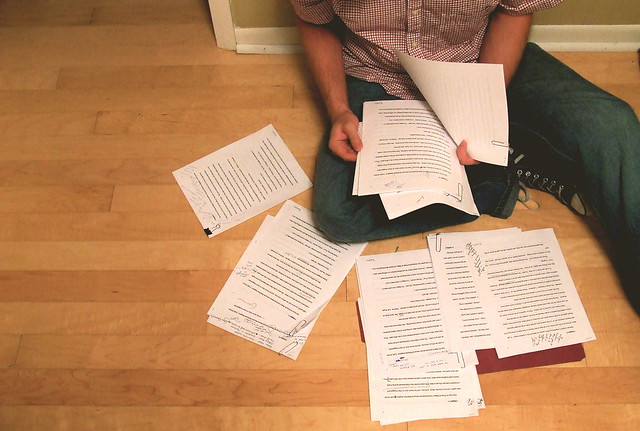
Photo credit: greg.turner on Flickr
So I've written in the past about how to know when it's time to shelve your WIP, and I've talked about how trunking your work doesn't mean the death of your novel, but I never really covered the afterlife of a trunked work: that is, the un-trunking. Ok, so un-trunking probably isn't a word, but hopefully you get what I mean.

I truly believe that nothing you write ever goes to waste — at least, not for writers. We learn and gain experience from every piece we write — whether it's an essay for school, or a report for work, or a poem scratched on the back of a napkin, or an 80k novel shoved in the drawer. You see, the great thing about putting WIPs that weren't working at the time away, is that nothing is stopping you from going back at a later time to bring them back to life. Or, if more drastic measures are necessary, cannibalizing its parts to create a completely new version of the novel.

Granted, rewriting a trunked WIP isn't skipping through a field of daisies whilst singing songs, but if you break it down into manageable steps, this seemingly daunting task can become significantly less overwhelming.

  1. Choose your soon-to-be reincarnated WIP wisely. Depending on how long your WIP has been sitting in the proverbial (or possibly literal) drawer and how much writing you've done between WIPs, you may have many WIPs to choose from when considering a rewrite. The key to a successful rewrite, however, begins with this crucial step.

    The good news is chances are, if you've become excited about a project again, or found new inspiration for an old WIP, you're headed in the right direction. We writers tend to have pretty decent instincts when it comes to what WIPs we're ready to work on, so just the fact that you're seriously considering rewriting an old WIP is a fantastic sign. The key is to make sure you choose a project that you're willing to put a lot of hard work, time and effort into. You need to be excited about your work in order to really be willing to put the time you'll need into it to create a decent rewrite. 

  2. Read it through (again). Before you begin any major rewrite, you need to re-familiarize yourself with your work. Since this is a trunked WIP, chances are it's been a while since you really took a good look at it, so now's the time to sit down and read from beginning to end.

    Depending on how long it's been since you wrote it, this step may be a bit painful, but if you're able to look at your old work, see the potential in it and cringe at your writing from however long ago at the same time, it's actually a good thing. It means you've grown as a writer, your writing skill has improved and you may very well have a potentially excellent rewrite on your hands.

    Note: now is NOT the time to edit. NO EDITING (seriously). Make notes on what you like, what you love and what you hate. Make a list of elements you'd like to keep in your rewrite and elements that need serious tweaking (or removal altogether). Now, however, is not the time to edit, because chances are you'll be ripping the WIP apart and completely rewriting large portions of it anyway. Any editing you do in this stage will very likely be altered or erased later on while rewriting. 

  3. Brainstorm. Now that you're familiar with your WIP and you have a list of elements you love and elements that need changing, it's time to delve deeper into the list. Brainstorm potential rewrite ideas — what works and what doesn't? Could you put it in a new setting? Rewrite the protagonist as someone new? Use the POV of a different character? Change the antagonist? Remember that you don't necessarily have to rewrite the same story — now's the time to consider maybe using the elements you like to create something entirely new. Push yourself to brainstorm new possibilities. You don't have to choose the craziest idea you put on your list, but you might surprise yourself with the scope of possibilities your WIP has. 

  4. Know where you're going with your new rewrite? Good. Now get to work. In other words: start writing. 

Have you ever rewritten or taken elements from a trunked WIP? What tips would you add to the list?

Write What You Know?

Photo credit: Chiot's Run on Flickr
Most writers hear pretty early on that you should write what you know. While many writers agree that writing what you know is key to genuine writing, others point to speculative and fantasy genres where much of the writing is clearly not based off of knowledge on the writer’s part and use that as proof that writing what you know isn’t sound advice.

The debate, I believe, depends largely on how you interpret those four words.

Taken literally, the “write what you know” adage could be seen as automatically disqualifying any novel with fantasy, supernatural or science-fiction elements. We obviously can’t write about magic, supernatural abilities and paranormal creatures from experience, and thus, can’t necessarily write what we know. 
But when applied to our characters experiences and surroundings, the “write what you know” adage couldn’t be more relevant.

You see, the key to making our readers experience what our characters are going through is to weave truths into the writing. When your protagonist is walking through a rainstorm in November, don’t just mention the rain—think back to the last time you were outside in a storm and describe how it felt. When your character is guilt-ridden over something he just did, don’t say he feels guilty—describe the heat flashes and nausea and fear that comes with every bout of guilt.

Writing what you know doesn’t mean that if you’re a single mother from Montana, you can only write about single mothers who live in Montana. Writing what you know doesn’t mean you have to move to Thailand to write a story set in the Far East.

The true meaning of write what you know is to draw from everyday life. It means you need to pay attention to the world and even the most simple of everyday occurrences, because you never know when you’ll need to relive a moment of your life in order to realistically write a similar experience for your book.

How do you interpret the "write what you know" adage? Do you utilize it in your writing?

How (Not) to Write Like a Master

Photo credit: Calamity Meg on Flickr
All writers strive to one day reach the literary level of the greats: Hemingway, Rowling, King, Tolkien, regardless of who your writing role model is, we all hope to be considered great writers.

Becoming a great writer, however, takes years of dedication, hard work, writing and writing. So for those of us interested in fast tracking our way to writerly stardom, here are a few shortcuts. As long as you don’t skip any, you’ll be well on your way to millions:

How to Write as Well as Hemingway, King or Rowling* 

Beginnings: 

  1. Irrelevant prologues. Prologues are the time to trick your readers into believing that they’re going to be reading about something entirely different from your actual WIP. Drone on about a character mentioned once on page 146, or throw in a high-speed car chase to your medieval fantasy novel for fun. It’s not like anyone actually reads them, anyway. 

  2. Long, arduous descriptions. Describe everything with meticulous detail. At least a page each should be dedicated to the color of the sky, the kind of trees outside, the animals going about their business and the exact physical description of every character (important and not), down to the shape of their eyebrows. 

  3. Itemization of your protagonist’s every move. Brushing teeth, tweezing eyebrows, shaving, preparing breakfast, choosing clothes—everything is relevant. After all, how are readers supposed to believe your characters are real if they don’t know their everyday routine? 

Middles: 

  1. Steal clichés. The calm before the storm. Cute as a button. Tongue-in-cheek. Wakeup call. These phrases are popular because they are the essence of writing genius. Use as many as you can possibly squeeze into your writing, in fact go here and here to find more and use them all. 

  2. Uniform sentences. This one is a bit tricky, but essential nonetheless: every sentence must have the same amount of words. There are absolutely positively no exceptions to this rule, and the longer they are the better the sentence. Trust me on this because it’s the only way to truly hone the essence of sentence writing skills. 

  3. Impressive vocabulary. As a writer, it’s your duty to show the world the depths of your carefully honed vocabulary. Your characters don’t think—they surmise; nor do they speak—they pontificate. Use that hard-earned vocabulary so your readers may be awed at your superior intellect. 

Endings: 

  1. Monologuing villains. If your villain doesn’t have a five-page monologue in which he explicates the full details of his diabolical plot, you’re not doing it right. 

  2. Kill everyone. It’s how Shakespeare ended everything, and he’s a literary genius, so... 

  3. Inception. Was the whole novel a dream or reality? If you did your job correctly, your readers will never know. 

  4. The end...or is it? Don’t tie off loose ends—you’re just destroying future possibilities for sequels and series continuations. The more questions your readers have at the end of your book, the more likely they are to continue the series to find answers. 

With these simple steps, you’ll have your name permanently etched in the literary hall of fame in no time. You’re welcome.

*There are no shortcuts to becoming a great writer. This is a sarcastic post and none of these points are meant to be taken seriously. In fact, it’d probably be best if you avoided every one of those so-called shortcuts.

What so-called shortcuts do you have for writing like the masters?

How to Think of Blog Post Ideas

Photo credit: Cayusa on Flickr
For roughly a year and a half now, I’ve written blog posts three times a week. I haven’t made any changes to the blogging schedule because I believe it’s important as a writer and a blogger to post consistently, and as of yet, I’ve never missed a day. I’ve also never run out of ideas.

Well.

That last part is a little misleading. Saying that I’ve never run out of ideas makes it sound like over the course of the last year and a half, I’ve never had a day where I wasn’t sure what I was going to post about, which is nowhere near the truth. I have, in fact, often had days where I stared at the screen, wondering how in the world I was going to come up with and write a post over the course of the next twenty-four hours.

But being the stubborn, stick-to-the-schedule person I am, I’ve always managed to wring a topic out of the air, one way or another.

The truth is, there’s nothing mystical about thinking up blog post ideas. While some days I’m lucky and the idea will just make itself known to me with little effort on my part, most days I have to go looking for ideas. Lucky for me, I have plenty of sources of inspiration all around me. Such as…

  • The blog archives. For those of you who run a blog, I highly recommend keeping a blog archive list. The funny thing about blog archives, is that while I originally created mine to make it easy for readers to dig through my old posts, I soon realized it was just as useful for me as it was for my readers.

    You see, when your posts start reaching triple digits (and even before that), it can start to become a little tricky to keep track of what you’ve written about and what you’ve missed. When I’m searching for blog post inspiration, I nearly always start by scrolling through my archives: not only does it keep me from unintentionally rewriting an old post, but it gives me a general idea as to what areas I could explore more in, and what areas are already well-saturated with posts.

  • The brainstorming list. I’ve written in the past about how helpful it is to keep a running list of ideas (both for writing and blogging), and this is a large part of the reason why. When I’m low on ideas and searching the archives isn’t helping, I often turn to my brainstorming list and either spend some time thinking up new ideas, or choose one that I’ve already thought of but haven’t written about yet.

  • Life. You’d be surprised how many ideas you can generate just from your everyday life. I’ll often turn to a problem I’ve recently encountered in my WIP, or a stage of writing I’m in, or a book I’ve recently read to try to think up of some blog post ideas. Another great life source is current events: whether in publishing or just a topic that’s trending online (that’s related to whatever you post about, of course), writing about current events or topics is a great way to tap into a collective discussion online. 

These are just a couple examples of places I find blog post inspiration from—now I want to hear from you. Where do you find blog post or writing inspiration?

The Cure to Resistance in Writing

Photo credit: colemama on Flickr
When working on the first draft of a WIP, writers will often hit this point when the writing no longer feels like cooperating. The words that once came easy now feel like are wading through an ocean of maple syrup to get to you. Sometimes even knowing where you're going with the writing does little to help—the words fight you anyway.

For some people, this stage comes in the middle of the WIP, for others it strikes shortly after the beginning or even at the end. The when doesn't really matter—the point is that it often strikes, sometimes randomly, often unexpectedly, and it can be very difficult to get through.

For me, I've noticed that I tend to slow down at the end. Even when I know exactly how the WIP will end, even when I have a scene-by-scene breakdown, I often find that for me, the end is the hardest part to write. I'm not sure if it's the pressure of trying to write an ending that simultaneously excites and ties up loose ends and creates a sense of closure, but my point of resistance invariably strikes as I near the completion of the first draft of my WIP.

The trouble is that there isn't a guaranteed cure. There isn't a special book you can read, or diet you can eat that will magically make the words start to flow like they did before you hit the resistance. There's only one thing you can really do to get through it, and it's the one thing that at that point in time, you'll find most difficult.

You have to write.

The truth is this: the only cure for the point of resistance is to force yourself to get through it. To write even when writing is difficult. To break through the resistance with the only weapon you have—your words.

Sometimes the resistance breaks quickly and the words return as normal, and sometimes it takes many thousands of words and days or weeks of fighting to emerge victorious. But as long as you fight through it, you'll find the words again soon.

What tips do you have for writing through resistance? Do you have a common resistance point?

The Heart of Social Media

Photo credit: PV KS on Flickr
Social media is a funny thing. When offline, people tend to talk about it in terms of promotional use—how many people they can get to see the ad about their book or business, how many followers they can get on Twitter or likes on Facebook and how many people in turn buy their product.

And I’m not going to pretend that social media isn’t great for that—just about every business knows that social media is key to getting exposure and ultimately getting clients or buyers. But the thing is, social media isn’t just about the numbers—if it was, it wouldn’t work because all we’d do is spam each other with Follow me!s and Buy my book!s and Hire me now!s and God knows that’s not what social media is about.

The heart of social media is something that I didn’t really discover until I was neck-deep in Twitter and tumblr and Facebook. I went in expecting it to be very much about the numbers, but I quickly realized it was about something else entirely: it was about the people. The relationships. The connections. It’s about helping and encouraging each other and celebrating victories as a community and mourning tragedies together.

The heart of social media is the community. It’s you and me. Your first Twitter follower and your last Facebook like and everyone in between. And that’s something that we should all be thankful for.

I’ve found that the writing community is especially wonderful—you see, the nice thing about us is that we can be genuinely happy for every new writer that gets signed or book that gets published, because the beauty of it is that we aren’t really each other’s competition. Many products rely on the fact that a buyer will only choose one product—one iPad or Surface or Android tablet. Writers, however, don’t live in that kind of cutthroat competitive environment—readers can and will buy multiple books, so when a new author is signed or a new book is published, we don’t have to feel threatened. We can be genuinely happy and help each other.

When used correctly, social media is truly a fantastic asset and using it is a joy. It enables us to be kind and lend a helping hand with minimal cost or effort, and it gives us opportunities to make new connections and relationships that would have been impossible otherwise. We are the heart of social media.

As an example of this, I’d like to give a shout-out to one of my favorite authors Beth Revis (Across the Universe), who is currently running a very cool contest with authors Marie Lu (Legend), Marissa Meyer (Cinder), Victoria Schwab (The Near Witch) and Megan Shepherd (The Madman's Daughter) called Bringing YA to You.

In short, these five authors will be taking a book tour trip to any city in the continental US or Canada that gets the most votes, so if you’ve ever wanted a YA book tour to take a trip to your hometown, now’s your chance to speak up and let them know. All you have to do to enter is fill out this form and you get extra votes for spreading the word about the contest. It seems like a really fun way to get readers involved and gives everyone a unique opportunity to have a say in where the book tour will go, so I wanted to share it with you guys. As a bonus, if you share the word about the contest, you could qualify to win ten signed books from the authors. Pretty cool, right?

The thing is, contests, giveaways and opportunities like these to really get readers involved would be impossible without social media. And if you ask me, there’s something really special about that.

So let’s make a point to remember to keep social media special and support each other this year, and it can start right here: what blog or social media account would you like to give a shout-out to?

First Ever E-Book Cover Design Giveaway

Photo credit: Mine
So remember that exciting thing I hinted about on my New Years roundup post? Yep. This is it.

Writability is roughly a year and a half old and for one reason or another, I’ve never had a giveaway, so I thought this would be a really fun way to kick off the New Year and tell you guys about the re-launch of my book cover design services. So!

Some of you may remember way back when I announced that I am now officially accepting submissions for book cover design work. In short, I’m also an artist as well as a writer, so the opportunity to be able to combine my love for books with my love for art is one that I won’t pass up. For an example of some of my work (beside the cover mock-up used for this post), you can check out my deviantart page.

While there will be a new page describing all the new details and fiddly-bits soon, let me tell you about the awesome giveaway.

I want to design an e-book book cover, bookmark or banner for you. For free. Should you win, all you would have to pay for is the cost of any stock images you wanted to use (which are optional). Considering these services usually run plus a hundred dollars, I think it’s a pretty exciting opportunity. The only thing I would ask is that you let me show everyone your shiny new awesome cover by putting it in my portfolio.

The best part is winning is easy—all you have to do is enter the Rafflecopter giveaway below. There are tons of ways to gain entries, and if you’re a follower of this blog, then congratulations! You already qualify. All you have to do is submit your entry below.

Now some of you without books in need of e-book covers may be wondering whether or not to enter. Even if you don’t have a book, I can also create blog or website banners (book-related or not), or you could always create one for fun. It’s all up to you.

The giveaway will run throughout this entire month and the winner will be announced on Monday, February 4th.

So what are you waiting for?

a Rafflecopter giveaway
Related Posts Plugin for WordPress, Blogger...