Mini Book Reviews: The False Prince & Re-Reading


Photo credit: Goodreads
So I’ve found that now that I’ve been reading more, I’ve really enjoyed the mini-book review system in which I give a little blurb about everything I’ve read over the past thirty days. Hopefully you lovely readers enjoy the system as well.

Now I’ll admit I’ve been a little negligent with the mini-book review system as I failed to post one last month, largely due to the fact that I’ve been doing a lot of re-reading as of late. In honor of The Hunger Games movie release, I re-read the trilogy in March, and now as Insurgent by Veronica Roth will be released in a DAY, it goes without saying that I spent time this month re-reading Divergent. (If you’d like to see my review, I posted it a while back here).

However! Divergent wasn’t the only book I read this month as I was fortunate enough to see an ad for The False Prince by Jennifer A. Nielsen, which lead me to track down the online sample, which lead me to promptly buy the book. All very fortunate indeed, because I loved it.

Firstly! The summary from Goodreads:

"THE FALSE PRINCE is the thrilling first book in a brand-new trilogy filled with danger and deceit and hidden identities that will have readers rushing breathlessly to the end. 
In a discontent kingdom, civil war is brewing. To unify the divided people, Conner, a nobleman of the court, devises a cunning plan to find an impersonator of the king's long-lost son and install him as a puppet prince. Four orphans are recruited to compete for the role, including a defiant boy named Sage. Sage knows that Conner's motives are more than questionable, yet his life balances on a sword's point -- he must be chosen to play the prince or he will certainly be killed. But Sage's rivals have their own agendas as well. 
As Sage moves from a rundown orphanage to Conner's sumptuous palace, layer upon layer of treachery and deceit unfold, until finally, a truth is revealed that, in the end, may very well prove more dangerous than all of the lies taken together.
An extraordinary adventure filled with danger and action, lies and deadly truths that will have readers clinging to the edge of their seats."

Besides the action and fabulous pacing, what I really loved about The False Prince was Sage—the first-person narrator. It can be very difficult to pull off an unreliable narrator convincingly, especially in first person, but Nielsen nailed it. Sage is witty and admirable, but flawed and makes more than a few face-desk-worthy mistakes, and to top it off, there are twists that I really enjoyed.

For all those reasons and more I highly recommend it.

What have you read/re-read as of late? Anyone else re-reading Divergent in anticipation of Insurgent? 

Do You Read What You Want to Write?

Photo credit: Mosman Library on Flickr
"If there's a book that you want to read, but it hasn't been written yet, then you must write it."—Toni Morrison
I'm sure most of you have heard that Toni Morrison quote, or some variation of it before, and I think there's a lot of truth to it.

Looking back at all of the manuscripts I've written, there's certainly a noticeable pattern as far as themes, elements, and style go, largely because I write about topics I like to read about. I suspect that most of you writers will find the same in your work, if you haven't already.

And let's face it—the reason why this tends to happen is pretty obvious: very few writers want to spend months or years writing a novel they aren't particularly interested in. We write what we want to read.

But what if we reverse that sentence? Most writers instinctively write what they want to read, but do you read what you want to write?

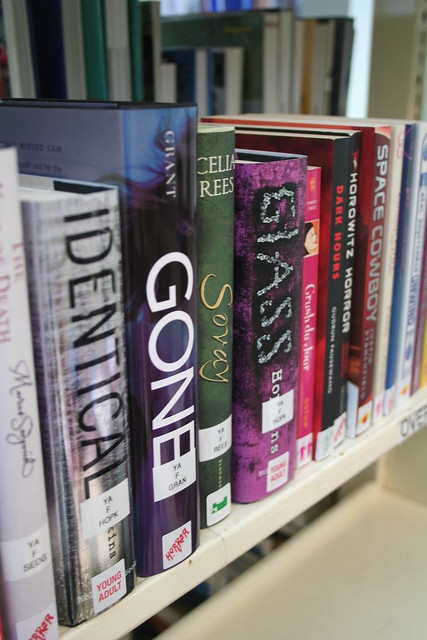
Since the beginning of my novel- writing days, I've written YA novels. There wasn't a doubt in my mind that that was the age group I enjoyed writing for. But initially I didn't read very much YA.

Honestly, it pains me to think about it now, and it's not like I didn't read any YA...I just didn't read nearly as much as a YA writer should. And I know some writers avoid reading novels in a similar genre while they're writing (that's another post all on its own), but in general, it's important for writers to read the genre they're writing in. Widely.

This is a lesson I learned the hard way—and sort of my accident—because once I really delved into YA books, something weird happened: my writing started to improve. Quickly. I learned different techniques and stylistic options I never realized were available to me. I learned about pacing and character development and voice and the sheer variety of novels out there.

I learned about how I should be writing. And as an added bonus, I came to realize just how much I loved the genre I was writing in.

This point is this: it's just as important (if not more so) to read what you like to write as it is to write what you like to read. Don't neglect your genre. There's always more to be learned.

Do you read what you like to write? Why or why not?

How to Finish Writing a Novel

Photo credit: Johan Larsson on Flickr
So the other day, the lovely @j_a_bennett brought up an interesting topic on her blog—namely, finishing a novel from first draft to polished prose.

I know a lot of writers who struggle with this—especially when they haven’t fully completed a novel before. And let’s face it—finishing a novel from start to finish isn’t easy. It’s difficult enough to put together a coherent first draft and even harder to take that first draft and transform it into a fully revised, layered story.

But truth be told, I feel like finishing the first book is more of a mind game than anything else. If you have a pattern of not finishing, it can sometimes be difficult to overcome that little voice that says the reason you haven't finished a novel is because you can't (which isn't true, by the way. The little voice lies). It’s often a matter of self-confidence, of fighting the underlying doubts that tell you inevitably something is going to happen to keep you from completing your story—whether it’s a gaping plot hole, loss of inspiration (or interest) or something else.

There are a million and two reasons to stop writing a novel. When battling these doubts, what you need to find is the one reason to ignore everything else and write it anyway.  

For me, finishing a novel from first draft to last revision takes two very important things:

  1. You have to LOVE your book. Really. You're going to be working on that baby a long time. If you don't love it, it's going to get exhausting very quickly, and another shiny novel idea may very well pop out of the blue and rip your attention away.

  2. Patience/perseverance. I know technically those are two different things, but they go hand-in-hand. You don't need to survive just one round of revision—but anywhere from 3-10+ drafts, and that's before you even try to get it published.  Not only that, but you need to be patient with yourself. You need to accept that you’re still learning, that it isn’t going to be perfect, and that it’s ok.

There’s a third thing too, that mostly ties in with the second point—understanding and acceptance. I’ve talked about this before, but not every novel you write is going to get published. Not every story is meant to be released to the world—some of them are meant for you, the writer, to learn from.

You need to understand that you may very well spend a couple months or even years working on a novel that will sit in your desk drawer. You need to understand that it’s only natural to write two or three (or five or seven) novels before you’ve developed your writing skill enough to be ready for the publishing world.

You need to understand that if you really want to be a writer, you’ll need to go through this process many many times. And sometimes you’ll get tired. And sometimes you’ll get bored. And sometimes you’ll wonder if you’re wasting your time with your current WIP and if you should start on something else or if you’ll really be able to survive a couple rounds of revision.

And all of that is ok.

Love your book. Have patience with the process and with yourself. Push through the obstacles, both mental and physical, until you have a gleaming, fully polished novel.

Then go write another one. You are a writer, after all.

What tips do you have for completing a novel? 

How (Not) to Write Great Characters

Photo credit: magia3e on Flickr
It’s no secret that characters can make or break a story. A poorly written or else unlikable character can bog down an otherwise interesting story and truly interesting characters can improve an already enjoyable story. Although it’s relatively easy to identify a well-written character, it can be significantly more difficult to figure out how to write one.

So without further ado, I give you ten foolproof secrets to writing captivating characters. You can thank me later.

10 Secrets for Extraordinary Character-Writing Success*:

  1. Don’t introduce any characters in the first chapter. When a reader picks up a book, they aren't immediately ready to meet a new character. The most important thing is to ground them in the world of your book. Spend the first chapter describing the grass, the political system, the language and laws, but don’t even THINK about introducing a character until the second chapter (you’re thinking about it, aren't you? Stop that. Stop that right now).

  2. Epic. Names. No one wants to read about a character named Jimmy Brown. Horationitus Mooncloud Bloodbone on the other hand, makes for a very interesting character name. Bonus points if you can’t pronounce it.

  3. For character inspiration, consult Stereotypes-R-Us. Readers are already accustomed to seeing stereotypical characters, and thus are immediately attracted to them. Don’t shy away from using stereotypical characters—embrace them like a baby panda cuddling with its mother. There’s no faster way to scare readers away than writing characters who break the mold. 

  4. Make your villain bald. With a (preferably twirly) mustache. No one will take him seriously if he has a full head of hair and no mustache to twirl around his finger while coming up with a maniacal plan to destroy the world with his death ray (because every villain worth his salt has a death ray. It’s part of the job description).

  5. Make your hero flawless. Unless your protagonist looks like a child of Persephone, has a genius IQ and a heart of gold, your readers will immediately reject him. The hero must be perfect in every way, because no one wants to read about a character with actual flaws.

  6. Only bad guys make mistakes. Just like the real world.

  7. Include a Mary Sue in every novel you write. As they say, write what you know—and who knows how to write you better than you do? That’s what I thought.

  8. Make sure everyone sounds the same. You don’t want to confuse your readers with varied voices. If you take away all of the dialogue tags and you can’t tell who says what just by the way they say it, then you know you've succeeded.

  9. Use cardboard cut-out minor characters. They’re not really important, anyway, so no need to bother developing them. Besides, you don’t want them to distract your readers from the main plot and the other, more important characters like Horationitus.

  10. Kill them all in the end. You don’t want to leave your readers lying awake at night wondering about your characters’ futures, do you? I didn't think so. Spare them the worry and just kill them all off in the end. As a bonus, it makes for a memorable last page. (As a double bonus, give Horationitus some epic last words).

*= Oh, the sarcasm! Please don’t do any of these things. Your readers (and Horationitus) will thank you.

So there you have it—the secrets to writing brilliant characters. What would you add to the list?

Writing Discussion: The Good, The Bad and The Tortuous


Photo credit: tonystl on Flickr
Not too long ago I turned the tables over to you lovely readers and asked whether or not you would publish traditionally if you had the chance. As the discussion there was absolutely fantastic, I’d like to extend another invitation for discussion.

This time, it’s about writing.

As a writer, it goes without saying that I (usually) enjoy writing.  Turning a wisp of an idea into a fully plotted, tangible novel is an incredible experience and I love so many things about it—from discovering new characters and worlds to surprising yourself with an unexpected plot twist, to watching a skeletal first draft develop into a complex, nuanced novel—writing can be truly amazing. This is the good.

But writing can also be an excruciatingly difficult experience. There are days—weeks, even—where it’d be easier and more enjoyable to sit through 48 hours of Teletubbies re-runs in the desert while attempting to find a particular grain of sand (don’t ask why there’s a television in this desert. There just is.) than to write a single paragraph. Or sentence. Or word. This is the bad.

There are moments when you look at the WIPs you’ve been slaving over for the last x years and wonder if you’ve wasted your time, if you’ll ever get published, if it’s worth spending another minute trying to do this writing thing. There are times when you’ve rewritten a manuscript three times and you think you’re finally finished, only to receive an edit letter or critique that requires you to rewrite it again. Then there’s rejection. Form “thanks but no thanks” letters. Manuscripts piling up in your drawers. Amazon e-books that don’t sell.

This is the tortuous.

No, writing isn’t all mounds of sugar, rainbows and bunnies, but to me, the good far outweighs the bad. I’d happily slog through a couple more decades of doubts, rejections and shelved manuscripts just to experience the joy of discovering a new story and meeting new characters and knowing those words marking the page are mine.

There’s something special about that. Something I won’t ever give up.

What do you think? What are the good, bad and tortuous parts of writing that you’ve experienced?

A Lesson from Bestsellers: Write Whatever You Want


Photo credit: K. Denman on Flickr
Not too long ago I wrote a post on What Makes a Book a Bestseller, and with The Hunger Games breaking all sorts of records in the box office, many people are left wondering what will be the next big thing.

Although fans would most certainly disagree, many have called The Hunger Games the next Twilight, and others have speculated what the next Hunger Games would be, but I think if bestsellers have taught us anything, it's that very rarely is there a next x (where x is a previous franchise, anyway).


Allow me to explain. If, for example, the fan base behind a non-Twilight vampire series exploded, meriting a debut on the screen and ridiculous merchandise sales, then yes, it might be appropriate to call the new phenomena the next Twilight. But as it is, The Hunger Games is about as similar to Twilight as Edward Cullen is to Mad-Eye Moody—both are fictional characters with recognizable names, but there ends the similarities.


Now I'm aware that when people refer to a phenomenon as the next x, they aren't referring to the similarities between the two, but the popularity of the franchise. That's fair, but comparing the two, at least to me, indicates some sort of lumping together (i.e.: Twilight and Hunger Games), which isn't fair to either book.


Harry Potter and Twilight and The Hunger Games are all their own separate entities. They were bestsellers for various reasons, none of which include their authors trying to write the next x. Time and time again when successful authors have talked about their experience writing their book, by and large they have talked about writing the story—their story, the story that only they could write. The point wasn't to be hugely successful or write the next big thing, the point was, and always will be, to write the book that demanded to be written.


And that is a lesson that all of us should remember.


The next hugely popular book won't be the next Harry Potter or Hunger Games or Twilight— it'll be the next it. It'll be its own thing with its own synthesis of ideas and characters and the right combination of word-of-mouth and captivating story. It'll be the book that the author had to write, the book that they pounded into the page over the course of years, the book that the author never equated with the other bestsellers because it is its own it.


The bestsellers are telling us something, and it's not just that vampires and magic and dystopians are popular— they're telling us to write the story that you want to write and worry about the rest later.


Or don't worry about it at all. Who knows? One day your book may be the next it.


What do you think? Have you learned any lessons from the bestsellers? 

Why Tough Critiques Are Exciting (To Me)

Photo credit: Roxanne Cooke on Flickr
I’m a quirky sort of writer. Aside from being a perfectionist and overly detail-oriented, I’m also a rather competitive person. Not so strange, I know, until you consider I’m competitive with myself.

This will make sense in a moment. Bear with me.

Last week, fellow awesomesauce writer/twitterer Daniel Swensen (@surlymuse) wrote a post about taking criticism gracefully. I recommend the post both for its insightfulness and his masterful way with dry wit and humor, but I digress.

The post reminded me that taking writing criticism gracefully has never been much of a problem for me—and that’s not because I have the patience of a Tibetan monk (I don’t) or because I’m a particularly graceful person (let’s not even pretend). The reason I’ve been able to take much of the writing criticism I’ve received in stride is, in fact, largely due to my competitive nature.

You see, when I receive a manuscript or chapter from a critique partner dripping with red ink, I don’t see it as a mountain load of work (even though, let’s face it, it usually is) or as another chore I have to now complete. To me, a manuscript that’s been ripped apart by my most difficult and nit-picky critique partner is a challenge. The red ink dares me to be better and the notes are arrows giving me a not-so-gentle nudges to a much improved manuscript.

When I see weaknesses pointed out in my WIP, something riles up inside me challenging me to do better, to be better, to make this WIP the very best it can be. I “compete” so-to-speak, with my desire to submit the manuscript for publication now now now and the part of me that is exhausted from years of work on a single story with the perfectionist, challenge-seeking part of me that loves nothing more than to rip the weaknesses out of my work until I’m confident it has reached its potential.

I also adopt the same attitude when critique another writer’s work—to me, when a writer hands over a chapter or manuscript for critique, they’re challenging me to find the weaknesses (I know that’s not actually the case, but try telling that to my competitive side). This can sometimes make me a rather nit-picky critique partner, but I digress.  

Now that’s not to say that I don’t get tired of doing revision after revision after revision only to have a critique partner tell me that it’s nowhere near ready. That’s not to say that sometimes I don’t feel like Sisyphus, forever pushing that boulder up the hill, with no end in sight. That’s not to say that sometimes this writer thing doesn’t feel ridiculously hard and I wonder if I’ll ever get published at all.

We all have those moments at one time or another. But that’s when we have to ask ourselves what kind of writer we want to be: one who buries his head in the sand and ignores the need to improve, perfectly content with his current writing ability or one who strives to continuously be better.

I for one choose the latter, even when it’s the more painful and exhausting option of the two. And a good critique partner can certainly help you get there.

How do you handle tough critiques? 
Related Posts Plugin for WordPress, Blogger...