Showing posts with label can't write. Show all posts

The Cure to Resistance in Writing

Photo credit: colemama on Flickr
When working on the first draft of a WIP, writers will often hit this point when the writing no longer feels like cooperating. The words that once came easy now feel like are wading through an ocean of maple syrup to get to you. Sometimes even knowing where you're going with the writing does little to help—the words fight you anyway.

For some people, this stage comes in the middle of the WIP, for others it strikes shortly after the beginning or even at the end. The when doesn't really matter—the point is that it often strikes, sometimes randomly, often unexpectedly, and it can be very difficult to get through.

For me, I've noticed that I tend to slow down at the end. Even when I know exactly how the WIP will end, even when I have a scene-by-scene breakdown, I often find that for me, the end is the hardest part to write. I'm not sure if it's the pressure of trying to write an ending that simultaneously excites and ties up loose ends and creates a sense of closure, but my point of resistance invariably strikes as I near the completion of the first draft of my WIP.

The trouble is that there isn't a guaranteed cure. There isn't a special book you can read, or diet you can eat that will magically make the words start to flow like they did before you hit the resistance. There's only one thing you can really do to get through it, and it's the one thing that at that point in time, you'll find most difficult.

You have to write.

The truth is this: the only cure for the point of resistance is to force yourself to get through it. To write even when writing is difficult. To break through the resistance with the only weapon you have—your words.

Sometimes the resistance breaks quickly and the words return as normal, and sometimes it takes many thousands of words and days or weeks of fighting to emerge victorious. But as long as you fight through it, you'll find the words again soon.

What tips do you have for writing through resistance? Do you have a common resistance point?

Why Writing Through Resistance is Essential

Photo credit: ~Minnea~ on Flickr
As a writer, you'll soon find there are good writing days and desperately bad writing days. We all love the good days—the moments when the words come easily and the new pages stack up quickly and you look at your fresh words with a smile and a dash of something else—pride.

When we think about writing, those are the days we like to remember.


But then there are those other days. Those awful periods when every time you look at the page you feel the powerful need to do something else—anything else. Check Twitter. Play with your Pandora settings. Scroll through your tumblr/Facebook feed. Check Twitter. Find a snack. Read that blog post. Check Twitter (someone could have @ mentioned you in the last thirty seconds, right? Right).


Then slowly, painfully, you drag yourself back to the page. Stare at it for a while. Write a few words and remember you haven't checked your e-mail in a whole hour. Check Twitter.


You get the idea.


Point is, writing isn't always easy or fun or even remotely enjoyable. Sometimes it's downright hard—so difficult, that even the most unpleasant of tasks sounds easier. All writers experience this at one point or another, and sometimes the best thing you can do is take a break. But sometimes even after your break, the words continue to fight you every step of the way.


And that's when you have to put the proverbial gloves on and get to work.


Because no, writing isn't always easy, but you knew that when you decided to do this writer-thing and you chose to pursue it anyway. Because the successful writers are the ones who don't give up, who write through the resistance, through the rejections, through the exhaustion and doubts and fears.


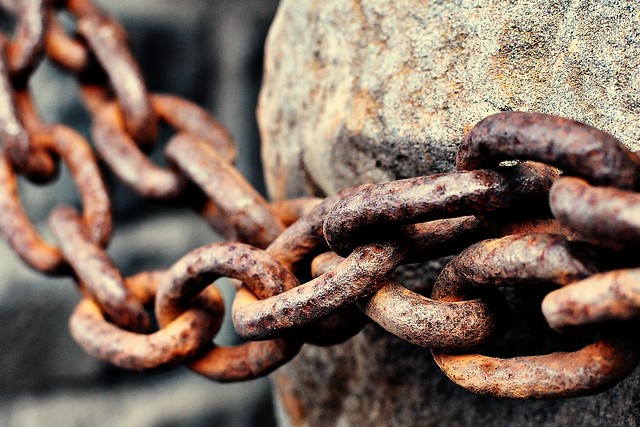
If you really want to do this writer-thing, you have to accept that that thing called writer's block isn't as much of a block as it is a ball-and-chain, a weight that makes every new word difficult to reach, that resists forward motion.


But it's not impossible to write through it. Difficult, yes, but not impossible. And there's a certain amount of gratitude you get from writing through the resistance because no, the words aren't perfect, but they're there. You put them there, even when you wanted to give up. They're yours.


So next time you're staring at a blank page and the resistance makes finding the words a battle, remember this little nugget of wisdom (via About.com):


"Don't get it right. Just get it written." James Thurber

Then get back to work.

What do you do to help break through the resistance?

Can You Lose the Ability to Write?

Photo credit: Chris Blakeley on Flickr
A little over a year ago, I hit a bump in my writing —a few bumps, actually. You see, I’d just sent out a flurry of query letters for my most recent WIP at the time after rewriting it (again), and I needed a distraction. I was ready to start a new novel.

Except I didn’t have any ideas. Nada.

I wracked my brain for possibilities until I finally landed on a decent idea. I was relieved—for a second there I worried I might not ever think of a good idea again—until I tried to write it. The voice was wrong, the character was wrong, the idea was wrong. It was a terrible idea. I needed something better.

So I tried again. And failed again. And I began to panic.

In my mind, I didn’t have an excuse for not being able to write—I wasn’t in the middle of some huge life change, I didn’t have any more stress than usual and I was perfectly healthy. Happy even, if you discounted the not-being-able-to-write-thing. And yet despite that, the desperate ideas I came up with were crap. I could barely write a few pages, let alone an entire novel.

I decided to give it some time. It’s just a phase, I thought.

Six months later, the “phase” hadn’t ended. I felt guilty calling myself a writer—after all, I hadn’t written a thing in six months. When my family asked how my writing was going, I mumbled some sort of nondescript answer and changed the subject.

I really started to wonder if maybe I wasn’t cut out for the whole writing thing, after all.

But then I imagined another six months without writing. I asked myself how I would feel if I never wrote another novel again. I thought about my characters, about the worlds I’d created, the stories that, although unpublished, still entertained my family and friends.

Could I go the rest of my life without that?

I’m not going to be overdramatic. It was certainly physically possible for me to move on. I just didn’t want to.

So I didn’t. I sat down at my computer and I wrote again. It wasn’t necessarily the best novel idea I’d ever had, but it was something. It was proof. I’m a writer.

The point of this story though, isn’t to prove to you that I’m a writer. The point is to answer the question of the title: can you lose your ability to write?

The answer guys, is no. You can’t forget how to write any more than you can forget how to ride a bicycle. Truth is, if you have the will to write, if you have the determination to follow your dreams and make them come true, then the ability on some level is there. Your skills might need some refining, but you don’t need to be a master of your craft to write a story.

All you need is will.

Do you want to write? Then go do it. It’s really that simple.

Don’t have the time? Make time. No one else is going to do it for you.

Don’t have the talent? Talent is overrated. You don’t need talent; you need practice.

Don’t have novel ideas? Then write something else—poetry, blog posts, stream of consciousness—it doesn’t matter. Writing is writing and you’ll benefit from it either way.

If you really want to write, if you really want to see your dreams come true, you have to go out there and do it yourself. Fulfilled dreams don’t just land on some lucky person’s lap—they’re chased down and snatched up by the ones who aren’t afraid to put in the extra work and won’t stop until they see them realized.

Is that person you?

Have you ever encountered a non-writing period? How long did it last? How did you break out of it? 
Related Posts Plugin for WordPress, Blogger...